http://AccessPirateBay.com- PirateBay's Newest Domain Feb 2014

TorrentFreak Email Update

TorrentFreak Email Update


Authorities Raid Large Torrent Site Again…aaand it’s Back Online

Posted: 24 Feb 2014 03:25 AM PST

There was a time when raiding a torrent site meant that it stayed down for good, but with 2014 just a couple of months old it’s clear that things have changed.

The latest signs relate to Tankafetast, Sweden’s #2 torrent site and the 95th most popular site in the country according to Alexa. The site, second only to The Pirate Bay, specializes in movies and TV shows and has been an anti-piracy target for some time. With a motto of “We shall never surrender!” one gets a flavor of how that’s gone so far.

On October 1, 2012, PRQ, a webhost previously owned by Pirate Bay co-founder Gottfrid Svartholm, disappeared offline after Swedish police raided the facility. Many file-sharing sites went offline and it was later confirmed that Tankafetast was the prime target.

Just three weeks later it was back online, taunting the authorities and nemesis Henrik Pontén at copyright protection outfit Antipiratbyrån (Rights Alliance).

In April 2013 yet more action was taken against the site, with the arrest of one of the site’s admins. Yet again the site remained intact and online.

And now, according to the site’s operators, Rights Alliance and local authorities have had another go at shutting Tankafetast down.

“Once again, we fell victim to a Rights Alliance (Anti-Piracy Office) ploy to shut down TankaFetast! Our data centers have been raided,” the site’s operators report.

It appears that a continuing investigation led authorities to a location from where they believed Tankafetast was operating. While the raid last week may have unearthed something, the site was fully prepared for the event.

“Instead of sitting and waiting to see what the authorities want us to do we can move just anywhere to our other servers located abroad. Once again we will rise up again!” the site’s operators said.

And, a few initial problems aside, Tankafetast returned online this weekend.

“We’re going nowhere Rights Alliance, believe it!” the site declared.

Interestingly there was no announcement of action against Tankafetast last week from Rights Alliance or the police. Both are usually fairly quick to inform the press of their achievements but there are no reports from either. TorrentFreak contacted lawyer Henrik Pontén for comment but we have received no response.

It is certainly possible that the raid on the Tankafetast datacenter was expected to fail. Last Thursday a site operator revealed that the 2012 raid on PRQ didn’t net the site, just a gateway.

“We had some old empty dusty boxes with PRQ a few years ago but that was merely a proxy. When police got them there was nothing left in them anyway, since the memory was cleared for the least outside risk,” he revealed.

While in the ‘old days’ torrent site admins simply crossed their fingers and perhaps wore garlic to fend off attacks, it’s becoming clear that these days site setups are being hardened in preparation for what many believe to be an increasingly likely event. But these systems cost money and that has to be made somehow. Intrusive advertising is one way, according to Tankafetast.

“It is precisely because of pop-under advertising that we have been able to have servers around the world. Here you get a really good example. When one goes down we just move to another. The advertising that many find annoying saves us in situations like this,” they conclude.

Source: TorrentFreak, for the latest info on copyright, file-sharing and VPN services.

Why Is The Copyright Monopoly Necessary, Anyway?

Posted: 23 Feb 2014 01:26 PM PST

copyright-brandedI sometimes try to hold the copyright monopoly to the same legislative quality standards as other laws.

It fails laughably at the “necessary, effective, and proportionate” test, where a law must be necessary (meet an identified legislative need), effective (solve that problem effectively), and proportionate (not cause worse damage in the process).

Most of the time, the copyright monopoly fails all three tests, and when legislators have this pointed out to them, they shift uncomfortably in their chairs and change the subject.

I don’t know any profession except legislation that gets away with such abysmal quality assurance.

Most of the time, the discussion focuses on the “effective” and “proportional” parts of copyright legislation, illustrating how it is absolutely toothless in the absence of draconian privacy invasions, which is exactly what the copyright industry is tenaciously pushing for – which brings us to the “proportional” part right in the next sentence.

For once, though, “necessary” is up for debate. Is the copyright monopoly even necessary to solve a real problem? If so, what specific problem is it trying to solve? This passage is notably absent from most copyright monopoly legislations: “The purpose of this law is X”. If you were arguing for the introduction of such a monopoly today, how would you justify it? Could you conceivably do so?

To that effect, a new book, Without Copyright, was published recently. It reminds us of a sobering fact – even though the copyright monopoly was created in 1554 in England by “Bloody” Mary I in order to persecute political dissenters, it didn’t have much of an international effect until the 1900s. The copyright monopolies only protected authors of books in their own countries; outside the author’s own country, it was generally a free-for-all, and nowhere moreso than in the United States.

The international convention that turns copyright monopolies international is known as the Berne Convention, and it is overseen by the UN organization WIPO (the only UN organization to be funded by outside private interests). The United States ratified the Berne Convention only when it became geopolitically important to aggressively push its monopolies onto other countries, as described in The History of Copyright. More specifically, the United States ratified international copyright monopolies on March 1, 1989.

That’s very recent. To put it in perspective, that’s a newer event than Mario Bros, Die Hard, The Princess Bride, and The Legend of Zelda. It’s over fifteen years after the introduction of TCP/IP, the communications protocol of the modern Internet.

The U.S. had recognized some international monopolies to a very limited degree before that point. But before 1891, only citizens and residents of the United States could qualify for copyright monopolies at all. In today’s words of the United States: America was a rogue piracy state, plain and simple. That begs the obvious question – if there was no copyright monopoly, how did the writers make money, and since we have been told this always depends on the copyright monopoly, why were any books written at all in this time period?

But books were written before 1891. Tons of them. And there’s nothing to indicate more books were written after the United States accepted international monopolies, neither in the 1891 change nor in the 1989 change.

The answer, it turns out, was very simple. There wasn’t really any need for the copyright monopoly. There was a whole slew of tools available for publishers and authors to enforce business terms and make their agreed money, where – notably – not a single one of them involved lawyers. And this was considered modern times.

So that lets us return to the question:

How necessary is the copyright monopoly, anyway?

About The Author

Rick Falkvinge is a regular columnist on TorrentFreak, sharing his thoughts every other week. He is the founder of the Swedish and first Pirate Party, a whisky aficionado, and a low-altitude motorcycle pilot. His blog at falkvinge.net focuses on information policy.

Book Falkvinge as speaker?

Source: TorrentFreak, for the latest info on copyright, file-sharing and VPN services.

TorrentFreak Email Update

TorrentFreak Email Update


Revealed: The Secrets of YIFY-Torrents’ Network

Posted: 23 Feb 2014 03:39 AM PST

Needing little introduction, YIFY (now correctly called YTS) is one of the world’s most popular sharing sites. At the start of 2014 it was the 5th most popular torrent site in the world and according to brand new figures provided to us yesterday, the site is currently handling around 10 million visits per month.

Speaking with TF, site developer Jduncanator says that since last month’s rebranding the team have been not only working on new features, but also making sure that existing processes are fine-tuned. The dev says that user experience at YTS is paramount.

Don’t make users wait

“Studies show that 100ms is how long you have for the user to feel like the task was instantaneous. One second is how long you have for the user's state of flow to remain uninterrupted (though the delay will still be noticeable). Ten seconds is how long you have before the user loses interest entirely and will want to multi-task while the task is completing,” JD explains.

“That 100-1000ms sweet spot is something most web developers aim for, but whats even more surprising is that only around 5% will actually achieve that. An average visitor will spend between 30 seconds to 4 minutes on YTS, so each individual page load will make up a large proportion of their overall user experience. This is what we wanted to focus on heading into 2014.”

Google-powered

One key upgrade towards achieving that aim is the inclusion of a brand new protocol called Spdy (pronounced Spee-dy), a Google-developed protocol designed to shift web content.

“Google’s new protocol enables extremely low latency round-trip times and compression of headers. All leading (up-to date) browsers support SPDY 3 and so now do our servers allowing for high speed access and connection to all of our site,” JD reveals.

While most site visitors won’t have any idea that things have changed, JD says that behind the scenes that’s definitely not the case. Network infrastructure has undergone significant upgrades, enhancing not only speed but security and overall experience.

Security

“With the latest NSA revelations and with overall ‘security’ paranoia going through the roof we decided to revise our current security setup to see if we could do anything better – turns out we could,” JD says.

“We used to have 2048-bit RSA keys. These by themselves don’t pose a security risk, but if we are to go by anything the NSA reports show, they could possibly have the technology to crack these more efficiently than the public. To be on the safe side, we decided to double the key size to 4096-bit RSA which effectively multiplied the amount of time to crack our encryption keys by 2³².”

And then, despite our requests to keep things pretty simple, JD just couldn’t contain himself, detailing the site’s BEAST attack protection, OCSP stapling enabling and HSTS implementation. Needless to say, he’s passionate about the site and keeping it finely tuned – fortunately he doesn’t mind if those listening need to Google acronyms every two minutes either.

“You can see a report of our SSL over here. We score an A+ and are in the top 3%, something even Google couldn’t achieve,” he proudly adds.

YTS-SSL

Network setup – On the Edge

YTS operates two levels of network – Edge and Internal. The Edge network is an array of servers running the open source NGINX high-performance HTTP server and reverse proxy software. These servers are what users connect to when visiting the site. The Edge servers communicate with the servers on the Internal network, keeping the latter hidden from the public eye.

“The idea of these reverse proxies is that they simply forward web requests to our ‘hidden’ network and then pass the response back to you. This means that all you ever see is our cheap web servers’ IP addresses and never our internal networks. It allows us to have large amounts of high capacity connections to gobble up any ‘naughty’ or attack packets trying to take down our site and allows us to get our static content (images) closer to our end users, improving page load time and overall User experience.”

YTS’ ‘Edge’ network proxies, locations marked with blue squaresYTS Netmap

“Because the closer you are to the server, the faster the connection, we obviously want as many servers as possible as close to as many countries as possible. In the last two days we have added 13 new edge servers all around the world. Up until then, we only had 9 edge servers located around Europe but we wanted to aim big and get our content closer to our users to obtain faster load times. We now have 22 Edge servers.”

JD says that initially the YTS setup was modeled on Cloudflare’s, but now the site has servers in more locations than Cloudflare does.

“With these now in place and serving content, you should immediately see an improvement in screenshot and static content load time as well as faster overall page load speeds if the Edge node is a reverse proxy,” he notes.

Network setup – On the inside

“Our Internal network is made up of a few dedicated servers that are located in a hidden location far away and never see a public internet request EVER,” JD explains. “There are many reasons behind this from mitigating DMCA issues and annoyances to DDoS and attack protection.”

YTS runs two other main servers with 16 cores each, easily allowing them to cope with the traffic generated by the site’s users. All key infrastructure is in one location allowing for easier maintenance and backups. Perhaps understandably JD didn’t share any additional information on the Internal network and there is certainly no map indicating server location.

However, the diagram below shows the YTS setup, with the user at the bottom communicating with the site’s Edge servers which in turn talk to the Internal setup consisting of a main web server and dedicated database server.

NetDiag1

What is evident when speaking with JD is that the site’s operators are not only passionate, but also blessed with seemingly endless energy and enthusiasm. The upgrades detailed above are just the beginning too, with yet more tweaks to come.

“Over the next few weeks we will be playing with our DNS settings to try and even out our load amongst servers and to make pings even LOWER. Updates to our DNS infrastructure now mean that all users will be given IPs for Edge servers that are closest to them and should provide the lowest pings possible.

“We’ll always be looking for ways to improve user experience and we plan on optimizing site code over the next few months to try and obtain even more speed out of the site,” JD concludes.

Source: TorrentFreak, for the latest info on copyright, file-sharing and VPN services.

Why YouTube’s Automated Copyright Takedown System Hurts Artists

Posted: 22 Feb 2014 03:54 PM PST

youtubesadsmallDay in and day out automated bots detect and report millions of alleged copyright infringements, which are then processed by the receiving site without a human ever looking at them.

Needless to say, this process is far from flawless. In the past we've covered countless false, inaccurate, and just plain hilarious DMCA claims, but YouTube’s takedown process is particularly problematic.

As we have noted previously, YouTube copyright claims are in a class of their own, thanks to a one-sided notification system that has no evidentiary requirement. Nowhere was this more apparent than the Mega song takedown of late 2011, but it's a constant problem.

The main issue is that automated bots don't (or rather can't) understand fair use, although to be fair, it's an area of copyright law most labels seem to want to ignore when it suits them, and one that won't be fixed until Lenz v Universal finishes its slow trip through the courts.

But in the meantime, many artists are still stuck dealing with systems that ignore significant sections of copyright law in order to keep things under lock and key, artists like Dan Bull for example.

Dan, as regular TorrentFreak readers will know, is an artist that relies heavily on fair use to create his music, and he recently gave fans an idea of just how much of a pain it can be.

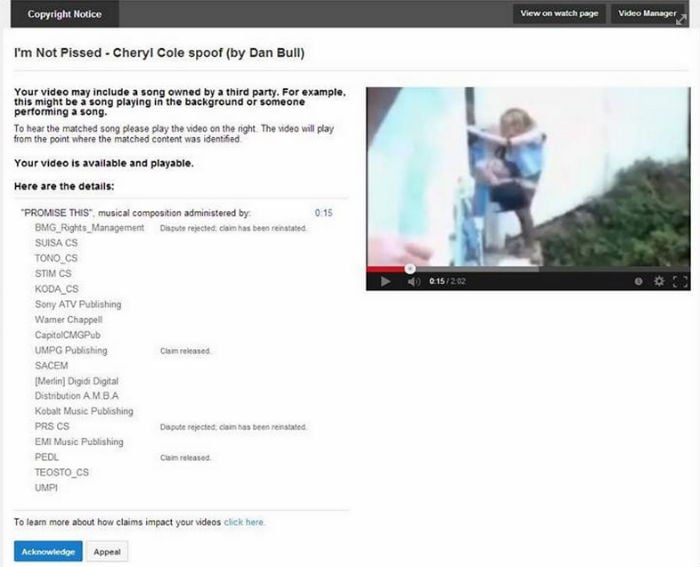
For his 2010 [NSFW] song "I'm not pissed", he reveals a screen-grab showing 18 separate claims that have been made against it. While some of them were released after being disputed, two of them, BMG Rights Management and PRS, rejected the dispute and stand by their initial claim.

“It is up to me to prove myself innocent by asking eighteen different publishing companies through an automated system to revoke the automated claims. Each publisher has a month to reply, with no obligation to even do so. If even one of the eighteen publishers says ‘nope’ then it’s back to square one,” Bull explains.

“Any financial loss or restrictions on my channel are entirely on me, and will not be compensated for once the claim is lifted. This has been going on since last year with no end in sight,” he adds.

notpissed

It's a situation that discourages new artists and stifles creativity. Despite the claims of the major labels, and until some actual consequences are introduced for false, inaccurate, or over-reaching claims, it's going to harm the greater creative world, just to enable the big guys to profit.

Meanwhile, Dan has expressed his ire at YouTube in the way he knows best, through [again NSFW] song.

And yes, he’s pissed now.

Source: TorrentFreak, for the latest info on copyright, file-sharing and VPN services.

“Artists Should Think, Instead of Spewing Misplaced Spotify Hate”

Posted: 22 Feb 2014 09:11 AM PST

flashbulbBoth the major record labels and some artists have a habit of complaining about every new technology that comes along.

Cassette tapes, recordable CDs and MP3 have all been described as a major threat to artists’ livelihoods, and with the surge of streaming services such as Spotify the broken record continues to play.

Artists in particular have been spewing Spotify hate, claiming that it’s hurting their income streams.

"We don't need you to do it. No artists needs you to do it. We can build the shit ourselves, so fuck off," Yorke said a few months ago in one of his many rants.

Not all artists agree with this view though. The Flashbulb, aka Benn Jordan, is coming to Spotify’s defense and urges his fellow musicians to “think before they bitch.”

“Really Thom? You've created a legal, royalty paying library of music that will allow me to literally listen to whatever artist I can think of, whenever and wherever I desire to?,” Jordan notes.

“Because that's the one thing we, the people, the pirates, the innovators, could not do in the last 7 years when we had all the technology in our hands to do it. Our alternative to piracy has been listening to music encoded as YouTube videos, which is so hilariously ass-backwards that I still can't wrap my head around it,” he adds.

Better Than Piracy

According to Jordan, Spotify is the answer many pirates have been waiting for. cassetteA way for people to have a library of millions of songs at their fingertips, and the option to play them on a variety of devices, for a reasonable fee.

“The real bottom line to every single issue in the music piracy debate is that people will turn to whatever is the most convenient, as long as it is affordable. I truly believe that the vast majority of music pirates in the Napster era weren't raiding the music industry like looters in a riot. They were simply acquiring music in a much more convenient way,” Jordan says.

For millions of people Spotify is a better alternative than piracy. And just as importantly, it also allows artists to get decent compensation for their work.

Why Hate Spotify?

So why are all these artists complaining about the “miserable” compensation they receive from Spotify? According to Jordan, this is in part their own fault, as many artists have signed away most (or all) of their streaming royalties to their record label or distributor.

Another group of artists simply lacks fans. If nobody is listening to your music on a regular basis, it’s not fair to expect a fat royalty check to arrive in the mail every month.

Contrary to the complaining artists, Jordan says that Spotify has been doing very well for him in terms of revenue. In fact, it outperforms the money he receives from most other digital stores combined.

Making a Spotify Living

“I can tell you that Spotify has made me about 30% more than iTunes, Pandora, Amazon, Xbox Music, Google Play, eMusic, Rhapsody, Rdio, Deezer, MediaNet, Simky, Nokia, and MySpace Music combined in that period. Even if you tack on my checks from ASCAP to that long list, Spotify is still ahead,” he says.

Spotify revenue alone now allows Jordan to pay his rent, and the numbers are increasing month after month whereas revenue from other services has remained flat.

“Spotify alone, for the last 9 months or so, has paid for my rent in a 2 floor coach house with garage. But what is predictably notable, is that the numbers for Spotify are growing monthly, and have actually doubled from the first month to the last while sales on other platforms remained the same,” Jordan adds.

The Flashbulb on Spotify

flashbulb-spotify

The fact that Spotify revenue is growing much faster than other services has two reasons according to Jordan. On the one hand the streaming model generates income from casual listeners who previously used pirated channels.

In addition, Spotify rewards artists who have a loyal and frequently listening fan base, as the payouts are per stream instead of the one-time fee traditional CD and MP3 sales bring in.

As a result, Spotify now allows Jordan to fulfill his dream of being an artist who can focus on creating new music, instead of doing jobs on the side.

“At the end of the day, that additional income has allowed me to almost completely scale back on television composing and concentrate hard, exclusively on writing and recording new material. For the first time in my life, I'm able to be ‘The Flashbulb’ and not have to worry about filling in the income holes to monetarily survive,” he notes.

“So in regards to Spotify, as a completely independent artist who does just about everything himself, the last thing I'm doing is bitching,’ Jordan concludes.

Source: TorrentFreak, for the latest info on copyright, file-sharing and VPN services.

TorrentFreak Email Update

TorrentFreak Email Update


Anti-Piracy Group Will Take Pirate Bay Blocking Case to Supreme Court

Posted: 22 Feb 2014 02:23 AM PST

brein-newFollowing a 2010 attempt by Dutch anti-piracy group BREIN to force local ISP Ziggo to block The Pirate Bay, rival ISP XS4ALL joined in the fight against the Hollywood-funded group. Initially a court decided that the ISPs wouldn’t have to block the site, but BREIN took the case to a full trial – and won.

On appeal the verdict swung in favor of the ISPs after they successfully argued that the blockade was ineffective and denied subscribers' free access to information. January 28, 2014, marked a big day in the Netherlands for both The Pirate Bay and its millions of fans, despite neither party’s involvement in the just-completed legal proceedings.

BREIN, on the other hand, went away licking its wounds and contemplating its 326,000 euro ($445,000) legal bill. Neither ISP wasted time unblocking The Pirate Bay.

pirate bayWith the verdict handed down and The Pirate Bay unblocked, the next step in the battle, should there even be one, lay in BREIN’s hands.

Now, three weeks later, the anti-piracy group has signaled its intention to fight on, criticizing The Court of The Hague’s ruling that site blocking should be dismissed if it’s ineffective.

“That statement is at odds with the opinion of judges in other European countries on blocking and preempts the judgment of the highest European court which is expected shortly. BREIN’s claim is that service providers blocking access to illegal websites has already been assigned by the court,” the group said in a statement.

BREIN adds that it has already established a number of grounds for appeal and will take its case to the Supreme Court.

“Depending on the type of appeal it can take a year to eighteen months before a decision,” BREIN chief Tim Kuik told Tweakers. “Moreover, there are still questions for the European Court of Justice so it might take even longer.”

In the wake of the Ziggo and XS4ALL victory, UPC, the Netherlands’ second largest ISP, said that it had reached an agreement with BREIN over its blocking of The Pirate Bay. The company said it would suspend the block, pending the outcome of its own case with the anti-piracy group.

Commenting on that development Friday, Kuik said that only the Supreme Court can provide the final answers. Taking further legal action now makes no sense, he said, as it only “makes the lawyers richer.”

Source: TorrentFreak, for the latest info on copyright, file-sharing and VPN services.

RapidShare Stops Washington Lobbying Efforts and Regains Pirate Stamp

Posted: 21 Feb 2014 09:19 AM PST

rsnewlogoIn recent years the Swiss-based file-hosting service has made tremendous efforts to cooperate with copyright holders and limit copyright infringements.

The company adopted one of the most restrictive sharing policies of all cloud providers. This resulted in an exodus of users, which cost 75% of RapidShare’s employees their jobs.

After the U.S. Government labeled the site as a “notorious” piracy-facilitating market a few years in a row, the company decided that it had to change the negative perceptions in Washington. To do so, RapidShare retained the lobbying firm Dutko.

"We decided to increase our efforts to explain what RapidShare really stands for and how we are spearheading the industry's efforts to combat copyright infringements," RapidShare attorney Daniel Raimer told TF at the time.

These efforts soon paid off, as RapidShare was no longer listed in the Government’s Special 301 Report of notorious markets during the years that followed. This change could be directly linked to its presence in Washington, the company believed.

"The fact that we were not included in the 2011 list is a result of these educational efforts," Raimer told us.

After joining the Washington lobby for nearly four years, RapidShare and Dutko recently decided to part ways. After spending well over a million dollars, paired with the drastic anti-piracy measures RapidShare had taken, both agreed that RapidShare’s image had significantly improved.

RapidShare lobbying budget

rapidshare-lobbying

Indeed, any neutral follower of the cloud hosting industry would agree that RapidShare is no longer a piracy magnet. It therefore came as a total surprise that the U.S. Government reinstated RapidShare as a notorious market in this month’s Special 301 Report.

"Although RapidShare.com's popularity has diminished since its 2012 listing, it remains one of the most active sites worldwide as well as in the Czech Republic, where it is best known as Share-rapid.cz," the Government wrote.

While it may be a total coincidence that RapidShare was put back on the list after it pulled its lobbying efforts from Washington, there is something uncanny about the development. And that’s not just because the site is no longer an appealing site for those who are out to share copyrighted material.

The United States Trade Representative (USTR), who compiles the list of notorious sites, does so based on public comments from copyright holders and other interested parties. However, none of the rightsholders who submitted their input for the most recent list mentioned RapidShare, or the seemingly unrelated Share-rapid.cz. All other file-hosting sites on the other hand, were mentioned.

Of course USTR does have the right to add websites based on other sources, but it’s definitely not common, especially not when it concerns a service that has taken such a strong stance against piracy in recent years.

It’s safe to conclude that someone has been pulling some strings behind the scenes to get RapidShare back on the list, but who, will probably remain a mystery.

Source: TorrentFreak, for the latest info on copyright, file-sharing and VPN services.

TorrentFreak Email Update

TorrentFreak Email Update


Canadian Court Slaps Restrictions on Copyright Trolling

Posted: 21 Feb 2014 03:01 AM PST

Do individuals using BitTorrent to download copyright material from the Internet via their ISP have a right to remain anonymous so that they remain out of reach to rightsholders? If so, what remedy will rightsholders have to prevent such infringement?

These questions and more have been under consideration in the Federal Court in Toronto as part of a case involving US-based movie studio and known copyright troll Voltage Pictures (“The Hurt Locker”) versus 2,000 currently anonymous Internet subscribers of local ISP TekSavvy.

Voltage say that via local anti-piracy company Canipre they tracked the Teksavvy customers downloading and sharing their movies online without permission and as a result want Teksavvy to hand over the alleged pirates names and addresses.

CIPPIC – protecting subscribers

The case has been dragging on for some time with third parties such as the Canadian Internet Policy and Public Interest Clinic (CIPPIC) getting involved in order to protect the subscribers’ rights. CIPPIC believes Voltage are nothing more than “copyright trolls” sending settlement letters to alleged pirates in order to extract hard cash from them.

trollVoltage’s previous actions in this area are well-known, with court documents showing that the movie company has filed 22 similar lawsuits in the United States, each with the same pattern. Various flaws exist in the company’s modus operandi, CIPPIC say, not least that an IP address in isolation does not identify an individual.

CIPPIC adds that Teksavvy shouldn’t hand anything over to Voltage, as this will “infringe the privacy rights of the subscribers and may affect the scope of protection offered to anonymous online activity.” CIPPIC fears that any ruling in this case could have a detrimental effect on whistle-blowers and others who leak documents in the public interest.

Voltage’s stance

For their part, Voltage believe that since they have a case under the Copyright Act, Teksavvy should be ordered to hand over the subscribers’ personal details.

Relying on a ruling in BMG Canada Inc. v Doe, 2005, Voltage says it has met all conditions therein (such as having a bona fide case, being reliant on the court/Teksavvy for information to proceed, and promising to reimburse Teksavvy for costs incurred), while adding that it “fully intends to pursue claims against the subscribers.”

The balancing act

So, should the court issue an order which compels Teksavvy to hand over the information to Voltage and, if so, what kind of protections could be baked into the order to minimize invasion of privacy for the Internet users involved?

“Privacy considerations should not be a shield for wrongdoing and must yield to an injured party’s request for information from non-parties. This should be the case irrespective of the type of right the claimant holds,” the Court writes in its ruling.

“Copyright is a valuable asset which should not be easily defeated by infringers. The difficulty in this case is that it is not clear that the protection of copyright is the sole motivating factor supporting Voltage’s claim in this Court. [Evidence] suggests but does not prove that Voltage may have ulterior motives in commencing this action and may be a copyright troll.”

Despite its concerns, the Court notes that Voltage has established a bona fide claim and as a copyright holder its rights outweigh the privacy rights of alleged infringers. However, it also notes that it would be taking steps to “ensure that privacy rights are invaded in the most minimal way possible.”

Privacy concerns and the trolling threat

For its part, Voltage previously argued that the alleged infringers had already made their IP addresses public when they joined BitTorrent swarms and therefore should not be able to remain anonymous in legal action.

The court accepted that stance to a degree but noted that the “specter raised of the copyright troll” and the “very real specter of flooding the Court with an enormous number of cases involving the subscribers, many of whom may have perfectly good defenses to the alleged infringement” had to be considered.

dollar-moneyInterestingly, the Court pointed out that damage provisions are limited by the Copyright Act and may prove to be “minuscule” when compared to the cost, time and effort expended when pursuing any claim against an alleged infringer. Here, the Court seems to have an eye on whether this exercise can be a profitable one for Voltage, and whether it should or not.

Also of interest is the Court’s examination of other ‘trolling’ cases in the United States and UK, particularly those involving ACS:Law and adult movie company GoldenEye. Alongside privacy issues, the Court looked at how the involvement of a consumer group in the latter case had influenced the letters of claim eventually sent out by GoldenEye.

Conclusion: Voltage get the green light, but must proceed with caution

The Federal Court notes that evidence exists to show that Voltage is a troll-like operation but the evidence was not compelling enough to put the brakes on the exercise. Voltage has a right to the subscriber information held by Teksavvy following the issue of a relevant order, the Court said.

However, in line with recent cases in the UK, the Federal Court says it intends to maintain control over the process by appointing a Case Management Judge to monitor “the conduct of Voltage in its dealings with the alleged infringers.”

Furthermore, the settlement letters sent out by Voltage will have to be approved by the Court and CIPPIC, and must include a copy of the court order and a clear statement that no court has yet found any recipient liable for infringement or liable to pay damages. This addresses concerns from past cases in the UK where letters implied that a court had already found guilt.

Other restrictions involve Teksavvy, who must be fully reimbursed for their costs incurred when handing over information, which will be restricted to names and addresses only. This data may not be handed to any other entity, including to the public or media.

Significant restrictions to protect subscribers

Describing the above safeguards as “significant”, Canadian lawyer Michael Geist says that the restrictions could affect the financial viability of troll-type activity.

“Given the cap on liability and the increased legal costs the court involvement will create (not to mention paying legal fees for the ISP), it calls into question whether copyright trolling litigation is economically viable in Canada. The federal court was clearly anxious to discourage such tactics and its safeguards certainly make such actions less likely,” Geist concludes.

Source: TorrentFreak, for the latest info on copyright, file-sharing and VPN services.

Twitter Blocks Kickass.to Links, Says They’re Unsafe

Posted: 20 Feb 2014 03:15 PM PST

kickassWith millions of unique visitors per day KickassTorrents is one of the most used torrent sites, trailing only behind The Pirate Bay.

The site indexes millions of torrents, some of which are then shared through Facebook, Twitter and other social media. For example, author Alex Sayf Cummings posted a link to a torrent of his book Music Piracy And The Remaking Of American Copyright in a tweet recently.

Cummings was obviously inviting people to grab a free copy from the site, but Twitter is not making that easy. Those who click on the link in question are presented with an ominous warning.

“The site you were trying to visit may be unsafe! This link has been flagged as potentially harmful.”

In the grey-on-black fine print in the bottom right corner, Twitter points out that people can proceed to the site at their own risk, but not everybody may be that gutsy.

The big question of course is why Twitter classified KickassTorrents as an unsafe website. TF contacted the company for an explanation, but 24 hours later we have yet to hear back.

On its website Twitter claims to use Google’s safe browsing diagnostic tool, but the Kickass.to domain is not blocked here. Perhaps even stranger, KickassTorrent’s old domain Kat.ph gets the same blocking treatment.

It appears that Twitter has decided on its own that the torrent site is a no-go zone for users. This is an option, as the site explains in one of its help sections.

“Even if Google’s diagnostic report of the URL is clean, we may decide to continue blocking the URL on Twitter as potentially harmful,” Twitter notes.

Whether the fact that KickassTorrent’s links to a lot of copyright infringing content has anything to do with the blockade is unknown. Previously Facebook restricted access to The Pirate Bay for the same reason, but this decision was reversed after a few months.

Thus far, Kickass.to appears to be the only large torrent site that’s blocked by Twitter, but perhaps it’s just the start?

Photo: Michael Theis

Source: TorrentFreak, for the latest info on copyright, file-sharing and VPN services.

RIAA Accuses Grooveshark of Making Piracy a Job Requirement

Posted: 20 Feb 2014 07:34 AM PST

groovesharkWith major adversaries Megaupload, Hotfile and isoHunt now part of history, U.S. entertainment companies have one more large local copyright battle to complete – the RIAA’s case against music-streaming service Grooveshark

The case, which sees Arista Music heading up a list of labels including Atlantic, Sony, UMG and Warner, has Grooveshark standing accused of massive copyright infringement. Grooveshark sees itself as nothing more than a music-only version of YouTube with all the legal protections that affords. Needless to say, the music giants frame things quite differently.

Motion for summary judgment

This week the labels went for the throat, moving for an order granting summary judgment against Grooveshark parent company Escape Media and Grooveshark founders Sam Tarantino and Joshua Greenberg.

“By any objective measure, Grooveshark is a linear descendant of infringing music services such as Napster, Grokster, and LimeWire, all shuttered by federal courts for large-scale copyright infringement,” law firm Jenner & Block wrote on behalf of the labels.

“Like those pirate services, Grooveshark illegally provides tens of millions of users with access to a comprehensive library of popular music overwhelmingly comprised of unlicensed copies of Plaintiffs' copyrighted sound recordings.”

The twist in the Grooveshark story is that the labels say that in order to build a comprehensive catalog of music, the company’s founders “expressly and repeatedly” instructed Escape employees to upload as many sound recordings to Grooveshark as possible, including ones from the plaintiffs’ catalogs.

Encouraged employees to upload music – the early days

Many of the labels’ claims date back to Grooveshark’s early days as P2P sharing software ‘Sharkbyte’, a service they say was trying to grow its catalog of musical offerings.

The labels say that in his deposition Tarantino admitted that the company intended to “vacuum in” all of the infringing music available on other then-current P2P networks with the aim of later monetizing it, “by selling pirated copies of Plaintiffs’ sound recordings to Grooveshark users for profit.”

And this is where the labels’ claims get very serious indeed. The RIAA says that Grooveshark’s founders instructed employees to create user accounts and store “hundreds of thousands of digital music files on their computers” with the aim of uploading these files to other service users.

“Thus, Defendants provided a substantial portion of the infringing content files used for the initial Grooveshark service,” the labels explain.

Citing information reportedly obtained from emails, sundry documents, and testimony from former Grooveshark employees, the labels claim that Tarantino and Greenburg made it very clear that all employees were expected to upload as much music as possible into the Grooveshark system, including the most popular current songs.

The aim, the labels say, was for Grooveshark to get big first, with an eye on striking licensing deals later. Directly quoting comments made by Escape Media’s Chairman, Grooveshark “bet the company on the fact that [it] is easier to ask forgiveness than it is to ask permission.”

Centralizing Grooveshark

Due to its peer-to-peer nature, the system preceding today’s Grooveshark required that users remain online in order to seed plenty of content, meaning that when those users disappeared, so did the music. The labels say that by introducing changes, Grooveshark made their service more commercially viable.

“In order to overcome this limitation, in June 2007, Defendants began to utilize their central servers – internally referred to as their ‘cache’ – as a vast central storage library for all of the music files available on the Grooveshark P2P Network (hereinafter the "Central Music Library"). As a result, users had access to all the music in the Central Music Library regardless of the number of users online at the time,” the labels write.

Those changes, they say, only came about through yet more infringement, with Grooveshark’s founders “repeatedly instructing” employees to upload infringing content.

“Simply put, Defendants made it a job requirement that Escape's employees engage in copyright infringement in order to attract users and thus benefit Defendants,” they write.

Web-based Grooveshark

The labels add that when Grooveshark introduced its current web-streaming model infringement continued, as “Escape employees regularly uploaded files to Grooveshark (including copies of popular sound recordings owned by Plaintiffs) in order to ‘test’ the functionality of the uploading process.”

In 2009 the record companies say they sent numerous DMCA notices to Grooveshark which “threatened to diminish” the Grooveshark library.

A sample of the alleged uploading activities of Grooveshark employeesUploads

“As part of this process, Escape's senior officers searched for infringing songs that Defendants had removed in response to DMCA takedown notices and re-uploaded infringing copies of those songs to Grooveshark to ensure that its music catalog was complete.”

While the exact number of infringements is redacted in court documents, the labels say that music by Michael Jackson, Prince, Beyoncé, Jay-Z, Green Day, Britney Spears, plus tens of thousands of other popular sound recordings had their copyrights infringed. Virtually all of Escape’s employees were identified as serial infringers, the labels say.

Liability for infringement

As a result of the actions detailed above, the record companies say that Escape Media is liable for both direct and secondary copyright infringement. Vicarious liability (profiting from and failing to prevent infringement), inducement (encouraging employees to infringe), and contributory infringement (assisting employees to infringe) are all in the mix.

The recording firms add that founders Sam Tarantino and Joshua Greenberg share personal liability for all of Escape’s infringing activities since they personally participated in and directed the infringing conduct of Escape’s employees. In addition, Tarantino and Greenberg are being held personally liable for direct infringement over their own infringing uploads to the Grooveshark service.

Destruction of evidence.

In addition to their motion for summary judgment, the labels have filed for evidentiary and monetary sanctions against Escape after the company allegedly engaged in “repeated, willful spoliation of multiple categories of key evidence.” If that evidence had been available it would have shown details of infringement which would’ve “exposed [Escape] to hundreds of millions of dollars” in additional damages.

The labels say that Escape destroyed hundreds of thousands of uploading accounts, including one operated by founder Joshua Greenberg.

“[It] is an undisputed fact that Escape's Chief Technology Officer, Joshua Greenberg, uploaded a massive volume of infringing copyrighted works to the Grooveshark service. However, despite explicit demands to preserve such evidence, Escape systematically deleted internal database records for Greenberg's user account.”

It’s further claimed that other Escape employees deleted their uploading accounts and the company created a script to purge uploading records. Important encryption data was also discarded.

“Escape has admitted that it deleted the method of encryption for the Upload Report after the report was produced to UMG thereby rendering it impossible for Plaintiffs to use the report to identify the uploading activities associated with hundreds of undisclosed employee accounts. In other words, Escape knowingly destroyed key evidence of the true scope and scale of its employees' infringement.”

As a result of these alleged actions the labels ask the court to impose penalties on Escape to not only punish the company, but to “deter others who might view Escape’s bad-faith litigation tactics as a blueprint for future cases.”

Endgame

Whether the case will end in summary judgment is yet to be seen but if the pattern for the Hotfile and isoHunt cases are anything to go by, a Grooveshark-terminating agreement could be on the cards in the months to come.

Source: TorrentFreak, for the latest info on copyright, file-sharing and VPN services.