http://AccessPirateBay.com- PirateBay's Newest Domain Feb 2014

TorrentFreak Email Update

TorrentFreak Email Update


‘Fining’ File-Sharers Makes Anti-Piracy Company Lose Money

Posted: 26 Mar 2014 10:26 AM PDT

rightscorpFor the past six years or so the idea that piracy can be turned into profit has been gaining traction. After Internet users sharing copyrighted material without permission are identified, they can be contacted and pressured into settling what might otherwise be an expensive lawsuit.

Discovering the real-life identities of pirates is not cheap, and that’s where US-based Rightscorp spotted a gap in the market. By attaching settlement demands to DMCA notices that ISPs are compelled to forward to alleged pirates, Rightscorp can reach alleged infringers without even knowing who they are.

Once a warning letter enters the email inbox of an account holder, he or she is invited to visit the Rightscorp website to settle for around $20.00. Some people simply ignore the warnings and nothing else happens. Others choose to pay $20 for say, a single music track, but sometimes discover that Rightscorp has more demands for the rest of the tracks in the album lined up at $20 a pop.

But while collecting $20 for sending an email might sound like a winner, financial results for 2013 just published by Rightscorp paint a pretty miserable picture.

For the year ending December 31, 2013, Rightscorp reports total revenue of just $324,016. So, presuming all of that revenue came from $20.00 settlements, around 16,200 infringement notices were paid during the 12 month period, or around 311 per week.

While this might seem like a decent return for just sending emails, they don’t just appear out of thin air. Rightscorp has costs, lots of them in fact.

When an Internet user settles with Rightscorp some of this money goes back to companies such as Warner Bros., who give permission for the anti-piracy company to exploit their content to generate revenue. According to Rightscorp, during 2013 it paid a total of $161,868 to these companies. When we compare that amount with total revenue of $324,016, we can see that Rightscorp gives away $10 from every $20 settlement.

On paper it’s money for nothing for the copyright holders, but Rightscorp’s $10 cut just isn’t balancing the books due to the large costs of running the business. Under ‘General and administrative expenses’ the company says it burnt through $1,663,921 in 2013, with ‘sales and marketing’ and ‘depreciation and amortization’ coming in at $275,616 and $33,438 respectively.

Add those all together and Rightscorp cost $2,134,843 to run in 2013, yet it brought in just $324,016, a shortfall of more than $1.8 million. After other adjustments the bottom line shows a loss of $2,042,779 for the anti-piracy company, an amount that would take their share of another 204,278 settlements to balance, providing no other costs increased.

While the company has expansion plans for Canada and has filed for patents to extend its monitoring services to Europe, China, Israel, Japan, Brazil, and India, the elusive aim of turning piracy into profit is still some way off.

Source: TorrentFreak, for the latest info on copyright, file-sharing and anonymous VPN services.

MPAA: Moviegoers Use More ‘Piracy-Enabling’ Smartphones

Posted: 26 Mar 2014 06:10 AM PDT

The MPAA just released their latest box-office statistics. Despite the continuing threat of online piracy the numbers once again show an increase in revenue worldwide, up to a record-breaking $35.9 billion in 2013.

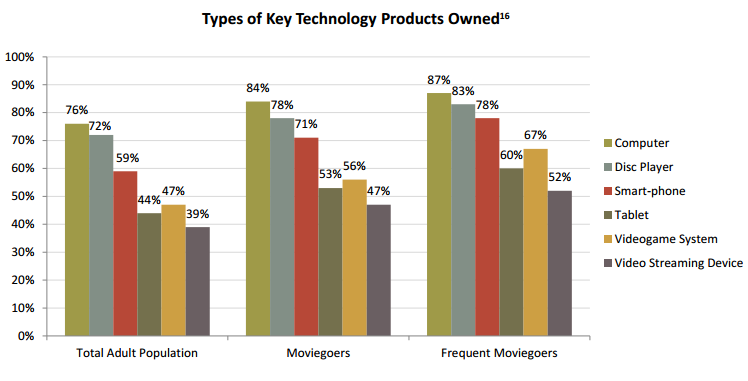
In addition to the revenue increase, the movie group emphasizes the importance of new technology in expanding its audience. The MPAA stresses that frequent moviegoers are also technology fanatics, with nearly three-quarters owning at least four new devices.

Smartphones are particularly popular among movie fans, and the MPAA notes that the movie industry can do more to use this technology to boost theater attendance even further.

"We need to keep exploring fresh ways of leveraging our new technology to drive traffic to your theaters,” MPAA CEO Chris Dodd said at The Colosseum inside Caesar's Palace where the findings were presented.

“We can embrace technology, and use it to complement our offerings….A smartphone can make more content available, but it will never be able to surpass the shared experience that you deliver to every person who sits in your theaters," he added.

Moviegoers own more tech devices (source: mpaa.org)
technology-mpaa

With the release of these statistics the MPAA wants to show that technology is not just a threat to the movie industry, but also an opportunity. While this is certainly true, the statements are not without conflict.

Using smartphones to drive more people to the movies also presents a problem, as the MPAA doesn’t want them to be used inside the theater.

The MPAA has previously published a set of anti-piracy practices movie theater owners should adhere to. This includes a very skeptical stance against any device that can be used to capture video, including smartphones.

"The MPAA recommends that theaters adopt a Zero Tolerance policy that prohibits the video or audio recording and the taking of photographs of any portion of a movie," MPAA states.

"Theater managers should immediately alert law enforcement authorities whenever they suspect prohibited activity is taking place. Do not assume that a cell phone or digital camera is being used to take still photographs and not a full-length video recording," the group adds.

mobile-mpaa

Past anecdotes show that theaters take these recommendations very seriously. A few years ago a girl was arrested for recording a 20 second clip from the movie Transformers on her phone, and more recently a Google Glass wearer was handed over to the authorities, without recording anything.

The above is a classical example of the dual role technology plays for the entertainment industries. Nearly every new invention poses both threats and opportunities, and the challenge is to find the right balance between them.

Source: TorrentFreak, for the latest info on copyright, file-sharing and anonymous VPN services.

TorrentFreak Email Update

TorrentFreak Email Update


File-Sharing Copyright Trolls Invade Finland

Posted: 26 Mar 2014 01:07 AM PDT

finlandIt's a system that first started in Europe with games and especially pornography, where people were less likely to fight back due to fear of public embarrassment.

The aim for copyright holders is to avoid litigation while generating revenue. Their evidence is often questionable and as a result those that fight back often have their cases dropped – trolls tend to prefer the escape option over the consequences of an adverse verdict.

After moving to the U.S., settlement programs gained prominence through the actions of entities including Prenda and X-Art. These schemes have come under increasing fire in U.S. courts, so it’s perhaps unsurprising that a new country is now on the agenda.

Citizens of Finland are now being subjecting to pay-up-or-else letters, but the decision to target this Scandinavian country isn’t the most obvious one, thanks to less favorable laws than those in the US.

Letters that have recently gone out to some Finnish Internet subscribers (translated example below, from a DNA customer)  accuse them of downloading porn using BitTorrent and include an offer to settle for 'only 600 euros' (about US$825). A vague reference to the police is also included,  ratcheting up the pressure to comply.

According to Ville Oksanne, vice chair of the EFFi and Post-doc researcher at Aalto University, under Finnish law the account holder is presumed to be the infringer by the courts, unless the or she can show that someone may have used the account.

In addition, the loser of a case pays the costs, unlike in the U.S. where each side pays its own costs with a few exceptions (such as a baseless case). More and more courts around the world are starting to look closely into these kinds of cases, and in some instances throwing them out. That’s not so good if you’re liable for the substantial cost of defense.

TorrentFreak has been able to confirm that the letters relate to content from the Hustler stable, who committed to "turning piracy into profit", presumably through these troll tactics, as far back as 2009.

Why this scheme is starting in Finland now is unknown, although the crowdsourced copyright law may make it less profitable in the future. According to Oksanen, the law as written would remove some sections of copyright law, making account-holder identification much harder.

The lawfirm behind this letter, Hedman Partners, did not respond to requests at the time of publication.

With thanks to rehanna, vhautaka and mikachu

Source: TorrentFreak, for the latest info on copyright, file-sharing and anonymous VPN services.

Google Takedown Notices Surge 711,887 Percent in Four Years

Posted: 25 Mar 2014 02:11 PM PDT

google-baySigned into law by President Bill Clinton in 1998, the Digital Millenium Copyright Act (DMCA) aimed to ready copyright law for the digital age.

The law heightened punishment for copyright infringement over the Internet and criminalized circumvention of DRM. In addition, it also introduced a safe harbor for Internet services, meaning that they can’t be held liable for their pirating users as long as they properly process takedown notices.

Initially these notices were mostly sent to consumer ISPs to alert them to pirating subscribers. At the time, rightsholders showed little interest in sending takedown notices to other online services, but this changed drastically in the years that followed.

New research by Stanford Law School’s Daniel Seng reveals that online services such as Google and Twitter have seen a surge in takedown requests in recent years. In fact, drawing on data from ChillingEffects.org, Seng finds that the number of DMCA notices processed by Google increased 711,887 percent in four years, from 62 in 2008 to 441,370 in 2012.

Published takedown notices per recipient*
noticesperyear

Titled “The State of the Discordant Union” and published in the Virginia Journal of Law and Technology, the paper discusses this upward trend. Two key changes Seng observes are that the average number of URLs in each notice is increasing, and that claims for multiple works are often included in a single notice.

Where copyright holders previously listed only one work per notice, there are now sometimes dozens of movies or tracks bundled in each. This is a worrying development according to Seng.

“It is disturbing to see the trend where more claims and more takedown requests are packed into each takedown notice. Up until 2010, each notice contained only one claim. But in 2011, the average number of claims per notice is 2.18, and in 2012, this average is 5.05,” Seng writes.

More copyrighted works per notice also means that the number of URLs per notice is increasing too. For example, between 2011 and 2012 the average number of URLs listed in each notice increased from 47.79 to 124.75.

According to Seng, these changes can be attributed to a small number of copyright holders. In fact, most copyright holders still submit only one notice.

“These increasing averages paint a slightly misleading picture. More than 65% of all reporters have only issued one notice, and almost 95% of all reporters have issued no more than 10 notices in 2012,” Seng writes.

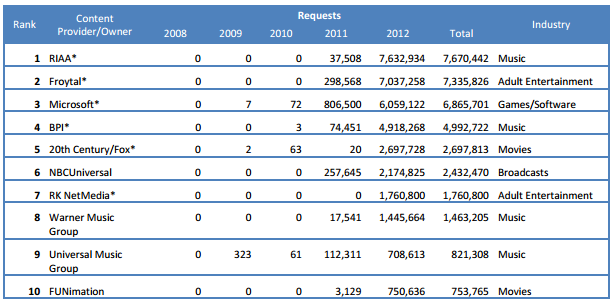
The most active copyright holders up until 2012 were the RIAA, Froytal and Microsoft, each listing more than five million notices. Seng’s paper doesn’t include the most recent data, but Google’s Transparency Report shows that these numbers more than doubled again in 2013.

Total URLs for all notices per reporting group
copyrightholder
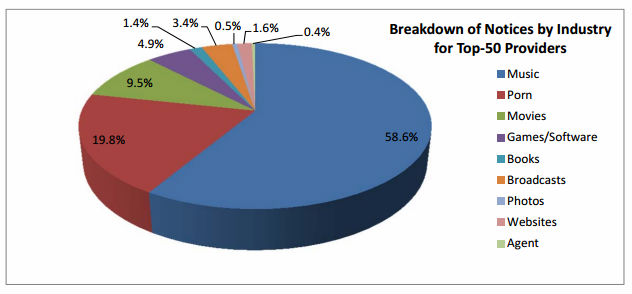
A breakdown by industry shows that most of the notices (59%) come from the music industry, followed by adult entertainment companies (20%), and the movie industry (10%) respectively.

Notices per industry
noticesperind
The paper emphasizes that most changes are driven by a small number of copyright holders and industry groups, who are mostly targeting Google. Roughly 95% of all notices and 99% of all URLs included in the research were sent to the search engine, which has been under fire from the MPAA and RIAA for two years now.

Interestingly, the surge in notices started right after the SOPA and PIPA bills failed to pass, suggesting that this is anti-piracy plan B for the entertainment industries.

The release of the paper documents an important change in the use of DMCA takedown notices and coincides with ongoing discussions between copyright holders and online service providers on how to improve the DMCA takedown process. What changes will be made, if any, remains to be seen.

*The number of notices sent by Yahoo in 2011 and 2012 are most likely 0 because they stopped reporting them to Chillingeffects.

Source: TorrentFreak, for the latest info on copyright, file-sharing and anonymous VPN services.

TorrentFreak Email Update

TorrentFreak Email Update


Android App Pirates Plead Guilty to Criminal Copyright Infringement

Posted: 25 Mar 2014 02:35 AM PDT

appbucketWith help from French and Dutch police, the FBI took over the “pirate” Android stores applanet.net, appbucket.net and snappzmarket.com during the summer of 2012.

The domain seizures were the first ever against “rogue” mobile app marketplaces and followed similar actions against BitTorrent and streaming sites.

Yesterday the Department of Justice announced that two of the three admins of the Appbucket site have plead guilty to criminal copyright infringement. Nicholas Narbone, 26, and Thomas Dye, 21, both signed a plea deal with the Government and are currently scheduled to be sentenced in June.

No information was provided on the third Appbucket defendant, Thomas Pace, who was primarily responsible for finding copies of Android apps and managing the site’s servers.

The authorities estimate that more than a million Apps were traded via Appbucket, with a retail value of approximately $700,000. Over the course of two years the site itself generated little over $80,000 in proceeds from subscriptions.

Seizure Banner

seizure

Acting Assistant Attorney General David O'Neil is happy with the guilty pleas, which are the first of their kind.

"These mark the first convictions secured by the Justice Department against those who illegally distribute counterfeit mobile apps,” O'Neil says.

“These men trampled on the intellectual property rights of others when they and other members of the Appbucket group distributed more than one million copies of pirated apps.”

Besides Appbucket, there are also cases pending against the operators of Snappzmarket and Applanet. The founder of Applanet previously launched a crowdfunding campaign to pay for his defense, but only managed to raised $1,029 of the required $50,000.

The FBI, meanwhile, is already on the lookout for their next targets.

"The FBI will continue to work with its various law enforcement partners in identifying, investigating, and presenting for prosecution those individuals and groups engaged in such criminal activities that involve the attempt to profit from the hard work and the developed creative ideas of others," FBI Special Agent Johnson says.

Source: TorrentFreak, for the latest info on copyright, file-sharing and anonymous VPN services.

Dotcom’s Mega Plans $179m Public Listing Via Reverse Takeover

Posted: 25 Mar 2014 12:36 AM PDT

megaKim Dotcom isn’t known for doing things ‘small’ and that was underlined today with news that the cloud storage firm he founded last year will hit the New Zealand stock exchange.

In keeping with the complex life of the entrepreneur, the plans for the listing aren’t completely straightforward. Mega.co.nz says it will achieve a backdoor listing on the New Zealand stock exchange via a reverse takeover of an existing company.

Earlier this morning TRS Investments, an inactive investment company valued at NZ$2.2m (US$1.88m), said it had reached an agreement to buy Mega Ltd through a share issue to Mega shareholders.

TRS will acquire the shares for NZ$210 million via the issue of 700 million new shares to the shareholders of Mega at a price of 30 cents per share. This will result in those shareholders owning a 99 percent share of TRS.

Once the deal is completed, TRS will change its name to Mega.

While Kim Dotcom himself is longer a director of Mega having stepped down to concentrate on his extradition battle, musical career and political party, his wife Mona owns 26.5 percent of the company.

The acquisition requires TRS to obtain shareholder approval and necessary collateral on or before May 30, 2014.

“The rapid global growth of Mega has generated significant interest from potential investors. Listing on the New Zealand Stock Exchange will allow investors to participate in the ongoing growth of Mega,” said Mega CEO Stephen Hall in a statement.

Perhaps unsurprisingly, the deal already has its controversy, with a report this morning that Paul Choiselat, a major TRS shareholder, is facing charges of concealing his interest in listed companies and alleged market manipulation.

Nevertheless, shares in TRS Investments soared to a seven year high, up 600 percent, following news of the takeover.

Mega reports that since its launch in January 2013 it has signed up around seven million users and is currently bringing on board more than 20,000 new ones every day. With encrypted chat video conferencing scheduled for the second quarter, Mega has big things ahead in 2014.

The full NZX announcement can be found here.

Source: TorrentFreak, for the latest info on copyright, file-sharing and anonymous VPN services.

Judge: IP-Address Is Not a Person and Can’t Identify a BitTorrent Pirate

Posted: 24 Mar 2014 10:08 AM PDT

ip-addressOver the past several years hundreds of thousands of alleged BitTorrent pirates have been sued by so-called ‘copyright trolls’ in the United States.

The rightsholders bringing these cases generally rely on an IP address as evidence. They then ask the courts to grant a subpoena, forcing Internet providers to hand over the personal details of the associated account holder.

The problem, however, is that the person listed as the account holder is often not the person who downloaded the infringing material. Although not many judges address this crucial issue early on, there are exceptions, such as the one raised by Florida District Court Judge Ursula Ungaro.

Judge Ungaro was presented with a case brought by Malibu Media, who accused IP-address “174.61.81.171″ of sharing one of their films using BitTorrent without their permission. The Judge, however, was reluctant to issue a subpoena, and asked the company to explain how they could identify the actual infringer.

Responding to this order to show cause, Malibu Media gave an overview of their data gathering techniques. Among other things they explained that geo-location software was used to pinpoint the right location, and how they made sure that it was a residential address, and not a public hotspot.

Judge Ungaro welcomed the additional details, but saw nothing that actually proves that the account holder is the person who downloaded the file.

“Plaintiff has shown that the geolocation software can provide a location for an infringing IP address; however, Plaintiff has not shown how this geolocation software can establish the identity of the Defendant,” Ungaro wrote in an order last week.

“There is nothing that links the IP address location to the identity of the person actually downloading and viewing Plaintiff's videos, and establishing whether that person lives in this district,” she adds.

The order

Even if Malibu Media can accurately show that the copyright infringer used the Internet connection of the account holder connected to IP-address 174.61.81.171, they still can’t prove who shared the file.

“Even if this IP address is located within a residence, the geolocation software cannot identify who has access to that residence's computer and who would actually be using it to infringe Plaintiff's copyright,” Judge Ungaro explains.

As a result, the court decided to dismiss the case for improper venue. The ruling is crucial as it’s another unique order confirming that an IP address alone is not enough to launch a copyright infringement lawsuit.

Copyright Troll watcher SJD points out that the same Judge has also issued orders to show cause in two other Malibu Media cases, which are also likely to be closed.

While not all judges may come to the same conclusion, the order definitely limits the options for copyright holders in the Southern District of Florida. Together with several similar rulings on the insufficiency of IP-address evidence, accused downloaders have yet more ammunition to fight back.

Source: TorrentFreak, for the latest info on copyright, file-sharing and anonymous VPN services.

TorrentFreak Email Update

TorrentFreak Email Update


Sssh! Dotcom’s Use of Twitter Problematic, Court Told

Posted: 24 Mar 2014 03:49 AM PDT

dotcom-laptopLast week the Supreme Court handed a significant blow to Kim Dotcom and his associates with a ruling confirming they would not be entitled to receive any more than a summary of the claims in the extradition case against them.

Just days later and the Megaupload and Mega.co.nz founder’s legal team were back in court in connection with their huge compensation claim against the New Zealand police and the government’s GCSB spy agency following the raid on Dotcom’s Coatville mansion in 2012.

The claim, for breaches of the Bill of Rights Act and the Government Communications and Security Bureau Act, spans not only Kim Dotcom but also his wife Mona, three of his Megaupload associates, plus one of their wives.

On the basis that the surveillance leading up to the raid was carried out illegally, and that the raid itself was executed by the police using excessive force, the claim for compensation has reached around NZ$5m (US$4.27m)

In the High Court in Auckland this morning, Dotcom lawyer Paul Davison said that he believed that additional documents being held by the government should be revealed as part of the discovery process. Should such documents exist, Davison said, then he would ask that Justice Winkelmann orders their disclosure.

However, Crown lawyer David Boldt said there was nothing left to hand over.

“The defendants at least have discovered thousands of documents in this proceeding and have been extraordinarily diligent in scouring records for relevant material,” Boldt said.

“What I can say is, if that material existed, it would have been discovered, and we’ve sworn affidavits to the effect that this is all there is.”

The Crown also took the opportunity to attack Dotcom’s use of Twitter, a service used by the Megaupload founder to give his followers a window into his private life.

Dotcom posts tweets several times every day, sometimes giving his 350,000 followers updates on his family but on other occasions referring to his ongoing legal battles with both the United States and New Zealand governments. That has included the posting documents connected to his case

Crown lawyer Kristy McDonald said that through his actions on Twitter, Dotcom had demonstrated “considerable disregard” for court processes and suggested that any documents obtained by Dotcom might end up getting published on the social networking platform.

“Is this about obtaining documents so they can be put out in the public arena?” McDonald questioned. The notion was dismissed by Dotcom’s lawyer.

This is the second attack on Dotcom’s use of Twitter. In December 2013, the U.S. Government claimed that the entrepreneur’s use of the social networking site made his defense less credible.

Dotcom’s legal team, however, suggested that government attempts “to widely disseminate a one-sided, cherry-picked set of facts” threatened to “infect the jury pool before defendants are afforded any opportunity to present their side of the story."

In the meantime, Dotcom’s tweets continue. Although not mentioning anyone by name, Dotcom today criticized former security staff for “leaking family secrets” and demanding large sums of money. He said that rumors suggesting he treats his staff badly are untrue.

Dotcom Tweets

The compensation hearings, which will continue in the High Court tomorrow, will see Dotcom’s lawyers argue that the manner in which the 2012 raid was carried out breached his human rights. Earlier this year the Court of Appeal decided that the warrants used in the raid were not in themselves unlawful. Dotcom’s appeal to the Supreme Court in that matter is pending.

Source: TorrentFreak, for the latest info on copyright, file-sharing and anonymous VPN services.

Top 10 Most Pirated Movies of The Week – 03/24/14

Posted: 24 Mar 2014 01:06 AM PDT

47roninThis week we have three newcomers in our chart.

47 Ronin is the most downloaded movie this week.

The data for our weekly download chart is estimated by TorrentFreak, and is for informational and educational reference only. All the movies in the list are BD/DVDrips unless stated otherwise.

RSS feed for the weekly movie download chart.

Ranking (last week) Movie IMDb Rating / Trailer
torrentfreak.com
1 (8) 47 Ronin 6.5 / trailer
2 (…) The Hobbit: The Desolation of Smaug 8.2 / trailer
3 (…) The Pirate Fairy 6.9 / trailer
4 (2) Anchorman 2 (Webrip) 6.9 / trailer
5 (1) The Wolf Of Wall Street 8.5 / trailer
6 (5) Frozen 8.1 / trailer
7 (3) 12 Years A Slave 8.4 / trailer
8 (…) 300: Rise of an Empire 7.0 / trailer
9 (4) Bad Country ?.? / trailer
10 (9) Gravity 8.2 / trailer

Source: TorrentFreak, for the latest info on copyright, file-sharing and anonymous VPN services.

Music Industry Wants Pirate Site Blockades in More Countries

Posted: 23 Mar 2014 11:32 AM PDT

stop-blockedIn recent years blockades of “pirate” websites have spread across Europe and elsewhere. In the UK, for example, more than 30 websites are currently blocked by the major ISPs per court order.
Opponents of this censorship route often warn that the measures inhibit free speech and risk overblocking. However, music industry group IFPI disagrees, pointing out that the rights of creators to protect their work trump these concerns.

“Despite misrepresentation by some anti-copyright campaigners, courts have consistently found that the blocking of sites providing illegal content achieves an appropriate balance of fundamental rights,” IFPI writes in its latest Digital Music Report.

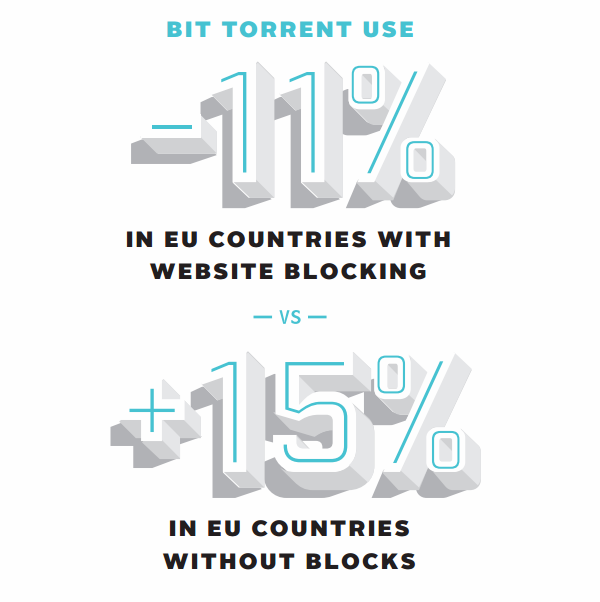
IFPI points out that the ISP blockades in several European countries are having effect. Drawing on information supplied by data intelligence firms comScore and Nielsen, they report that “BitTorrent usage” decreased 11 percent in countries where pirate sites are censored, while it increased elsewhere.

“Website blocking measures implemented by ISPs have been effective. Between January 2012 and July 2013, European countries where blocking orders are in place saw BitTorrent use decline by 11 per cent, while European countries without such orders saw BitTorrent use increase by 15 per cent.”

The data further shows that this blockade effect is most pronounced in Italy and the UK, where the most torrent sites are blocked. In Italy BitTorrent traffic dropped 13 percent and in the UK the decline was even larger, 20 percent.

The report doesn’t make it clear whether actual BitTorrent traffic was measured, or only page views at popular torrent sites. Regardless, IFPI notes that there’s still plenty of work to be done.

The blockades are currently limited to fixed lines, for example, and should be expanded to mobile networks as well. In addition, IFPI says that the blockades should be expanded to other countries worldwide.

“The industry believes that website blocking is an effective tool to help tackle digital piracy and should be available in more countries worldwide. It also needs to be extended to cover mobile networks,” IFPI reports.

The music industry group doesn’t name any countries, but perhaps they are hinting at the RIAA to push for “voluntary” blockades in the United States. In any case, if it’s up to IFPI the number of ISP blockades around the world will continue to increase.

The results reported by IFPI run contrary to a decision from the Dutch Court of Appeals earlier this year, which concluded that the Pirate Bay blockade was “disproportionate and ineffective.” As a result, Dutch ISPs were allowed to lift the access restrictions.

Photo: Michael Theis

Source: TorrentFreak, for the latest info on copyright, file-sharing and anonymous VPN services.

TorrentFreak Email Update

TorrentFreak Email Update


BitTorrent Hip Hop Album Becomes First Ever to Accept Bitcoin

Posted: 23 Mar 2014 02:40 AM PDT

Following a December 2013 teaser, February builds of FrostWire's Windows, Mac and Linux BitTorrent clients included a ground-breaking new feature.

The Frostwire client, which can be used in the same way as uTorrent or Vuze for example, now includes a torrent creation feature which supports Bitcoin, Litecoin, Dogecoin and PayPal donations.

Once a torrent is created and loaded into FrostWire, downloaders are given a new set of icons indicating which crypto-currency donation options are programmed into the release.

FrostBit

Clicking any of these takes the downloader to a custom donation page, meaning that there is a direct connection between a torrent and a monetization option, something that has been absent from torrents since their creation well over a decade ago.

Although software and a music single were used as a demo for the tipping system, no band had taken the plunge and used it for one of their albums. A month later and hip hop band Ain’t No Love have made history, becoming the first ever band to offer a full album for free on BitTorrent, using an integrated Bitcoin tipping mechanism.

AintNoFrost

"Using Bitcoin has definitely widened our reach to people who don't necessarily listen to our type of music, but like that we get down with Bitcoin, and started listening to our music, which is a cool thing in itself,” says lead singer Saidah Conrad.

Having worked hard on a Bitcoin implementation, FrostWire say they are pleased to welcome the band on board.

“Ain't No Love's Tears of Joy comes to FrostWire during a very special time – as a first ever .torrent album to support crypto-currency donations such as Bitcoin, Litecoin, and Dogecoin (as well as the more traditional PayPal),” the company said.

“So if you love the band just as much as we do, be sure to check them out on Facebook, share the video, spread the news on Twitter or simply show some support by giving a little tip, whatever you can, any way you can.”

The other neat thing is that all donations go directly to the band as there is no middleman, and FrostWire is promising to keep it that way forever.

The torrent for Ain’t No Love’s Tears of Joy can be downloaded here.

Source: TorrentFreak, for the latest info on copyright, file-sharing and anonymous VPN services.

Busted: BSA Steals Photo For “Snitch On a Pirate” Campaign

Posted: 22 Mar 2014 11:48 AM PDT

nopiracyA few weeks ago we reported on a controversial anti-piracy campaign operated by the Business Software Alliance (BSA).

Representing major software companies, the BSA is using Facebook ads which encourage people to report businesses that use unlicensed software. If one of these reports results in a successful court case, the pirate snitch can look forward to a cash reward.

Below is one of the promoted Facebook posts that appeared in the timeline of thousands of people on Saint Patrick’s Day. It features a homemade cake in the shape of a pot of gold and sends a clear message to the readers.

“Your pot of gold is right here baby. Report unlicensed software and GET PAID,” the post reads.

Unlicensed Photo
snitchbsa

The ad is a bit misleading, since those who read the fine-print realize that the pot of gold is as unreachable as any. However, there’s a more worrying issue with the ad.

On closer inspection the photo appears to be lifted from Cakecentral where a user named ‘bethasd’ posted her home-baked creation. Indeed, all signs suggest that the photo for this campaign wasn’t properly licensed, but pirated by the BSA.

Hoping that this was all a misunderstanding, TF contacted the BSA yesterday afternoon, asking for a comment. Thus far the group hasn’t responded to us, but an hour after we sent the inquiry the infringing photo magically disappeared from Facebook.

Luckily we made a copy, and so did Google.

So while the BSA didn’t comment, their attempt to cover up the situation clearly shows that they didn’t have the right to use the image in question. Needless to say, that is more than a touch ironic, especially for an image that’s being used in an anti-piracy campaign.

We encourage ‘bethasd’ to get in contact with the software industry group, and demand both licensing fees and damages for the unauthorized use of her photo. Surely, the BSA will be happy to hand over a pot of gold to her.

For the BSA it’s probably wise to reconsider their marketing strategy on Facebook. Right now the overwhelming majority of the comments are negative, which defeats the purpose of the campaign.

Facebook love


face

Source: TorrentFreak, for the latest info on copyright, file-sharing and anonymous VPN services.