http://AccessPirateBay.com- PirateBay's Newest Domain Feb 2014

Torrentfreak: “Mega Goes Legal, Issues Ultimatum Over Cyberlocker Report” plus 1 more

Torrentfreak: “Mega Goes Legal, Issues Ultimatum Over Cyberlocker Report” plus 1 more


Mega Goes Legal, Issues Ultimatum Over Cyberlocker Report

Posted: 25 Sep 2014 02:55 AM PDT

Last week the Digital Citizens Alliance and NetNames released a new report with the aim of shining light on the business models of "shadowy" file-storage sites.

While listing some domains that may well live up to that less-than-flattering billing, the authors of Behind The Cyberlocker Door: A Report How Shadowy Cyberlockers Use Credit Card Companies to Make Millions, also decided to include New Zealand-based Mega.

Mega was founded by Kim Dotcom but the site bears little resemblance to his now defunct Megaupload. Perhaps most importantly, Mega was the most-scrutinized file-hosting startup ever, so every single detail simply had to be squeaky clean. As a result the site took extensive legal advice to ensure that it complies with every single facet of the law.

Nevertheless, NetNames took the decision to put Mega in its report anyway, bundling the site in with what are described as some of the market’s most dubious players. This was not received well by Mega CEO Graham Gaylard. In a TorrentFreak article he demanded a full apology from NetNames and Digital Citizens Alliance and for his company to be withdrawn from the report. Failure to do so would result in “further action”, he said.

TF asked NetNames’ David Price whether his company stood by its allegations. The response suggested that it did and no apology was forthcoming. It’s been a week since that ultimatum and as promised Mega is now making good on its threats.

“Mega’s legal counsel has written to NetNames, Digital Citizens Alliance and The Internet Technology & Innovation Foundation (ITIF) stating that the report is clearly defamatory,” Mega CEO Graham Gaylard told TorrentFreak this morning.

Given NetNames’ and Digital Citizens Alliance failure to respond, it comes as little surprise that Mega’s formalized demands now go beyond an apology and retraction.

Firstly, Mega’s legal team are now demanding the removal of the report, and all references to it, from all channels under the respondents’ control. They also demand that further circulation of the report must be discontinued and no additional references to it should be made in public.

That’s a tough one. NetNames’ effort is currently the most-circulated report in the ‘piracy’ space and TorrentFreak is also informed that the paper is set to become the supporting documentation to Hollywood and the labels’ follow-the-money anti-piracy drive.

Mega are also demanding a list of everyone who has had a copy of the report made available to them along with details of all locations where the report has been published. Again, that will be an interesting one to see Mega’s targets fulfill.

Finally, Mega is demanding a full public apology “to its satisfaction” to be published on the homepages of the respondents’ websites. What form that could take without discrediting the rest of the report is probably up for negotiation, but having Mega in there at all was bound to be a controversial and potentially damaging move.

Mega has given the companies seven days to comply with the above requests. No official line has been provided as to what will happen if Mega is met with a refusal, but it seems that the company is serious about protecting its reputation and will do whatever it takes to do that.

It’s perhaps of note that to our knowledge none of the other sites listed in the report have come out publicly to protest their inclusion in it. That’s not to say that some weren’t wrongfully included of course, but when a company like Mega stands up in order to protect its brand that should set off alarm bells.

Do ‘pirate’ sites with “shadowy” business models ever bother to publicly defend their reputations unless they’re the ones being hauled into court?

Source: TorrentFreak, for the latest info on copyright, file-sharing and anonymous VPN services.

UK Govt Hopes to ‘Profit’ From Anti-Piracy Measures

Posted: 24 Sep 2014 10:16 AM PDT

pirate-cardA few weeks ago the UK Government announced its support for a new anti-piracy plan, the Voluntary Copyright Alert Programme (VCAP).

The Government teamed up with copyright holders and ISPs, who will start sending warning emails to pirating Internet users next year. In addition there will be a broader educational campaign to steer people towards using legal options.

While the campaign is a private initiative the Government has decided to back it financially with several million pounds. However, TorrentFreak has learned that the Government funding wasn’t straightforward and was made outside of the available marketing budget.

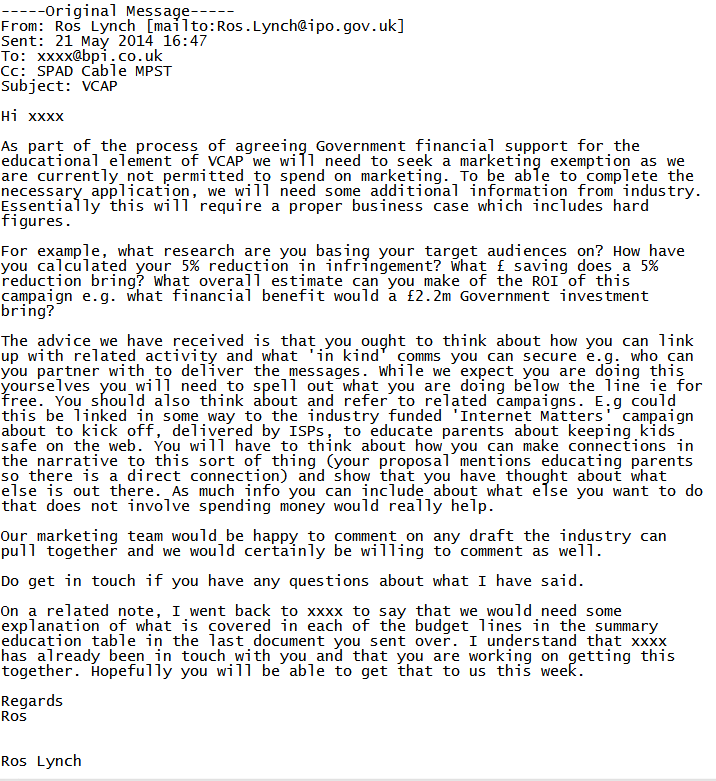
Through a Freedom of Information request we obtained an email conversation between the UK Intellectual Property Office (IPO) and music industry group BPI. In the email from May this year IPO’s Ros Lynch explains that there are no regular marketing funds available to support VCAP.

“As part of the process of agreeing Government financial support for the educational element of VCAP we will need to seek a marketing exemption as we are currently not permitted to spend on marketing,” Lynch writes to BPI’s Ian Moss.

To be able to get the exception the Government needs additional information from the entertaining industries, showing that the investment makes sense financially. Or put differently, that the Government will see a good return for their invested taxpayer money.

“Essentially this will require a proper business case which includes hard figures,” Lynch writes.

“For example, what research are you basing your target audiences on? How have you calculated your 5% reduction in infringement? What £ saving does a 5% reduction bring? What overall estimate can you make of the ROI of this campaign e.g. what financial benefit would a £2.2m Government investment bring?”

ipoemail

The above suggests that the BPI is predicting a 5% drop in piracy from the anti-piracy measures. However, in a response to the IPO’s request the industry group writes that even with a lower success rate the Government’s spending will pay off.

In a “Summary Business Case” (pdf) BPI uses the expected VAT increase to convince the Government of the “profitability” of the campaign. It estimates that if 15% of all illegal downloads are lost sales, piracy only has to decline 1% over three years for the Government to recoup their investment.

“The underlying assumptions are based on very good data that has been produced by Ofcom and by a number of academic studies looking at the replacement ratios. It shows that only very small changes in piracy lead to significant returns to Government,” BPI notes.

The music industry group stresses that the calculation only looks at VAT income and that the effects on the wider economy may be even greater. However, the static model they presented should already be good enough to warrant the funding.

“So even from a very simple, static assumption, a small reduction in piracy of between .49% and 1% over the three years would return Government investment of £4m in an education scheme,” BPI writes.

This prediction was apparently good enough for the Government to invest in the new anti-piracy plans beyond the available marketing budget. Even more so, the authorities committed £3.5 million to the campaign, instead of the £2.2 that was discussed in May.

Whether the Government will indeed be able to recoup the taxpayer money through the anti-piracy campaign will be hard to measure, but the plan is going full steam ahead.

Source: TorrentFreak, for the latest info on copyright, file-sharing and anonymous VPN services.

Torrentfreak: “Alleged Topsite Operator Charged With Mass Movie Piracy” plus 1 more

Torrentfreak: “Alleged Topsite Operator Charged With Mass Movie Piracy” plus 1 more


Alleged Topsite Operator Charged With Mass Movie Piracy

Posted: 24 Sep 2014 02:39 AM PDT

pirate-cardAfter becoming almost synonymous with file-sharing and its connections with The Pirate Bay, Sweden began escalating its efforts to stamp out online piracy.

As a result, during the past several years many file-sharers were targeted by anti-piracy groups looking to send a message to the masses. And with government providing additional funding, increasingly police became involved in joint operations.

After a period of dealing with smaller cases, Swedish police have just charged a man for illegally making available large amounts of copyrighted material. According to their intellectual property division, the suspect “intentionally or by gross negligence” unlawfully made films available on 2,250 occasions.

The police add that the individual acted “in consultation or concert with other persons, supplied, installed, programmed, maintained, funded and otherwise administered and managed” the file-sharing network from where the infringements were carried out.

The charges are the result of an investigation initially carried out by Rights Alliance, the anti-piracy group previously known as Antipiratbyran. It’s been revealed they’re representing six major studios in the case, so the usual Hollywood giants will be directly involved.

Few additional details have been made public but after contacting lawyer Henrik Pontén at Rights Alliance, TorrentFreak has learned that the charges relate to a raid carried out in 2010 against “The Scene”, the collection of servers and individuals which inhabit the top of the so-called piracy pyramid.

The case involves a so-called ‘topsite’ known as 'Devil' which at the time was claimed to carry between 200 and 250 terabytes of media. During the raid, which according to Scene sources took place December 15, 2010, police seized a dozen servers and detained one person.

In press releases following the police action it was claimed that the man was responsible for the unauthorized distribution of "tens of thousands" of mainly Hollywood movies. Those estimates appear to have been rounded down.

An element of the case that remains a mystery for now surrounds the prosecution’s current claims that the man made the movies available “to the public”. Topsites tend not to deliberately distribute movies outside of their immediate circles for security reasons.

Source: TorrentFreak, for the latest info on copyright, file-sharing and anonymous VPN services.

The Art of Unblocking Websites Without Committing Crimes

Posted: 23 Sep 2014 11:21 AM PDT

networkThe blocking of sites such as The Pirate Bay, KickassTorrents and Torrentz in the UK led to users discovering new ways to circumvent ISP-imposed censorship. There are plenty of solutions, from TOR and VPNs, to services with a stated aim of unblocking ‘pirate’ sites deemed illegal by UK courts.

Last month, however, dozens of these went offline when the operator of Immunicity and other related proxy services was arrested by City of London Police’s Intellectual Property Crime Unit. He now faces several charges including breaches of the Serious Crime Act 2007, Possession of Articles for Use in Fraud, Making or Supplying Articles for use in Frauds and money laundering.

While it’s generally accepted that running a site like The Pirate Bay is likely to attract police attention, merely unblocking a domain was not thought to carry any such risk. After all, visitors to torrent sites are just that, it’s only later on that they make a decision to infringe or not.

In our earlier article we discussed some of the possible reasons why the police might view “pirate” proxies to be illegal. However, there are very good arguments that general purpose proxies, even ones that are expressly setup to bypass filtering (and are able to unblock sites such as Pirate Bay), remain on a decent legal footing.

One such site is being operated by Gareth, a developer and networking guru who grew so tired of creeping Internet censorship he began lobbying UK MPs on the topic, later moving on to assist with the creation of the Open Rights Group’s Blocked.org.uk.

After campaigning and documenting Internet censorship issues for some time, Gareth first heard of last month’s proxy arrest during a visit to the United States.

“I was at DefCon in Las Vegas when the news of the Immunicity arrest reached me and I realized that for all my volunteer work, my open source applications, operation of Tor relays, donations and letters to MPs to highlight/combat the issues with Internet censorship, it was not enough,” the developer told TorrentFreak.

“I felt that this issue has moved from a political / technical issue to one about personal liberty and Internet freedom. e.g. first they came for the ‘pirate proxies’, then the Tor operators, then the ISPs that don’t censor their customers. The slippery slope is becoming a scary precipice.”

Since his return to the UK, Gareth has been busy creating his own independent anti-censorship tool. He’s researched in detail what happened to Immunicity, taken legal advice, and is now offering what he hopes is an entirely legal solution to website filtering and subsequent over-blocking (1)(2).

“Unlike Immunicity et al I'm not specifically building a ‘Pirate Proxy’. Granted people might use this proxy to navigate to torrent websites but were I to sell a laptop on eBay that same person may use it for the same reasons so I see no difference,” he explains.

“In fact Section 44, subsection 2 of the Serious Crimes Act 2007 even states [that an individual] is not to be taken to have intended to encourage or assist the commission of an offense merely because such encouragement or assistance was a foreseeable consequence of his act.”

The result of Gareth’s labor is the anti-censorship service Routing Packets is Not a Crime (RPINAC). People who used Immunicity in the past should feel at home, since RPINAC also utilizes the ability of popular browsers to use Proxy Auto-Config (PAC) files.

In the space of a couple of minutes and with no specialist knowledge, users can easily create their own PAC files covering any blocked site they like. Once configured, their browser will silently unblock them.

Furthermore, each PAC file has its own dedicated URL on RPINAC’s servers which users can revisit in order to add additional URLs for unblocking. PAC ‘unblock’ files can also be shared among like-minded people.

“When someone creates a PAC file they are redirected to a /view/ endpoint e.g. https://routingpacketsisnotacrime.uk/view/b718ce9b276bc2f10af90fe1d5b33c0d. This URL is not ephemeral, you can email it, tweet it (there is a tweet button on the left hand side of the site) etc and it will provide the recipient with the exact same view.

“It’ll show which URLs are specified to be proxied, which have been detected as blocked (using the https://blocked.org.uk database) and if the author passed along the password (assuming the PAC was password protected) they can add or remove URLs too,” Gareth explains.

“Each view page also has a comments section, this could allow for a small collection of individuals to co-ordinate with a smaller subset of password possessing moderators to create a crowd sourced PAC file in an autonomous fashion. There is also a ‘Clone’ button allowing anybody to create their own copy of the PAC file with their own name, description and password if the PAC file they’ve received isn’t quite what they need.”

This user-generated element of the process is important. While dedicated ‘pirate’ proxy sites specifically unblock sites already deemed illegal by the UK courts (and can be deemed to be facilitating their ‘crimes’), RPINAC leaves the decision of which sites to unblock completely down to the user. And since no High Court injunction forbids any user from accessing a blocked domain, both service and user remain on the right side of the law.

In terms of use, RPINAC is unobtrusive, has no popups, promotions or advertising, and will not ask for payment or donations, a further important legal point.

“To avoid any accusations of fraud and to avoid any tax implications RPINAC will never ask for donations,” the dev explains. “The current platform is pre-paid for at least a year, the domain for 10. At a bare minimum PAC file serving and education for creating local proxies will continue indefinitely.”

Finally, Gareth notes that without free and open source software his anti-censorship platform wouldn’t have been possible. So, in return, he has plans to release the source code for the project under the GPL 3.0 license.

RoutingPacketsIsNotACrime can be found here and is compatible with Firefox, Chrome, Safari and IE. Additional information can be sourced here.

Source: TorrentFreak, for the latest info on copyright, file-sharing and anonymous VPN services.

Torrentfreak: “Why Record Labels Want Kim Dotcom’s Album Taken Down” plus 1 more

Torrentfreak: “Why Record Labels Want Kim Dotcom’s Album Taken Down” plus 1 more


Why Record Labels Want Kim Dotcom’s Album Taken Down

Posted: 23 Sep 2014 03:44 AM PDT

goodtimesEarlier this year Kim Dotcom released his first music album “Good Times,” giving it away for free to anyone interested.

An official copy of the album was posted on the cloud hosting service Mega, which is linked from Dotcom’s homepage. This has never caused any issues, until a few weeks ago, when various copyright holders started sending unusual takedown requests to have the content removed.

IFPI, representing the major music labels, submitted several DMCA notices to Mega claiming that the file infringed the rights of various artists. This resulted in a game of whack-a-mole in which the album was removed and reinstated a few times. Currently it’s unavailable yet again.

megadown

When we previously covered the issue, Mega stressed that the takedown requests were clearly mistaken. The company accused IFPI of not doing their homework and doubted the accuracy of their notices in general.

However, since the takedown notices kept targeting the same link, there was a good chance that these mistakes were orchestrated in some way. Assuming that someone was making IFPI and others believe that the link pointed to albums of other artists, we decided to do some research.

Eventually we stumbled upon a series of Pastebin pages where the URL of Dotcom’s album is linked to titles of other artists. Several of the artists mentioned in the pastes are the same as the one’s IFPI listed in their DMCA notices, so this would explain the mistakes.

kimdown

The above is concerning for several reasons. First of all, it shows that IFPI and others don’t verify the legitimacy of their takedown notices. This means that pranksters can easily get them to censor legitimate content.

Secondly, Mega usually can’t check the validity of a claim, or it simply doesn’t know whether or not a user has permission to publish it. So they have very little options to stop the abuse.

“Mega aims to process all takedowns promptly, within a few hours. It is impossible to verify the claims as the files are encrypted so we don't know the contents (unless the full link is provided with the key included), and we can't verify if the person has a valid ownership/license or not,” a Mega spokesperson told us.

Despite these restrictions, the cloud hosting provider says it’s setting up a system where repeated takedowns can be flagged to prevent this type of abuse in the future.

“We are improving our systems to monitor the takedown process and will eventually be able to identify repeated incorrect notices,” Mega says.

Until then, Dotcom’s album will most likely disappear from Mega a few more times. Luckily for the fans, there’s also a copy hosted on the soon-to-be-released music service Baboom.

Source: TorrentFreak, for the latest info on copyright, file-sharing and anonymous VPN services.

Giganews Resorts to DMCA to Quieten FBI Allegations

Posted: 22 Sep 2014 11:20 AM PDT

GNlogoOn the morning of September 11, 2014, TorrentFreak was greeted with one of the most unusual emails we’ve ever received.

Sent from an alleged former employee of Giganews who identified himself as Nick Caputo, the email contained serious allegations about his former employer. Caputo told us that he’d begun working at the company in 2009 and as a “huge pirate” he loved to help people download “all the rich multimedia content they could.” But that was just the beginning.

The email outlined Caputo’s rise through the company through two quick promotions in two-and-a-half years. However, it quickly descended into allegations that far from being a straight-down-the-line newsgroup provider, Giganews is in fact an FBI-run operation. Caputo says he discovered this after getting into a dispute with the company about removing child abuse material and elevating his complaint to the FBI.

TorrentFreak decided not to run with the story, despite clear indications that Caputo is who he claimed he was. The story, which had plenty of detail, just didn’t hold up on its own. There was plenty of ‘evidence’ provided but the problem was that none of it added up to a level of proof that we’d be prepared to stand behind.

But four days later and after being contacted by Caputo, Cryptome published the email and documents originally sent to TorrentFreak and possibly others.

The story quickly spread around dozens of sites including Reddit and HackerNews forcing Giganews to respond, acknowledging that Caputo was indeed a former employee but denying the allegations.

“This is a hoax. These allegations are 100% false,” the company wrote.

“Unfortunately, since his termination, the poster has periodically posted versions of this information online. Sometimes, he tries to misrepresent himself as our CEO and sometimes he posts as himself.”

With Giganews criticizing Cryptome for publishing the allegations, Caputo it seemed was not giving up. The archive of evidence originally offered to TF found itself uploaded to Internet Archive from where Caputo hoped it would be spread far and wide.

However, according to a new email published by Cryptome, that has now been brought to halt by the issuing of a DMCA notice.

Subject: archive.org item subject to copyright claim
From:”Internet Archive”
Date:Sep 18, 2014 9:41:11 PM

Hello,

Access to the item at https://archive.org/details/giganews-fbi has been disabled following receipt by Internet Archive of a copyright claim submitted on behalf of Data Foundry, Inc (datafoundry.com). The claim was submitted with information and statements requested by Internet Archive’s Copyright Policy (posted at https://archive.org/about/terms.php near the bottom of the page). If you have questions regarding the claim, please let us know.

Sincerely,

The Internet Archive Team

While Giganews clearly thinks the contents of the archive are defamatory, one has to dig into the details to see where the company has a copyright claim over the file.

That can be found in a dump of employee contact details which documents show were obtained from Data Foundry’s intranet. Each employee card has a photograph attached and those are likely to have been taken by a company employee in company time.

Also included in the dump is a Giganews appraisal of Caputo’s performance during 2010. It was authored by a manager and the rights to the form will most likely sit with the company. While Giganews would probably write something different today, four years ago the company felt that Caputo was “the go-to guy” for getting stuff done on nights, ranking his overall performance as “exceeding” the standard required.

“Giganews is in the impossible position of proving a negative,” the company said in a statement.

“If we say our list of employees does not include any FBI employees, then they must be ‘using false identities.’ If we say the named FBI operatives don’t look like any of our employee photos, ‘the pictures must have been altered.’ Even the denial itself is used as further evidence of the truth of the accusation. In a court of law, such an accusation would never stand up to scrutiny, but on the Open Internet, opinions can be formed by only a few words on a popular website.”

Whether the allegations will now calm down and go away is anyone’s guess, but a DMCA notice to one of the many sources of the file is unlikely to make it disappear forever.

Source: TorrentFreak, for the latest info on copyright, file-sharing and anonymous VPN services.

Torrentfreak: “BPI Hits Record Breaking 100 Million Google Takedowns” plus 2 more

Torrentfreak: “BPI Hits Record Breaking 100 Million Google Takedowns” plus 2 more


BPI Hits Record Breaking 100 Million Google Takedowns

Posted: 22 Sep 2014 02:11 AM PDT

bpiDespite the growing availability of legal music services in many countries, record labels are facing a constant stream of pirated music.

In an attempt to prevent these infringements, the BPI and other music industry groups send millions of takedown notices to Internet services every month. Most of these requests are directed at Google.

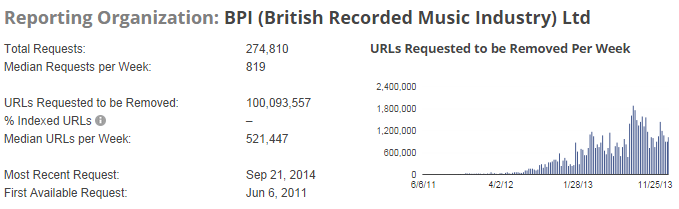
This week the UK music industry group BPI reached a new milestone after notifying Google of the 100 millionth allegedly infringing URL, up from 50 million just 10 months ago.

http://pastebin.com/search?cx=013305635491195529773%3A0ufpuq-fpt0&cof=FORID%3A10&ie=UTF-8&q=https%3A%2F%2Fmega.co.nz%2F%23%21fNFSiJxa%21ePxcgzjVYy6fxt0ep15iUyhnOgedIOcXQUs7U5myurE&sa.x=0&sa.y=0&sa=Search

As can be seen below, the latest update shows that the 100 million links were spread out over 274,810 separate DMCA takedown notices.

BPI’s takedown notices

bpi100m

With 100 million requests the BPI has broken a new milestone. Never before has a copyright holder representative reported so many allegedly infringing links to Google. Degban is currently second in this list with 99 million URLs, followed by the RIAA with 57 million.

For the BPI this record isn’t something to be proud of though. The music industry group tells us that it shows just how hard it is for copyright holders to have infringing content taken offline.

"This milestone makes two things very clear. First, that however much creators do, the system of ‘notice and takedown’ will never be enough on its own to protect them or consumers from the online black market, or to spur growth in the digital economy,” a BPI spokesperson says.

“Second, that despite its clear knowledge as to which sites are engines of piracy, Google continues to help build their illegal businesses, by giving them a prominent ranking in search results.”

The BPI stresses that Google should do more to lower the visibility of unauthorized content in its search results. Despite promises to do so, the music group still sees very little improvement on this front.

"To illustrate: Google's records show it has been told more than 10 million times that content on 4shared.com is illegal – yet it's still the very first result today when we search for ‘Calvin Harris mp3′ – ahead of Amazon and every other legal service,” BPI notes.

Addressing this issue is pretty straightforward, the BPI argues. Google should work with the entertainment industries to adjust its search algorithm, as the UK Government also highlighted recently.

"Google can simply fix this problem by amending its algorithm. We hope they will respond positively to the invitation from Government to negotiate voluntary measures to do so,” BPI says, closing with an iconic lyric.

“It's time the media giant changed its tune – we need a little less conversation and a little more action please."

Google has thus far been hesitant to fiddle with its search results.

The company has made several changes to address the complaints of copyright holders. However, it also stressed that the entertainment industries themselves should take responsibility, arguing that piracy is primarily an availability and pricing problem.

Source: TorrentFreak, for the latest info on copyright, file-sharing and anonymous VPN services.

Top 10 Most Pirated Movies of The Week – 09/22/14

Posted: 21 Sep 2014 11:51 PM PDT

transThis week we have two newcomers in our chart.

Transformers: Age of Extinction is the most downloaded movie.

The data for our weekly download chart is estimated by TorrentFreak, and is for informational and educational reference only. All the movies in the list are BD/DVDrips unless stated otherwise.

RSS feed for the weekly movie download chart.

Ranking (last week) Movie IMDb Rating / Trailer
torrentfreak.com
1 (…) Transformers: Age of Extinction 6.1 / trailer
2 (3) Edge Of Tomorrow 8.1 / trailer
3 (9) X-Men: Days of Future Past 8.4 / trailer
4 (1) Maleficent 7.4 / trailer
5 (…) Million Dollar Arm 7.3 / trailer
6 (2) How To Train Your Dragon 2 8.3 / trailer
7 (5) The Fault in Our Stars 8.3 / trailer
8 (4) The Giver 6.9 / trailer
9 (7) Godzilla 7.1 / trailer
10 (10) Divergent 7.2 / trailer

Source: TorrentFreak, for the latest info on copyright, file-sharing and anonymous VPN services.

“The Letter” Is Still The Best Story To Explain Why Copyright Monopoly Must Be Reduced

Posted: 21 Sep 2014 01:30 PM PDT

copyright-brandedAs I travel the world and speak to people from all professions and walks of life about the copyright monopoly, “the letter” is still the story that causes the most pennies to drop about why the copyright monopoly must be reduced. It’s by far the angle that makes the message come across to the most people.

“How will the artists make money” is basically just a distraction from the real and important issues at hand, and this story helps bring them there.

The story of “the letter” deals with just how big and vital civil liberties have been sacrificed in the transition from analog to digital at the tenacious insistence of the copyright industry for the sake of their bottom line. The analog letter was the message sent the way our parents sent them: written onto a physical piece of paper, put into an envelope, postaged with an old-fashioned stamp and put into a mailbox for physical delivery to the intended recipient.

That letter had four important characteristics that each embodied vital civil liberties.

That letter, first of all, was anonymous. Everybody had the right to send an anonymous message to somebody. You could identify yourself on the inside of the message, for only the recipient to know, on the envelope, for the postal services to know, or not at all. Or you could write a totally bogus name, organization, and address as the sender of your message, and that was okay, too. Not just okay, it was even fairly common.

Second, it was secret in transit. When we talk of letters being opened and inspected routinely, the thoughts go to scenes of the East German Stasi – the Ministerium für Staatssicherheit, the East German National Security Agency (yes, that’s how Stasi’s name translates). Letters being opened and inspected? Seriously? You had to be the primary suspect of an extremely grave crime for that to take place.

Third, the mailman was never ever held responsible for the contents of the letters being carried. The thought was ridiculous. They were not allowed to look at the messages in the first place, so it was unthinkable that they’d be held accountable for what they dutifully delivered.

Fourth, the letter was untracked. Nobody had the means – nor indeed the capability – to map who was communicating with whom.

All of these characteristics, which all embed vital civil liberties, have been lost in the transition to digital at the insistence of the copyright industry – so that they, as a third-party, can prevent people from sending letters with a content they just don’t like to see sent, for business reasons of theirs.

The question of “how will somebody make money” is entirely irrelevant. The job of any entrepreneur is to make money given the current constraints of society and technology.

No industry gets to dismantle civil liberties with the poor excuse that they can’t make money otherwise. They have the simple choice of doing something else or go out of business. And yet, that’s exactly what we have allowed the copyright industry to do: dismantle vital civil liberties. Dismantle the very concept of the private letter. And they’re continuing to do so under pretty but deceptive words.

When I explain the situation like this, the penny drops for an astounding amount of people and they stop asking the learned, but silly, question about how somebody is to get paid if we have the rights we’ve always had – to send anything to anybody anonymously.

That’s the Analog Equivalent Right. To be able send anything to anybody anonymously. And that’s what we need to bring to the digital environment, even if an obsolete industry doesn’t like it because it may or may not hurt the bottom line. That’s completely irrelevant.

Try telling this story and watch the penny drop, almost every single time. It’s remarkable.

About The Author

Rick Falkvinge is a regular columnist on TorrentFreak, sharing his thoughts every other week. He is the founder of the Swedish and first Pirate Party, a whisky aficionado, and a low-altitude motorcycle pilot. His blog at falkvinge.net focuses on information policy.

Book Falkvinge as speaker?

Source: TorrentFreak, for the latest info on copyright, file-sharing and anonymous VPN services.

Torrentfreak: “The Pirate Bay Runs on 21 “Raid-Proof” Virtual Machines” plus 2 more

Torrentfreak: “The Pirate Bay Runs on 21 “Raid-Proof” Virtual Machines” plus 2 more


The Pirate Bay Runs on 21 “Raid-Proof” Virtual Machines

Posted: 21 Sep 2014 05:18 AM PDT

pirate cloudTwo years ago The Pirate Bay made an important change to its infrastructure by switching its entire operation to the cloud.

Instead of buying their own hardware The Pirate Bay decided to serve its users from several cloud hosting providers scattered around the world. This saved costs, guaranteed better uptime, and made the site more portable and thus harder to take down.

The operational change also had a downside. Before the move the notorious torrent site had a dedicated page displaying its hardware and server setup, which was something true geeks kept a close eye on.

Today the site no longer owns any crucial pieces of hardware. However, it’s worth taking a look at the virtual setup the site is running on now. TorrentFreak asked the Pirate Bay team for an update and they were happy to oblige.

At the time of writing the site uses 21 “virtual machines” (VMs) hosted at different providers. This is up four machines from two years ago, in part due to the steady increase in traffic.

Most of the VMs, eight in total, are used for serving the web pages. The searches take up another six machines, and the site’s database currently runs on two VMs.

The remaining five virtual machines are used for load balancing, statistics, the proxy site on port 80, torrent storage and for the controller.

In total the VMs use 182 GB of RAM and 94 CPU cores. The total storage capacity is 620 GB, but that’s not all used. Needless to say, that is relatively modest considering the size of the site.

- 8 web
- 6 search
- 2 database
- 1 lvs
- 1 stats
- 1 for proxy site on .80,
- 1 torrents
- 1 control

All virtual machines are hosted with commercial cloud hosting providers, who have no clue that The Pirate Bay is among their customers. All traffic goes through the load balancer, which masks what the other VMs are doing. This also means that none of the IP-addresses of the cloud hosting providers are publicly linked to TPB.

According to the Pirate Bay team the current setup works pretty well. Although small issues pop up every now and then, the site has had no major downtime recently.

If the police come knocking in the future the cloud servers can of course be disconnected. However, with the site’s current setup it would be fairly easy to continue operating from another provider in a relatively short time.

For now, the most vulnerable spot appears to be the site’s domain. Just last year the site burnt through five separate domain names due to takedown threats from registrars.

But then again, this doesn’t appear to be much of a concern for TPB as the operators have dozens of alternative domain names standing by.

Source: TorrentFreak, for the latest info on copyright, file-sharing and anonymous VPN services.

Anti-Piracy Police Begin Targeting eBook Pirates

Posted: 20 Sep 2014 10:02 PM PDT

cityoflondonpoliceThis year the City of London Police Intellectual Property Crime Unit has built a reputation for being one of the most prolific and aggressive anti-piracy groups operating today.

PIPCU, as its more commonly known, has been involved in the closure of dozens of domains, the closure of several sites, and the arrests of individuals up and down the country.

Until now PIPCU’s most visible partners, at least in terms of enforcement in the Internet space, have been the Federation Against Copyright Theft (movies and TV) and the BPI (music). However, there are now signs that sites offering pirated ebooks are part of PIPCU’s strategy.

Like many movie, music, sports and proxy fans have in recent months, this week visitors to the ebook site OnRead.com were confronted with the ominous PIPCU “seized” notice.

“You have tried to access a website that is under criminal investigation by the UK Police Intellectual Property Crime Unit (PIPCU). This site is being investigated for online copyright infringement,” the page reads.

The signs suggest that OnRead knew something was coming. After regular and often daily tweets of new literature appearing on the site, on September 2 the account fell silent.

TorrentFreak asked City of London Police for specifics on the site’s closure, including whether the domain seizure and shutdown had been carried out together with The Publishers Association, a known PIPCU partner.

“As part of Operation Creative PIPCU is working closely with the Publishers Association, as well as FACT, IFPI and BPI to disrupt copyright infringing websites. Since the launch of the operation several illegal film, music and publishing sites have been suspended,” a PIPCU spokesperson said.

e-booksWhile it seems more than likely that OnRead was operating without licenses recognized by UK publishers, an archive of the domain reveals that the site’s operators tried to claim that in at least one jurisdiction the site had operated legally.

“All materials presented on this site are available for the distribution over the Internet in accordance with the license of the Russian Organization for multimedia and Digital Systems (ROMS) and intended for personal use only. Further distribution, resale or broadcasting is strictly prohibited,” the recent archive reads.

ROMS was a Russian collective rights management organization that attracted public attention in 2006 when notorious music download site, AllofMP3, insisted it operated legally under ROMS’ remit to collect and distribute statutory royalty payments as allowed under Russian law. In 2007, AllofMP3 closed down for good.

While the legal claims made by OnRead are fuzzy and by now years out of date, additional notes do warn users that they have “no right to download any files from the site if this violates the law of his country.”

It’s clear that PIPCU and quite probably The Publishers Association felt that OnRead was not in compliance with UK law. As a result the site’s domain, registered with InternetBS, is now in police hands.

In 2007, ZML.com, a site that offered movies to US customers, also tried to claim ROMS protection. That domain is now under the control of ICE and Homeland Security after being seized in the very first wave of Operation in Our Sites.

Source: TorrentFreak, for the latest info on copyright, file-sharing and anonymous VPN services.

Dotcom’s Internet Party Fails to Enter New Zealand Parliament

Posted: 20 Sep 2014 06:18 AM PDT

internetpartyJanuary this year Kim Dotcom launched his Internet Party with an ambition to enter the New Zealand Parliament a few months later.

The Internet entrepreneur could not run for election himself, but as the party’s president and visionary he would gain significant political power.

Today New Zealanders went out to vote and the Internet Party was listed on the ballots in an alliance with the Mana Party.

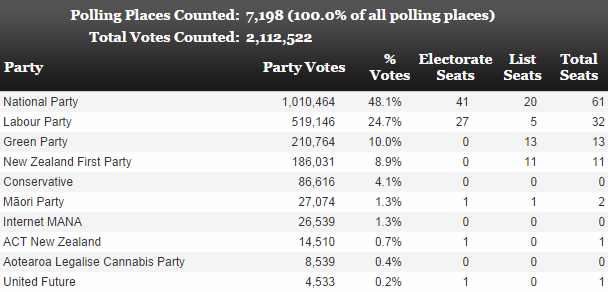
Voting booths officially closed at 7 PM local time and the provisional results show that Internet Mana failed to win a seat.

The party managed 1.26% of the total vote, somewhat short of the 5% required to enter the New Zealand Parliament. A disappointing result after Dotcom spent more than $2 million on the party and its election campaign.

kiwi-results

Over the past several weeks Internet Mana received a lot of attention in the press. Dotcom actively campaigned against his arch-rival Prime Minister John Key, and earlier this week the party organized the “Moment of Truth” during which Edward Snowden, Glen Greenwald and Julian Assange all criticized New Zealand’s secret spying efforts.

Despite the heavy critique of the Prime Minister, Key’s National Party became the overwhelming winner of the elections with nearly half of all votes.

Following the defeat Dotcom apologized to Mana leader Hone Harawira and the Maori people. Mr Harawira lost his Parliament seat and Dotcom suggests that he may be to blame for the disappointing result.

“I take full responsibility,” Dotcom said in a short speech. “The brand Kim Dotcom was poisoned … and I did not see that before the last couple of weeks.”

After his speech Dotcom left the building, declining interview requests from local reporters.

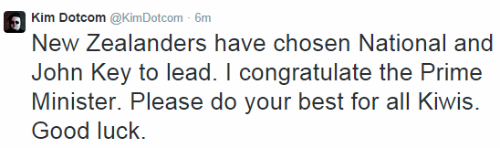
In a tweet Dotcom later congratulated the Prime Minister and his National Party on their win.

“New Zealanders have chosen National and John Key to lead. I congratulate the Prime Minister. Please do your best for all Kiwis. Good luck,” he wrote.

dotcomkey

Responding to the results Internet Party leader Laila Harre said that the party’s policy went unreported in the media, which mostly focused on scandals and the dirty games being played.

Harre thanked Dotcom for the opportunity to shake up New Zealand politics. She said that Dotcom became the symbol of Internet Mana, but that the party likely underestimated the impact this would have on the campaign.

“There’s been a two-year campaign of vilification of Kim and that was clearly impacted on our campaign,” Harre noted.

Source: TorrentFreak, for the latest info on copyright, file-sharing and anonymous VPN services.