http://AccessPirateBay.com- PirateBay's Newest Domain Feb 2014

Torrentfreak: “Piracy Monetization Firm Rightscorp Sued for Harassment and Abuse” plus 2 more

Torrentfreak: “Piracy Monetization Firm Rightscorp Sued for Harassment and Abuse” plus 2 more


Piracy Monetization Firm Rightscorp Sued for Harassment and Abuse

Posted: 24 Nov 2014 03:23 AM PST

rightscorp-realCopyright holders have been sending DMCA takedown notices to ISPs for over a decade, but in recent years these warnings turned into revenue opportunities.

Companies such as Rightscorp ask U.S. ISPs to forward DMCA notices to subscribers,with a settlement offer tagged on to the end. On behalf of Warner Bros, BMG and others Rightscorp asks subscribers to pay $20 per pirated file or risk a potential $150,000 in court.

In recent months there have been various complaints from people who were aggressively approached by Rightscorp, which has now resulted in a class-action complaint against the piracy monetization firm.

The lawsuit was filed at a California federal court on behalf of Karen Reif, Isaac Nesmith and others who were approached by Rightscorp. In the complaint, Rightscorp is accused of violating the Telephone Consumer Protection Act, violations of debt Collection laws and Abuse of Process.

One of the allegations describes the repeated use of robo-calls to alleged infringers. A summary of what happened to Karen Reif shows that once Rightscorp knows who you are, they don’t give up easily.

“By late September of 2014, Ms. Reif was receiving on average about one robo-call per day, and sometimes one robo-call and one live call in the same day.These calls came in from a variety of different numbers, from different area codes all over the country,” the complaint alleges.

This bombardment of harassing robo-calls is a violation of the Telephone Consumer Protection Act, the lawyers argue.

The class-action further includes a long list of violations regarding Rightscorp’s debt collection practices, violating both the FDCPA and the Rosenthal Act.

“Among other wrongful conduct: Rightscorp has engaged in telephone harassment and abuse; made various false and misleading representations; engaged in unfair collections practices; failed to provide validation and required notices relating to the debts..,” the complaint reads.

In addition to the above Rightscorp allegedly made false representations that ISPs were participating in the debt collection. For example, the warning letter stated that ISPs would disconnect repeat infringers, something that rarely happened.

Finally, the complaint raises the issue of Rightscorp’s controversial DMCA subpoenas which demand that smaller ISPs should hand over personal details of their subscribers. Thus far most ISPs have complied, but according to the complaint these requests are a “sham and abuse” of the legal process.

“To identify potential consumers to target, Rightscorp has willfully misused this Court's subpoena power by issuing at least 142 special DMCA subpoenas, per [the DMCA], to various Internet Service Providers.”

“These subpoenas, which were issued on this Court's authority, but procured outside of an adversarial proceeding and without any judicial review, are so clearly legally invalid as to be a sham and abuse of the legal process,” the complaint reads.

The above is just a summary of the long list of complaints being brought against Rightscorp. With these settlement practices becoming more common, the case will definitely be one to watch.

Attorney Morgan Pietz is confident that they have a strong case and told FCT that other Rightscorp victims are invited to get in touch.

"We would still be very interested to talking to anyone who was being contacted by Rightscorp or who paid settlements, particularly anyone who was getting the pre-recorded robo-calls," Pietz said.

For Rightscorp the lawsuit is yet another setback. Earlier this month the piracy monetization firm reported that it continues to turn a loss, which may eventually drive the company towards bankruptcy.

Source: TorrentFreak, for the latest info on copyright, file-sharing and anonymous VPN services.

Top 10 Most Pirated Movies of The Week – 11/24/14

Posted: 24 Nov 2014 12:01 AM PST

guardiansThis week we have four newcomers in our chart.

Guardians of the Galaxy is the most downloaded movie for the second week in a row.

The data for our weekly download chart is estimated by TorrentFreak, and is for informational and educational reference only. All the movies in the list are BD/DVDrips unless stated otherwise.

RSS feed for the weekly movie download chart.

Ranking (last week) Movie IMDb Rating / Trailer
torrentfreak.com
1 (1) Guardians of the Galaxy 8.5 / trailer
2 (…) Lucy 6.5 / trailer
3 (2) Dawn of the Planet of the Apes 8.0 / trailer
4 (…) Predestination 7.6 / trailer
5 (3) Dracula Untold 6.3 / trailer
6 (…) Falcon Rising 5.7 / trailer
7 (4) If I Stay 7.0 / trailer
8 (…) Interstellar (TS) 9.0 / trailer
9 (6) Let’s Be Cops 6.7 / trailer
10 (5) The November Man 6.3 / trailer

Source: TorrentFreak, for the latest info on copyright, file-sharing and anonymous VPN services.

Google Refuses MPAA Request to Blacklist ‘Pirate Site’ Homepages

Posted: 23 Nov 2014 11:43 AM PST

google-bayEvery week copyright holders send millions of DMCA takedown notices to Google, hoping to make pirated movies and music harder to find.

The music industry groups RIAA and BPI are among the most active senders. Together they have targeted more than 170 million URLs in recent years.

The MPAA’s statistics are more modest. Thus far the Hollywood group has asked Google to remove only 19,288 links from search results. The most recent request is one worth highlighting though, as it shows a clear difference of opinion between Hollywood and Google.

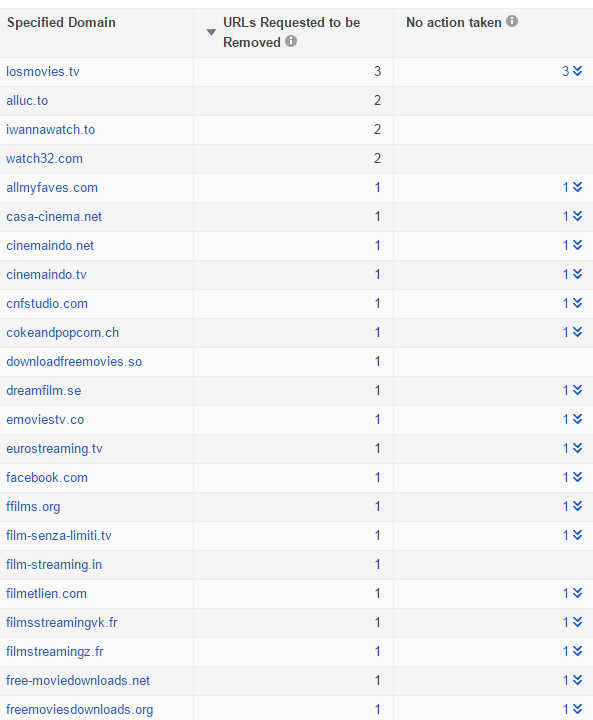
Last week the MPAA sent a DMCA request listing 81 allegedly infringing pages, mostly torrent and streaming sites.

Unlike most other copyright holders, the MPAA doesn’t list the URLs where the pirated movies are linked from, but the site’s homepages instead. This is a deliberate strategy, one that previously worked against KickassTorrents.

However, this time around Google was less receptive. As can be seen below most of the MPAA’s takedown requests were denied. In total, Google took “no action” for 60 of the 81 submitted URLs, including casa-cinema.net, freemoviestorrents.com and solarmovie.is.

Part of MPAA’s takedown request

mpaa-takedown-refusal

It’s unclear why Google refused to take action, but it seems likely that the company views the MPAA’s request as too broad. While the sites’ homepages may indirectly link to pirated movies, for most this required more than one click from the homepage.

We previously asked Google under what circumstances a homepage might be removed from search results. A spokesperson couldn’t go into detail but noted that “it’s more complex than simply counting how many clicks one page is from another.”

“We’ve designed a variety of policies to comply with the requirements of the law, while weeding out false positives and material that’s too remote from infringing activity,” Google spokesperson told us.

In this case Google appears to see most reported homepages as not infringing, at least not for the works the MPAA specified.

The MPAA previously said that it would like to move towards blocking pirate sites from search engines entirely, however Google’s recent actions suggest that the company doesn’t want to go this far just yet.

Source: TorrentFreak, for the latest info on copyright, file-sharing and anonymous VPN services.

Torrentfreak: “Luxury Watchmakers Target Pirate Smartwatch Faces” plus 1 more

Torrentfreak: “Luxury Watchmakers Target Pirate Smartwatch Faces” plus 1 more


Luxury Watchmakers Target Pirate Smartwatch Faces

Posted: 23 Nov 2014 01:23 AM PST

rolx-360While digital watches have been becoming more complex in recent years, the advent of a new generation of smartwatches is changing the market significantly. Manufacturers such as Samsung, Sony, Pebble, Motorola and LG all have an interest in the game, with Apple set to show its hand in the early part of 2015.

Currently Android Wear compatible devices such as Motorola’s Moto360 are proving popular, not least due to their ability to display custom watch faces. Fancy Tag Heuer’s latest offering on your wrist? No problem. Rolex? Omega? Cartier? Patek Philippe? All just a click or two away.

Of course, having a digital copy of a watch on one’s wrist is a much cheaper option than the real deal. See that Devon watch fourth from left in the image below? A real-world version will set you back a cool $17,500. The copy? Absolutely free.

watches

While it’s been fun and games for a while, makers of some of the world’s most expensive and well known watches are now targeting sites offering ‘pirate’ smartwatch faces in order to have digital likenesses of their products removed from the market.

TorrentFreak has learned that IWC, Panerai, Omega, Fossil, Armani, Michael Kors, Tissot, Certina, Swatch, Flik Flak and Mondaine are sending cease and desist notices to sites and individuals thought to be offering faces without permission.

Richemont, a company behind several big brands including Cartier, IWC and Panerai, appears to be one of the frontrunners. The company is no stranger to legal action and recently made the headlines after obtaining court orders to have domains selling counterfeit watches blocked at the ISP level in the UK.

Notices seen by TorrentFreak reveal that the company, which made 2.75 billion euros from its watch division during 2012/2013, is lodging notices against watch face sites citing breaches of its trademark rights. Owners are being given 24 hours to remove infringing content.

We discussed the issue with Richemont’s PR representatives but were informed that on this occasion the company could not be reached for comment.

Earlier this week a source informed TF that Swatch-owned Omega had also been busy, targeting a forum with demands that all Omega faces should be removed on “registered trademark, copyright and design rights” grounds. Although the forum would not talk on the record, its operator revealed that the content in question had been removed. Omega did not respond to our requests for comment.

While watchmakers are hardly a traditional foe for those offering digital content, history shows us that they are prepared to act aggressively in the right circumstances.

mondaineMondaine, a Swiss-based company also involved in the latest takedowns, famously found itself in a huge spat with Apple after the company included one of its designs in iOS6. That ended up costing Apple a reported $21 million in licensing fees. The same design is readily available for the Moto360 on various watch face sites.

So how are sites handing the claims of the watchmakers? TorrentFreak spoke with Luke, the operator of leading user-uploaded watch face site FaceRepo. He told us that the site had indeed received takedown notices from brand owners but made it very clear that uploading infringing content is discouraged and steps are being taken to keep it off the site.

“Although some of the replica faces we’ve received take downs for are very cool looking and represent significant artistic talent on the part of the designer, we believe that owners of copyrights or trademarks have the right to defend their brand,” Luke explained.

“If a copyright or trademark owner contacts us, we will promptly remove infringing material. To date, all requests for removal of infringing material have been satisfied within a matter of hours.”

Learning very quickly from other user generated content sites, FaceRepo notifies its users that their content has been flagged as infringing and also deactivates accounts of repeat infringers. A keyword filter has also been introduced which targets well known brands.

“If these [brand names] are found in the face name, description or tags, this will cause the upload to be rejected with a message stating that sharing of copyrighted or trademarked material is prohibited,” FaceRepo’s owner notes.

The development of a new front in the war to keep copyrighted and trademarked content off the Internet is hardly a surprise, and considering their power it comes as no shock that the watchmakers have responded in the way they have. We may be some time from an actual lawsuit targeting digital reproductions of physical content, but as the wearables market develops, one can not rule them out.

Source: TorrentFreak, for the latest info on copyright, file-sharing and anonymous VPN services.

Fail: MPAA Makes Legal Content Unfindable In Google

Posted: 22 Nov 2014 11:50 AM PST

wheretowatchThe entertainment industries have gone head to head with Google in recent months, demanding tougher anti-piracy measures from the search engine.

According to the MPAA and others, Google makes it too easy for its users to find pirated content. Instead, they would prefer Google to downrank sites such as The Pirate Bay from its search results or remove them entirely.

A few weeks ago Google took additional steps to decrease the visibility of pirated content, but the major movie studios haven’t been sitting still either.

Last week MPAA announced the launch of WhereToWatch.com, a website that lists where movies and TV-shows can be watched legally.

“WheretoWatch.com offers a simple, streamlined, comprehensive search of legitimate platforms – all in one place. It gives you the high-quality, easy viewing experience you deserve while supporting the hard work and creativity that go into making films and shows,” the MPAA’s Chris Dodd commented.

At first glance WhereToWatch offers a rather impressive database of entertainment content. It even features TorrentFreak TV, although this is listed as “not available” since the MPAA’s service doesn’t index The Pirate Bay.

Overall, however, it’s a decent service. WhereToWatch could also be an ideal platform to beat pirate sites in search results, something the MPAA desperately wants to achieve.

Sadly for the MPAA that is only a “could” since Google and other search engines currently have a hard time indexing the site. As it turns out, the MPAA’s legal platform isn’t designed with even the most basic SEO principles in mind.

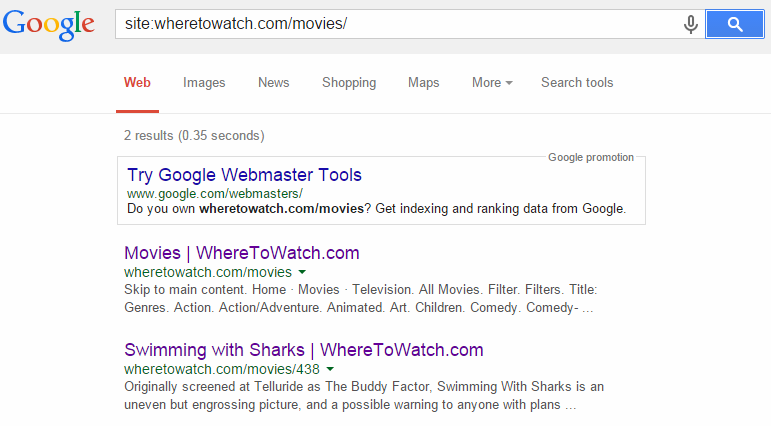
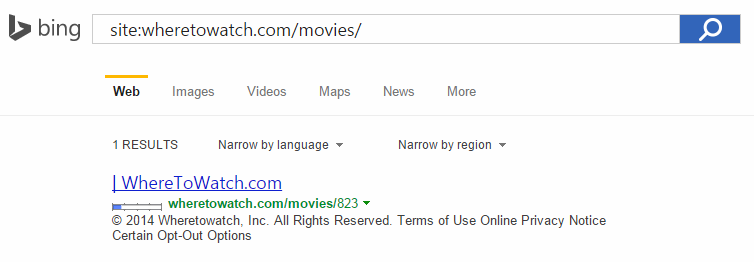
For example, if Google visits the movie overview page all links to individual pages are hidden by Javascript, and the search engine only sees this. As a result, movie and TV-show pages in the MPAA’s legal platform are invisible to Google.

Google currently indexes only one movie page, which was most likely indexed through an external link. With Bing the problem is just as bad.

wtw-google

It’s worth noting that WhereToWatch doesn’t block search engines from spidering its content through the robots.txt file. It’s just the coding that makes it impossible for search engines to navigate and index the site.

This is a pretty big mistake, considering that the MPAA repeatedly hammered on Google to feature more legal content. With some proper search engine optimization (SEO) advice they can probably fix the problem in the near future.

Previously Google already offered SEO tips to copyright holders, but it’s obvious that the search engine wasn’t consulted in this project.

To help the MPAA on its way we asked isoHunt founder Gary Fung for some input. Last year Fung lost his case to the MPAA, forcing him to shut down the site, but he was glad to offer assistance nonetheless.

“I suggest MPAA optimize for search engine keywords such as ‘download ‘ and ‘torrent ‘. For some reason when people google for movies, that’s what they actually search for,” Fung tells us.

A pretty clever idea indeed, as the MPAA’s own research shows that pirate-related search terms are often used to “breed” new pirates.

Perhaps it’s an idea for the MPAA to hire Fung or other “industry” experts for some more advice. Or better still, just look at how the popular pirate sites have optimized their sites to do well in search engines, and steal their work.

Source: TorrentFreak, for the latest info on copyright, file-sharing and anonymous VPN services.

Torrentfreak: “Swedes Prepare Record File-Sharing Prosecution” plus 1 more

TorrentFreak

Torrentfreak: “Swedes Prepare Record File-Sharing Prosecution” plus 1 more


Swedes Prepare Record File-Sharing Prosecution

Posted: 22 Nov 2014 01:27 AM PST

serversFollowing a lengthy investigation by anti-piracy group AntipiratbyrÃ¥n, in 2010 police raided a “warez scene” topsite known as Devil. Dozens of servers were seized containing an estimated 250 terabytes of pirate content.

One man was arrested and earlier this year was eventually charged with unlawfully making content available "intentionally or by gross negligence.”

Police say that the man acted "in consultation or concert with other persons, supplied, installed, programmed, maintained, funded and otherwise administered and managed" the file-sharing network from where the infringements were carried out. It’s claimed that the Devil topsite had around 200 members.

All told the man is accused of illegally making available 2,250 mainly Hollywood movies, a record amount according to the prosecutor.

“We have not prosecuted for this many movies in the past. There are many movies and large data set,” says prosecutor Fredrik Ingblad. “It is also the largest analysis of computers ever made in an individual case.”

Few details have been made available on the case but it’s now been revealed that AntipiratbyrÃ¥n managed to trace the main Devil server back to the data center of a Stockholm-based electronics company. The site’s alleged operator, a man from Väsbybo in his 50s and employee of the company, reportedly admitted being in control of the server.

While it would likely have been the intention of Devil’s operator for the content on the site to remain private, leaks inevitably occurred. Predictably some of that material ended up on public torrent sites, an aggravating factor according to AntipiratbyrÃ¥n lawyer Henrik Pontén.

“This is a very big issue and it is this type of crime that is the basis for all illegal file sharing. The films available on Pirate Bay circulate from these smaller networks,” Pontén says.

The big question now concerns potential damages. Pontén says that the six main studios behind the case could demand between $673,400 and $2.69m per movie. Multiply that by 2,250 and that’s an astonishing amount, but the lawyer says that in order not to burden the justice system, a few titles could be selected.

Henrik Olsson Lilja, a lawyer representing the defendant, declined to comment in detail but criticized the potential for high damages.

“I want to wait for the trial, but there was no intent in the sense that the prosecutor is looking for,” Lilja told Mitte.se. “In practice, these are American-style punitive damages.”

Source: TorrentFreak, for the latest info on copyright, file-sharing and anonymous VPN services.

U.S. Copyright Alert System Security Could Be Improved, Review Finds

Posted: 21 Nov 2014 09:45 AM PST

spyFebruary last year the MPAA, RIAA and five major Internet providers in the United States launched their "six strikes" anti-piracy plan.

The Copyright Alert System's main goal is to inform subscribers that their Internet connections are being used to share copyrighted material without permission. These alerts start out friendly in tone, but repeat infringers face a temporary disconnection from the Internet or other mitigation measures.

The evidence behind the accusations is provided by MarkMonitor, which monitors BitTorrent users’ activities on copyright holders’ behalf. The overseeing Center for Copyright Information (CCI) previously hired an impartial and independent technology expert to review the system, hoping to gain trust from the public.

Their first pick, Stroz Friedberg, turned out to be not that impartial as the company previously worked as RIAA lobbyists. To correct this unfortunate choice, CCI assigned Professor Avi Rubin of Harbor Labs to re-examine the system.

This week CCI informed us that a summary of Harbor Labs’s findings is now available to the public. The full review is not being published due to the vast amount of confidential information it contains, but the overview of the findings does provide some interesting details.

Overall, Harbor Labs concludes that the evidence gathering system is solid and that false positives, cases where innocent subscribers are accused, are reasonably minimized.

“We conclude, based on our review, that the MarkMonitor AntiPiracy system is designed to ensure that there are no false positives under reasonable and realistic assumptions. Moreover, the system produces thorough case data for alleged infringement tracking.”

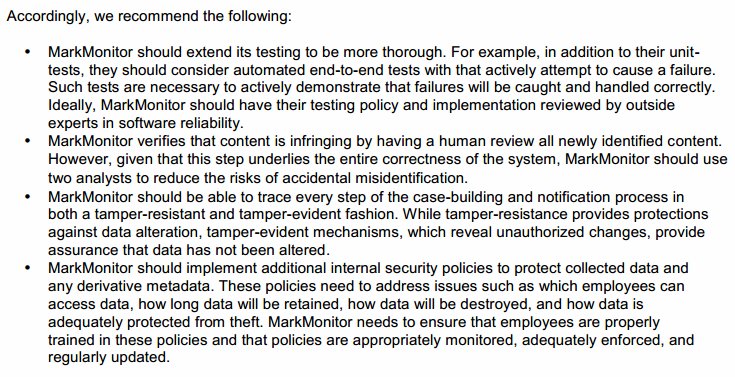
However, there is some room for improvement. For example, MarkMonitor could implement additional testing to ensure that false positives and human errors are indeed caught.

“… we believe that the system would benefit from additional testing and that the existing structure leaves open the potential for preventable failures. Additionally, we recommend that certain elements of operational security be enhanced,” Harbor Labs writes.

In addition, the collected evidence may need further protections to ensure that it can’t be tampered with or fall into the wrong hands.

“… we believe that this collected evidence and other potentially sensitive data is not adequately controlled. While MarkMonitor does protect the data from outside parties, its protection against inside threats (e.g., potential rogue employees) is minimal in terms of both policy and technical enforcement.”

The full recommendations as detailed in the report are as follows:

recommendations

The CCI is happy with the new results, which they say confirm the findings of the earlier Stroz Friedberg review.

"The Harbor Labs report reaffirms the findings from our first report – conducted by Stroz Friedberg – that the CAS is well designed and functioning as we hoped,” CCI informs TF.

In the months to come the operators of the Copyright Alert System will continue to work with copyright holders to make further enhancements and modifications to their processes.

“As the CAS exits the initial ramp-up period, CCI has been assured by our content owners that they have taken all recommendations made within both reports into account and are continuing to focus on maintaining the robust system that minimizes false positives and protects customer security and privacy,” CCI adds.

Meanwhile, they will continue to alert Internet subscribers to possible infringements. After nearly two years copyright holders have warned several million users, hoping to convert then to legal alternatives.

Thus far there's no evidence that Copyright Alerts have had a significant impact on piracy rates. However, the voluntary agreement model is being widely embraced by various stakeholders and similar schemes are in the making in both the UK and Australia.

Source: TorrentFreak, for the latest info on copyright, file-sharing and anonymous VPN services.

Torrentfreak: “BitTorrent Users are Avid, Eclectic Content Buyers, Survey Finds” plus 2 more

Torrentfreak: “BitTorrent Users are Avid, Eclectic Content Buyers, Survey Finds” plus 2 more


BitTorrent Users are Avid, Eclectic Content Buyers, Survey Finds

Posted: 21 Nov 2014 01:23 AM PST

Each month 150-170 million Internet users share files using the BitTorrent protocol, a massive audience by most standards. The common perception is that these people are only interested in obtaining content for free.

However, studies have found that file-sharers are often more engaged than the average consumer, as much was admitted by the RIAA back in 2012. There’s little doubt that within those millions of sharers lie people spending plenty of money on content and entertainment.

To get a closer look, in September BitTorrent Inc. conducted a survey among a sample of its users. In all, 2,500 people responded and now the company has published the results. The figures aren’t broken down into age groups, but BitTorrent Inc. informs TF that BitTorrent users trend towards young and male.

Music

From its survey the company found that 50% of respondents buy music each month, with a sway towards albums rather than singles (44% v 32%). BitTorrent users are reported as 170% more likely to have paid for a digital music download in the past six months than Joe Public.

Citing figures from the RIAA, BitTorrent Inc. says its users are also 8x more likely than the average Internet user to pay for a streaming music service, with 16% of BitTorrent users and 2% of the general public holding such an account.

Perhaps a little unexpectedly, supposedly tech-savvy torrent users are still buying CDs and vinyl, with 45% and 10% respectively reporting a purchase in the past 12 months. BitTorrent Inc. says that the latter represents users “engaging and unpacking art as a multimedia object”, a clear reference to how the company perceives its BitTorrent Bundles.

On average, BitTorrent Inc. says its user base spends $48 a year on music, with 31% spending more than $100 annually.

bit-music

Movies

When it comes to movies, 47% of respondents said they’d paid for a theater ticket in the preceding 12 months, up on the 38% who purchased a DVD or Blu-ray disc during the same period.

Users with active movie streaming accounts and those making digital movie purchases tied at 23%, with DVD rental (22%) and digital rental (16%) bringing up the rear.

All told, BitTorrent Inc. says that 52% of respondents buy movies on a monthly basis with the average annual spend amounting to $54. More than a third say they spend in excess of $100.

bit-movie

So do the results of the survey suggest that BitTorrent Inc.’s users have a lot to offer the market and if so, what?

“The results confirm what we knew already, that our users are super fans. They are consumers of content and are eager to reward artists for their work,” Christian Averill, BitTorrent Inc.’s Director of Communications, told TF.

“BitTorrent Bundle was started based on this premise and we have more than 10,000 artists now signed up, with more to come. With 90% of purchase going to the content creators, BitTorrent Bundle is the most artist friendly, direct-to-fan distribution platform on the market.”

It seems likely that promoting and shifting Bundles was a major motivator for BitTorrent Inc. to carry out the survey and by showing that torrent users aren’t shy to part with their cash, more artists like Thom Yorke will hopefully be prepared to engage with BitTorrent Inc.’s fanbase.

Also of note is the way BitTorrent Inc. is trying to position that fanbase or, indeed, how that fanbase has positioned itself. While rock (20%), electronic (15%) and pop (13%) took the top spots in terms of genre popularity among users, 23% described their tastes as a vague “other”. Overall, 61% of respondents described their musical tastes as “eclectic”.

“[Our] users are engaged in the creative community and they have diverse taste. They also do not define themselves by traditional genres. We feel this is a true representation about how fans view themselves universally these days. They are eclectic,” Averill concludes.

While monetizing content remains a key focus for BitTorrent Inc., the company is also making strides towards monetizing its distribution tools. Last evening uTorrent Plus was replaced by uTorrent Pro (Windows), an upgraded client offering torrent streaming, an inbuilt player, video file converter and anti-virus features. The ad-free client (more details here) is available for $19.95 per year.

Source: TorrentFreak, for the latest info on copyright, file-sharing and anonymous VPN services.

Torrents Good For a Third of all Internet Traffic in Asia-Pacific

Posted: 20 Nov 2014 12:56 PM PST

download-keyboardOver the years we have been following various reports on changes in Internet traffic, specifically in relation to torrents.

One of the patterns that emerged with the rise of video streaming services is that BitTorrent is losing its share of total Internet traffic, in North America at least, where good legal services are available.

This downward spiral is confirmed by the latest report from Sandvine which reveals that torrent traffic is now responsible for ‘only’ 5% of all U.S. Internet traffic in North America during peak hours, compared to 10.3% last year.

In other countries, however, this decrease is not clearly visible. In Europe, for example, the percentage of Internet traffic during peak hours has remained stable over the past two years at roughly 15%, while absolute traffic increased during the same period.

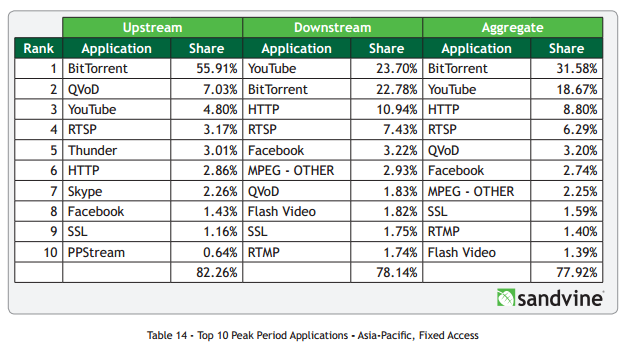
In Asia-Pacific BitTorrent traffic there’s yet another trend. Here, torrents are booming with BitTorrent traffic increasing more than 50% over the past year.

asia-pacific

According to Sandvine torrents now account for 32% of all traffic during peak hours, up from 21%. Since overall traffic use also increased during the same period, absolute traffic has more than doubled.

Looking at upstream data alone torrents are good for more than 55% of all traffic during peak hours.

One of the countries where unauthorized BitTorrent usage has been growing in recent years is Australia, which has one of the highest piracy rates in the world.

There are several reasons why torrents are growing in popularity, but the lack of good legal alternatives is expected to play an important role. It’s often hard or expensive to get access to the latest movies and TV-shows in this region.

It will be interesting to see whether this trend will reverse during the coming years as more legal services come online. Netflix’ arrival in Australia next year, for example, is bound to shake things up.

Source: TorrentFreak, for the latest info on copyright, file-sharing and anonymous VPN services.

BitTorrent Preps Sync Pro to Take on the Cloud

Posted: 20 Nov 2014 08:11 AM PST

Sharing files across multiple devices used to be laborious and time-consuming affair but with the advent of services such as Dropbox the practice has become a breeze.

However, while many users remain unconcerned that third-party companies offering ‘cloud storage’ have control of their files, the revelations of Edward Snowden have undoubtedly increased fear of government snooping. With their new product ‘Sync’ in alpha, this data security loophole was pounced upon last year by BitTorrent Inc.

Released in early 2013, BitTorrent Sync is a tool that allows users to securely sync folders across multiple devices using the BitTorrent protocol. In terms of functionality it can be compared to any number of cloud-based services but with one key exception – Sync does not store data in the cloud but does so on users’ devices instead.

The software has now reached version 1.4 and the take-up has been impressive. During August, BitTorrent Inc. confirmed that there had been 10 million user installs transferring over 80 Petabytes of data between them.

Now the company is preparing to debut Sync 2.0 with greater functionality and flexibility while maintaining the privacy of its users. For the first time it will be made available in two editions, ‘free’ and ‘pro’. So what’s the difference?

“Sync 2.0 free will be an improvement from 1.4 and there won’t be any limits on performance or size of individual folders,” BitTorrent Inc.’s Christian Averill informs TorrentFreak.

“Pro users simply get premium functionality, catered specifically to individuals with large data needs and business workgroups.”

Sync 2.0 Free Edition
● Feature improvements, to enhance sharing and syncing folders
● Updated UI across platforms, new tablet apps on Android/iOS
● General performance improvements and bug fixes
● 30-day trial period for Sync Pro
● No restrictions on performance or individual folder sizes.

Sync 2.0 Pro Edition
● Access to very large folders (TBs): allows for on-demand access to individual files
● Control over folder permissions and ownership (see image below)
● Automatic synchronization across devices: all your devices are tied via a common identity; moves the relationship from device-to-device to person-to-person
● Priority technical support

sync-pro

BitTorrent Inc. believes that Sync 2.0 trumps services like Dropbox, Google Drive and OneDrive on a number of fronts. Sync 2.0 places no file-size restrictions on users versus a 1TB limit for rivals. Files are also synced more quickly, up to 16X, since Sync does not rely on uploads to the cloud.

Finally, in addition to enhanced security Sync 2.0 aims to offer better value for money too. The ‘free’ edition is just that and the ‘pro’ version costs $39.99. Competitors Dropbox, Google Drive, and Microsoft OneDrive charge upwards of $83.99 for comparable services.

No firm release data has been announced for Sync 2.0 but those interested in becoming an early adopter can do so here.

Source: TorrentFreak, for the latest info on copyright, file-sharing and anonymous VPN services.

Torrentfreak: “U.S. Brands Kim Dotcom a Fugitive, ‘Spies’ on Others” plus 2 more

Torrentfreak: “U.S. Brands Kim Dotcom a Fugitive, ‘Spies’ on Others” plus 2 more


U.S. Brands Kim Dotcom a Fugitive, ‘Spies’ on Others

Posted: 20 Nov 2014 02:32 AM PST

megaupload-logoIt’s been nearly three years since Megaupload was taken down by the U.S. authorities but it’s still uncertain whether Kim Dotcom and his fellow defendants will be extradited overseas.

Two months ago the U.S. Government launched a separate civil action in which it asked the court to forfeit the bank accounts, cars and other seized possessions of the Megaupload defendants, claiming they were obtained through copyright and money laundering crimes.

Megaupload responded to these allegations at the federal court in Virginia with a motion to dismiss the complaint. According to Megaupload's lawyers the U.S. Department of Justice (DoJ) is making up crimes that don't exist.

In addition, Dotcom and his co-defendants claimed ownership of the assets U.S. authorities are trying to get their hands on. A few days ago the DoJ responded to these claims, arguing that they should be struck from the record as Dotcom and his colleagues are fugitives.

In a motion (pdf) submitted to a Virginia District Court the U.S. asks for the claims of the defendants to be disregarded based on the doctrine of fugitive disentitlement.

“Claimants Bram van der Kolk, Finn Batato, Julius Bencko, Kim Dotcom, Mathias Ortmann, and Sven Echternach, are deliberately avoiding prosecution by declining to enter the United States where the criminal case is pending,” U.S. Attorney Dana Boente writes.

“The key issue in determining whether a person is a fugitive from justice is that person's intent. A defendant who flees with intent to avoid arrest is a fugitive from justice,” he adds.

Since Kim Dotcom and his New Zealand-based Megaupload colleagues are actively fighting their extradition they should be seen as fugitives, the DoJ concludes.

“Those claimants who are fighting extradition on the criminal charges in the related criminal case, claimants van der Kolk, Batato, Kim Dotcom, and Ortmann, are fugitives within the meaning of the statute, regardless of the reason for their opposition.”

Megaupload lawyer Ira Rothken disagrees with this line of reasoning. He told TF that the fugitive disentitlement doctrine shouldn’t apply here.

"The DOJ is trying to win the Megaupload case on procedure rather than the merits. Most people don’t realize that Kim Dotcom has never been to the United States,” Rothken says.

A person who has never been to the United States and is currently going through a lawful procedure in New Zealand shouldn’t be seen as a fugitive, according to Rothken.

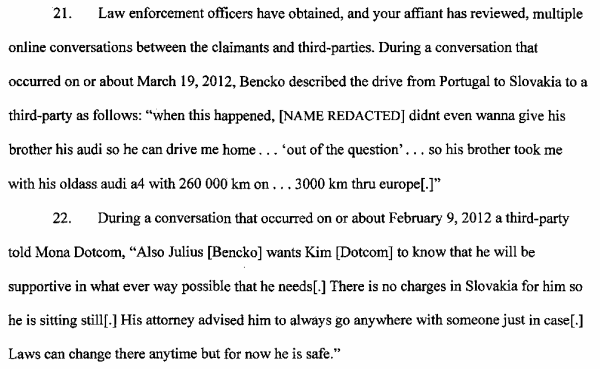
The recent DoJ filing also highlights another aspect of the case. According to a declaration by special FBI agent Rodney Hays, the feds have obtained “online conversations” of Julius Bencko and Sven Echternach, the two defendants who currently reside in Europe.

These conversations were obtained by law enforcement officers and show that the authorities were ‘spying’ on some of the defendants months after Megaupload was raided.

tapped

“During a conversation that occurred on or about March 28, 2012, Bencko allegedly told a third-party, ‘I can come to Bratislava [Slovakia] if needed .. bu [sic] you know .. rather not travel around much .. ‘ Later in the conversation, Bencko states ‘i’m facing 55 years in usa’,” the declaration reads.

In addition to the two defendants, law enforcement also obtained a conversation of Kim’s wife Mona Dotcom, who is not a party in the case herself.

“During a conversation that occurred on or about February 9, 2012 a third-party told Mona Dotcom, ‘Also Julius [Bencko] wants Kim [Dotcom] to know that he will be supportive in what ever way possible that he needs’,”

According to the U.S. the ‘tapped’ conversations of Bencko and Echternach show that since they are avoiding travel to the United States, they too can be labeled fugitives.

It’s unclear how the online conversations were obtained, but Megaupload lawyer Ira Rothken told TF that he wouldn’t be surprised if civil liberties were violated in the process, as has happened before in the case.

Whether these fugitive arguments will be accepted by the court has yet to be seen. Highlighting the motion Megaupload submitted earlier, Rothken notes that regardless of these arguments the case should be dismissed because the court lacks jurisdiction.

“The United States doesn’t have a stature for criminal copyright infringement,” Rothken tells us. “We believe that the case should be dismissed based on a lack of subject matter jurisdiction.”

Source: TorrentFreak, for the latest info on copyright, file-sharing and anonymous VPN services.

Court: $30,000 for Sharing a Pirated Movie is Excessive Punishment

Posted: 19 Nov 2014 01:30 PM PST

cashOver the past several years hundreds of thousands of Internet subscribers have been sued in the United States for allegedly sharing copyrighted material, mostly films, online.

The goal of these lawsuits is to encourage alleged downloader to settle, and in some cases copyright holders continue proceedings against the defendants after being identified by their ISPs.

If the alleged pirates then fail to respond, the rightsholder can ask the court for a default judgment, where they usually get their way.

This also happened in lawsuits brought by the makers of the independent films Elf-Man and The Thompsons. In both cases the copyright holders asked the court for a default judgment of $30,000 for sharing a single film.

With 11 defendants, including one couple who would share the fine, the potential damage award amounted to a massive $300,000. The copyright holders argued that this is justified since they suffered significant losses as a result, but the court disagreed.

In related orders U.S. District Court Judge Thomas Rice notes that a $30,000 punishment per shared film is excessive, considering the evidence that was presented.

“This Court finds the evidence in this case, which merely shows that each Defendant copied and published via BitTorrent Plaintiff's motion picture––the cost of which to rent or purchase was less than $20––rather than distributed for commercial resale, does not support a $30,000 penalty for each Defendant,” Judge Rice writes.

In his order the Judge refers to the Eighth Amendment which prohibits excessive fines as well as cruel and unusual punishments. In this case the requested damages are unconstitutional as they’re seen as excessive in relation to the nature of the offense.

“This Court finds an award of $30,000 for each defendant would be an excessive punishment considering the seriousness of each Defendant's conduct and
the sum of money at issue,” the order reads.

The filmmakers argued that the pirated downloads threaten the financing of future films and that high damages could serve as a deterrent. Judge Rice, however, was not convinced and set these arguments aside.

“… this Court is unpersuaded that the remote damages––’downstream revenue’ and destroyed plans for a sequel due, in part, to piracy––justify an award of $30,000 per defendant, even in light of the statute's goal of deterrence.”

Judge Rice opted to award the minimum in statutory damages instead, which is $750 per film. In addition, he awarded $2,225 in attorney fees per defendant, which brings the total to a little under $3,000.

This is not the first time that the Eighth Amendment has been raised in a file-sharing case. The same argument was used to lower the damages award in RIAA’s case against Jammie Thomas, although this was overturned on appeal.

Source: TorrentFreak, for the latest info on copyright, file-sharing and anonymous VPN services.

Artists and Labels Now Sue Chrysler Over CD-Ripping Cars

Posted: 19 Nov 2014 07:59 AM PST

ripping-carToward the end of the last century record labels feared that home taping would kill the music industry.

To counter the threat cassette tape recorders posed at the time, they asked Congress to take action.

This eventually resulted in the Audio Home Recording Act (AHRA) of 1992. Under this law importers and manufacturers must pay royalties on "digital audio recording devices," among other things.

The legislation is still in play today. Instead of targeting cassette recorders, however, the threats are now other copying devices. According to the Alliance of Artists and Recording Companies, this includes media entertainment systems that are built into many cars.

This week the music group, which lists major record labels and 300,000 artists among its members, sued Chrysler and its technology partner Mitsubishi (pdf) for failing to pay royalties.

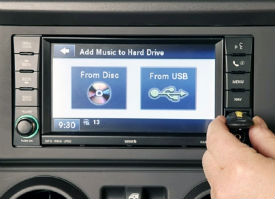
The dispute revolves around Chrysler’s media entertainment systems including "MyGIG" and "Uconnect Media Center" which allow car owners to rip CDs to a hard drive.

“These devices are covered by the AHRA, but the defendants have refused to pay royalties on them or include the required serial copy protections,” AARC Executive Director Linda Bocchi comments.

The music group reached out to Chrysler and Mitsubishi hoping to settle the issue, but these talks failed. As a result AARC saw no other option than to take the case to court.

“We had hoped Chrysler and the Mitsubishi Electric companies would settle their liability and begin paying what they owe once they had an opportunity to study and assess the issues,” Bocchi says.

“But it has now become painfully clear they have no intention of complying with the law. While litigation is always a last resort, it is clear this lawsuit is the only way to protect our members' rights.”

The current lawsuit follows an earlier case against Ford and General Motors, which is still ongoing.

In both cases artists and record labels are looking for statutory damages, which could amount to hundreds of millions of dollars. In addition, they want to prevent the manufacturers from selling these unauthorized devices in their cars.

Ford has already filed a motion to dismiss arguing that AHRA doesn’t apply to their systems, and the other defendants including Chrysler are likely to do the same. Whose side the court will agree with is expected to become clear in the months to come.

Source: TorrentFreak, for the latest info on copyright, file-sharing and anonymous VPN services.