http://AccessPirateBay.com- PirateBay's Newest Domain Feb 2014

TorrentFreak Email Update

TorrentFreak Email Update


Aussie Govt. To Consider Site Blocking, File-Sharing Warnings

Posted: 05 May 2014 12:48 AM PDT

pirate-runningFor years Australia has wrestled with the thorny issue of online piracy. Citizens have long complained of being treated as second class consumers, in many cases having to wait months or years for new content from the United States to appear Down Under. This has only fueled the uptake of illegal file-sharing.

While there are signs that plans for improved availability of content might be developing, impatient entertainment companies want action now, and talks with ISPs have failed to show significant progress.

The threat that the government could get involved if voluntary agreements can not be reached has always loomed in the background, and now it seems that the government is getting ready to act. According to Fairfax (subscription), as early as this week the federal cabinet will consider two proposals to crack down on illegal file-sharing.

The first proposal, of sending letters to those found infringing copyright online, will already be familiar to Internet users in the United States, France, New Zealand, Taiwan and South Korea. The idea is that persistent infringers receive subsequent and increasingly threatening letters in order to deter future offending but there is still debate whether such mechanisms are effective.

It will perhaps come as no surprise that the second discussion will center on the blocking or censoring of so-called ‘pirate’ sites by local ISPs, with the effect that their subscribers can no longer access them.

Andrew Maiden, CEO of ASTRA, the industry body for subscription TV, told Mumbrella that the legislative changes required to effect the above could be brought in as early as mid or late June this year.

"They have already made commitments to take action against piracy so I would think they would want to act sooner rather than later," Maiden said.

While there are few details on the proposed letter-writing scheme, entertainment companies will be hoping that there will be consequences for those who fail to heed advice to stop downloading and sharing copyrighted material. At this stage, however, no punitive measures are being reported for the Aussie scheme.

But even before letter writing begins, there are complex issues for the government to overcome. In the past talks between movie and music companies and Aussie ISPs have deadlocked over, among other things, who should pay for such a program. There are no signs that the parties have reached consensus on this or any other matter.

On site blocking, it is expected that entertainment companies will be allowed to go to court to obtain injunctions against sites such as The Pirate Bay, which will compel local ISPs to block the sites. This same strategy is being used in several countries in Europe, notably the UK, although not in the United States where many of the entertainment companies are based.

blocktpb1However, the big difference with Australia is that as a result of content being made available elsewhere first, Aussie citizens have already become adept at using VPN and proxy services to access legal services such as Netflix. The exact same techniques can be used to access a blocked Pirate Bay, for example.

With the Australian government having previously promised to make “significant” changes to Australia's copyright laws, the movie and music industries will be hoping that 2014 turns out to be a productive year. In the meantime, companies such as Google will continue to remind the Australian government that piracy is a pricing and availability problem.

Source: TorrentFreak, for the latest info on copyright, file-sharing and anonymous VPN services.

Top 10 Most Pirated Movies of The Week – 05/05/14

Posted: 05 May 2014 12:48 AM PDT

robocopThis week we have five newcomers in our chart.

RoboCop is the most downloaded movie this week.

The data for our weekly download chart is estimated by TorrentFreak, and is for informational and educational reference only. All the movies in the list are BD/DVDrips unless stated otherwise.

RSS feed for the weekly movie download chart.

Ranking (last week) Movie IMDb Rating / Trailer
torrentfreak.com
1 (…) RoboCop 6.5 / trailer
2 (1) Captain America: The Winter Soldier (Cam/TS) 8.3 / trailer
3 (…) Pompeii 6.0 / trailer
4 (…) The Monuments Men 6.2 / trailer
5 (3) Vampire Academy 6.3 / trailer
6 (2) That Awkward Moment 6.2 / trailer
7 (…) I Frankenstein 5.2 / trailer
8 (7) Rio 2 (HDTS) 6.8 / trailer
9 (…) About Last Night 6.2 / trailer
10 (6) Her 8.2 / trailer

Source: TorrentFreak, for the latest info on copyright, file-sharing and anonymous VPN services.

How To Crack The Facade In Any Copyright Monopoly Discussion

Posted: 04 May 2014 12:37 PM PDT

copyright-brandedIn my last column, I explained how the copyright monopoly is fundamentally incompatible with private communications as a concept, and how we must weigh a silly distribution monopoly for one of many entertainment industries against such vital functions of society as whistleblower protection, freedom of the press, and the ability to hold a private conversation in the first place. While this argument is strong, it does require a bit of intelligence and the ability to see how two ideas conflict, so it can be hard to get across to copyright monopoly pundits.

The threat against private communications isn’t the only thing wrong with the copyright monopoly, of course. I have previously argued here on TorrentFreak that there’s really nothing defensible about the monopoly at all. But in order to break the spell of “publishers have always told me that the copyright monopoly is good and I have never had any reason to question their self-interest in the matter”, there are other tricks of honest, effective argumentation.

While it’s possible to attack the copyright monopoly construct from many angles – all of them, in fact – some fruit is more low-hanging than others. One easy angle is to point at the usual (horrible) motivation of the copyright monopoly; that it “enables creators to make money” (which is factually false, misleading, and dishonest). If you’re talking to a monopoly pundit, or just somebody who hasn’t had reason to question the monopoly, this point will come up sooner or later.

Once this point comes up, it’s an open goal. To make sure you understood the point correctly, reiterate back; “So your point is that they should be rewarded with a monopoly to make money, in order to give them an incentive to create more art?” Any monopoly pundit will nod enthusiastically.

Then, score the goal. “So why does the monopoly last 70 years after the author’s death? I don’t know of a single author who keeps writing books after they’re dead and buried. The copyright monopoly term is at least 70 years – a whole lifetime – too long. And if it is that obviously 70 years too long, then it’s absurd in the first place.”

Occasionally, you’ll see some fightback that their children and grandchildren and great-grandchildren should inherit the privileges of the author, which you can easily refute by pointing out that the purpose was already agreed to be an incentive for the artist to create more art, not for their children to get privileged at the expense of others.

Once you have established that the copyright monopoly term is indefensively long – at least a lifetime too long – then the facade of pretend perfection is broken. If something as fundamental as that can be questioned, and it can, then everything else is also up in the air.

Have fun making the pennies drop and the facades crack.

About The Author

Rick Falkvinge is a regular columnist on TorrentFreak, sharing his thoughts every other week. He is the founder of the Swedish and first Pirate Party, a whisky aficionado, and a low-altitude motorcycle pilot. His blog at falkvinge.net focuses on information policy.

Book Falkvinge as speaker?

Source: TorrentFreak, for the latest info on copyright, file-sharing and anonymous VPN services.

TorrentFreak Email Update

TorrentFreak Email Update


‘Skidrow’ Pirates Get Pirated After Removing Their Own ‘DRM’

Posted: 04 May 2014 03:30 AM PDT

warezIt’s very common for the entertainment industries to get their collective undergarments in a twist over piracy, so it makes an interesting change to see the same kinds of emotions spill over onto the other side of the piracy fence.

It all began a couple of weeks ago with the release of the Redlynx / Ubisoft motorcross game Trials Fusion. Released on all the top platforms mid April, the race was immediately on for a so-called ‘Scene’ group to remove its copy protection and release a pirated version. On April 16 the group ‘MoNGoLS’ released the game on XBox 360 and eight days later a group called ‘CODEX’ released the Windows version.

Scene records show that CODEX have only been around since February this year yet they managed to beat other leading groups on this particular release. Was that due to them being clever and working hard, or was there another explanation? According to one of the most famous cracking/piracy groups on the Internet, CODEX cheated their way to the win.

Skidrow is one of the most famous groups around and is responsible for the cracking and release of hundreds of games over the years. On April 27, three days after the CODEX release of Trials Fusion, Skidrow released their own version. Then, the day after, revealed why that had been necessary.

According to Skidrow, CODEX had – shock, horror – PIRATED Skidrow’s work.

“While looking inside their emulation code, we discovered something that was about to shock us completely,” Skidrow explained in an announcement this week.

“It was OUR work, OUR emulator.”

But how could Skidrow be so sure? Apparently the group employs rudimentary watermarking.

“CODEX must be stupid to think that we don’t mark our code, but we had it clean on our screens, that CODEX are thieves of our Ubisoft emu. 99 percent of all their API calls in the code are identical with ours.”

Just to be sure, Skidrow say they also plant “several stealth API calls, that identify and tag” their work. Those were apparently found inside CODEX emulation DLLs. For those who understand it, the proof is apparently revealed in the image below.

CODEX

“[The image] shows the original function written by the coder, using a global variable for another function. Basically, the way the coder wrote the API to set the flag is unique, and [this is] simply copy and paste of our code by CODEX,” Skidrow say.

But while the irony of one group complaining about the pirating (or plagiarizing) of another’s work is pretty obvious, this week Skidrow revealed something else of interest. The group said that while previously it had taken measures to protect its cracks and emulators and obfuscate their code, it had decided to stop doing so when the code got in the way of enjoying the release.

“In the past we used to protect our creations, but lately we have found out that even the most functional [encryption] tools have certain limits when it comes to preventing them from stealing CPU resources,” Skidrow revealed.

“Furthermore we have noticed that some people that use our releases, sometimes have issues with our work being notified as dangerous, when they run them on machines with certain antivirus, spam, spyware programs etc. Therefore we have decided to let our work, which is OUR work, be as clean and direct as you can get it.”

So there you have it. Even the swarthiest of game pirates get upset when people “steal” their code, and not even leading experts in consumer DRM cracking can get their own ‘DRM’ working without negatively affecting the gaming experience. Intriguing indeed…..

Note: For clarity some of Skidrow’s English translation errors have been tidied up.

Source: TorrentFreak, for the latest info on copyright, file-sharing and anonymous VPN services.

Accused Pirate Slams BitTorrent Tracking Outfit in Court

Posted: 03 May 2014 11:19 AM PDT

elf-manMass-piracy lawsuits have been dragging on for years in the US, involving hundreds of thousands of alleged downloaders.

All of these cases are initiated with an IP address as the main piece of evidence. This address is usually collected by a file-sharing monitoring company using software to connect to the BitTorrent swarm where the infringing files are shared.

A common problem with this evidence is that it generally can't identify a movie pirate. In fact, some evidence gathering techniques are so sloppy that it’s not even possible to confirm whether the ISP account connected to the IP-address was actively sharing the pirated file in question.

This issue has also been brought to the attention of the court in the ongoing case between the “Elf-Man” movie studio and Ryan Lamberson. The counsel of Lamberson has been trying to get more information on how the “investigators” gathered their evidence, but thus far without result.

This week the attorney submitted a motion to compel, hoping that the court would order the movie studio to have the German-based Michael Patzer and Daniel Macek testify in Spokane, Washington, so they can answer crucial questions about evidence collection.

Among other things, the defendant would like to know how the tracking outfit can be so sure that the IP-address wasn’t spoofed, and how they know that the defendant was the one who used the IP-address to share the film. The defendant’s attorneys doubt that the tracking software is capable of doing this.

“Apparently, Mr. Patzer’s software does not account for the numerous ‘false positive’ possibilities, including the accuracy of the harvested IP addresses, even though the person in the swarm may be ‘spoofing’ his or her IP address, since certain bit torrent software allows for IP address spoofing,” defendant’s attorneys write.

“Apparently, the software has no way to verify the actual person who might be in the swarm, even if the IP address is accurate. The software does not engage the person in the swarm to inquire as to the reason for the activity, including fair use reasons for being in the swarm. Indeed, there are no corroborating witnesses at all…”

In addition, the defendant’s legal team doubts that the “investigators,” who are closely involved with numerous lawsuits in the United States, have a proper license.

“The investigators are engaged in activity which is covered by the Washington State Private Investigator statutory provisions, but there is no evidence that Messrs. Patzer or Macek are licensed or bonded [under theState's regulatory scheme governing private investigators],” they write.

The Washington State legislature defines a “private investigator agency” as an entity “engaged in the business of detecting, discovering, or revealing” “evidence to be used before a court,” which appears to be exactly what they are doing.

It wouldn’t be the first time that the PI angle has caused trouble for a file-sharing monitoring firm. Several years ago the RIAA’s technology partner MediaSentry was found to have acted illegally in several states because it operated without the appropriate and required paperwork.

It will be interesting to see how this angle is played out in the current case. Generally speaking these tracking outfits, which are often the main drivers of these types of lawsuits, are not too eager to talk.

Whether they have something to hide remains to be seen. A recent presentation from the “Anti-Piracy Management Company,” which is believed to be spinoff of the same tracking outfit Michael Patzer and Daniel Macek are connected to, is telling.

“Paragraph 2 in regards to software consultant (i.e., he can talk about software issues), & we’re hoping the judge won’t question his qualifications too much,” the leaked presentation reads, seemingly referring to Macek.

To be continued.

Source: TorrentFreak, for the latest info on copyright, file-sharing and anonymous VPN services.

TorrentFreak Email Update

TorrentFreak Email Update


Pirate Bay Blockade Dismissed By Icelandic Supreme Court

Posted: 03 May 2014 02:31 AM PDT

Following in the footsteps of copyright groups around Europe, last year representatives of the music and movie industry in Iceland decided to take action against The Pirate Bay.

Several copyright groups, including the local RIAA equivalent ‘STEF’ and MPAA equivalent ‘SMAIS’, filed a complaint with the police last October. Their aim was to obtain an injunction compelling local Internet service providers to block not only TPB, but also the largest Iceland-focused private BitTorrent tracker, Deildu.net.

"Blocking access to websites that offer a wide range of entertainment without permission of the copyright holders has been proven effective in neighboring countries, and has a strong foundation in EU legislation," the groups said.

The request for an injunction, filed by four entertainment industry groups against five local ISPs including Vodafone, was initially rejected by a Reykjavík magistrate. As a result the case ended up in the District Court of Reykjavik in March but was dismissed when the Court decided that only music group STEF had the rights to claim injunctive relief.

The case was appealed to the Supreme Court which handed down its decision this week. Affirming the decision of the District Court, the Supreme Court highlighted problems in two key areas.

Firstly, it appears that once the district magistrate rejected the original blocking request, the matter should have been referred to the District Court within a week. It took the entertainment groups twelve days, well outside the requirements prescribed by law.

Furthermore, while the complaint was filed in the names of four organizations, only one was recognized by the Supreme Court as having the right to bring this kind of complaint. While it was agreed that music group STEF has lawful standing to fight in court, the others had only local distribution rights.

“The fact remains that STEF can make these injunction requests. But not all of these groups together,” lawyer Tómas Jónsson told local media.

After the Supreme Court’s rejection the case can now return to the District Court where it’s likely that STEF will continue the process alone. If it succeeds the net result will be no different than if all parties had obtained an injunction.

Whether the Court will subsequently grant a blockade of The Pirate Bay remains to be seen though, as this type of injunction is yet to be tested under Icelandic copyright law.

Source: TorrentFreak, for the latest info on copyright, file-sharing and anonymous VPN services.

HBO Demands Takedown of “Pirated” Game of Thrones Trailers

Posted: 02 May 2014 09:37 AM PDT

thronesGame of Thrones is without a doubt the most pirated TV-show on the Internet.
The popular series entered its fourth season early April and broke the record of most people sharing a pirated copy simultaneously. While several people connected to Game of Thrones have noted that piracy might actually benefit the show, HBO executives are clamping down on widespread piracy nonetheless.

Over the past few weeks the TV-network has sent dozens of takedown requests to Google, listing thousands of allegedly pirated copies of their work. Many of these are links to torrent sites and streaming portals where recent episodes can be downloaded for free.

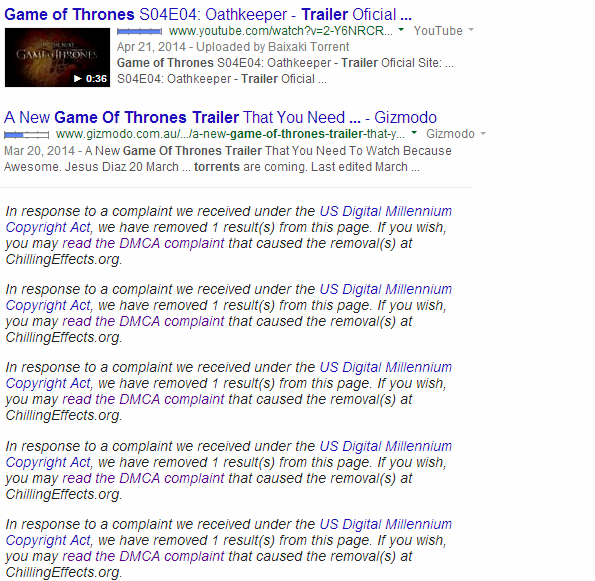
With these takedown requests HBO hopes to make it harder for people to find unauthorized copies. However, a careful inspection of the notices by TorrentFreak reveals that promotional material such as trailers are also being censored.

Unfortunately for HBO, Google happily processed these requests and removed the “infringing” trailers from their search results. As can be seen below, a search for “Game of Thrones trailer torrent” includes a notice that several results have been removed on copyright grounds.

GoT trailer torrent search results

gottrailertorrent

Looking at the individual notices, it becomes clear that these are indeed links to promotional trailers which should be freely available to the public. The DMCA notice pictured in the screenshot below lists several of these URLs, but it’s just the tip of the iceberg.

GoT trailer takedowns

gotdmca

The current crackdown on Game of Thrones runs counter to comments from director David Petrarca who said that piracy generates much-needed "cultural buzz." These dubious takedowns may create a buzz as well, but probably not the kind HBO is hoping for.

As for the trailer takedowns, we expect that these have been taken down in error. That wouldn’t be HBO’s first mistake either, as the company previously tried to censor their own website HBO.com because it apparently contained infringing content.

Perhaps their automated takedown tools need some further adjustments?

Source: TorrentFreak, for the latest info on copyright, file-sharing and anonymous VPN services.

TorrentFreak Email Update

TorrentFreak Email Update


Tarantino is Back, Now Claiming Gawker is an Illegal Downloader

Posted: 02 May 2014 01:10 AM PDT

Earlier this month, news publication Gawker and Quentin Tarantino traded early blows in their dispute over the the leak of a screenplay to Tarantino’s potential upcoming movie The Hateful Eight.

The background is relatively straightforward. Someone leaked the script “within Hollywood circles” without Tarantino’s permission, Gawker asked its readers for a link to a copy and was told where to find it on a file-hosting site. The publication grabbed a copy itself to ensure it was the real deal, and then wrote an article titled "Here is the Leaked Quentin Tarantino Hateful Eight Script" which contained links to the infringing file.

Tarantino’s legal team asked Gawker to take down the links so that others wouldn’t be tempted to download the script, Gawker refused, and an enraged Tarantino launched legal action. Last week, however, U.S. District Judge John F. Walter kicked out Tarantino’s lawsuit which alleged contributory infringement against Gawker after the director failed to allege a supporting and necessary claim for direct infringement.

Now Tarantino is back with an amended complaint that supplements allegations of contributory infringement by going straight after Gawker as a direct infringer, claiming that the publication made use of Tarantino’s script after illegally downloading it from a file-hosting site.

“Gawker…utilized the unauthorized infringing PDF copy of the Screenplay to disseminate portions of and/or content from the unpublished work. Accordingly, Gawker is liable to Tarantino for direct copyright infringement,” it reads.

The complaint also reiterates claims that having heard of the initial leak (apparently at this point restricted to Hollywood insiders), Gawker called out to its “47 million monthly United States readers” in an attempt to find someone willing “to infringe Tarantino's copyright” by “asking and inducing anyone to leak and provide Gawker with an unauthorized infringing copy of the Screenplay.”

Tarantino’s legal team adds that “Gawker’s solicitation and direct inducement for copyright infringement worked, as, by the next day, Gawker itself obtained a PDF of the Screenplay” which had been stored on the Anonfiles.com site. The new claims of direct infringement in this amended complaint rest on the moment Gawker accessed this file and confirmed its authenticity.

“Gawker itself illegally downloaded to its computers an unauthorized infringing PDF copy of the Screenplay — read it and learned that the PDF download document was 146 pages — directly infringing Tarantino's copyright,” the complaint reads.

Interestingly, Tarantino’s legal team also suggest that the while the script had been stored “privately” on Anonfiles by another direct infringer, Gawker went on to make up a story claiming that the file had already been made public.

Gawker “…fabricated a ‘story’ that the script had been made publicly available online so that Gawker could then trumpet to the world and begin promoting itself as the very first source for the public to be able to obtain the entire Screenplay,” the complaint reads.

As a direct result of Gawker’s actions several other people illegally downloaded the script, Tarantino’s legal team claim, adding that even after the file had been removed from Anonfiles after a DMCA complaint (rendering the link in the Gawker article useless), the publication re-published links to the same script that had been uploaded elsewhere.

In their prayer for relief Tarantino’s legal team seek damages in excess of $1m plus statutory damages, plus an injunction against Gawker forbidding the unauthorized use of the leaked script.

Gawker is yet to comment on the amended complaint.

Source: TorrentFreak, for the latest info on copyright, file-sharing and anonymous VPN services.

Dotcom Thanks RIAA and MPAA for Mega’s Massive Growth

Posted: 01 May 2014 10:26 AM PDT

megaActing on a lead from the entertainment industry, the U.S. Government shut down Megaupload early 2012.

Exactly a year later Kim Dotcom made a comeback with a new file-storage venture. Together with several old colleagues and new investors, Mega was launched. The new service, which has a heavy focus on privacy and security, has expanded ever since.

This morning Dotcom posted an image showing how user uploads have increased more than 300% over the past six months. The graph doesn’t specify the scale, but the New Zealand-based entrepreneur told TF that the service now processes over half a billion uploads per month.

That’s more than 10,000 files per minute….

“We are experiencing massive growth. We can’t add new servers and bandwidth fast enough,” Dotcom tells us.

According to Mega’s founder there are several factors that have contributed to the increasing interest in the service. monthly-uploadsIronically, Dotcom believes that the same people who destroyed Megaupload are now partly responsible for the success of Mega.

“There are several growth factors. People spend more time at the computer due to the cold weather, the lawsuits by MPAA and RIAA which advertised Mega, and the ongoing advertising from the dumbest ever U.S. Department of Justice case,” Dotcom says.

“Some users get pleasure from the fact that the US government and Hollywood hate Mega’s success and that I continue to expose them. The more people use Mega the more powerful our defense becomes. So, why wouldn’t Mega grow like crazy?” he adds.

The continuing debate about the NSA’s mass-surveillance is also likely to have helped Mega. Unlike other popular cloud hosting services, Mega encrypts all stored files so they can’t be snooped on. Similarly, the fact that former U.S. Secretary of State Condoleezza Rice joined Dropbox may have also had an impact according to Dotcom.

During the months to come Mega will work on their recently announced backdoor stock market listing, which the company hopes to complete next year. In addition, the cloud hosting service will roll out many new features, all focused on counter surveillance.

“The people of the Internet love us. And we haven’t even launched our encrypted communication suite yet. That’s like a point-to-point encrypted Skype on steroids, running in your browser,” Dotcom tells us, teasing Mega’s upcoming tools.

With the ongoing legal battle against the U.S. Government and civil cases against the MPAA and RIAA, Mega is guaranteed a regular place in the spotlight. In any case, we certainly haven’t heard the last of Dotcom and his team yet.

Source: TorrentFreak, for the latest info on copyright, file-sharing and anonymous VPN services.

TorrentFreak Email Update

TorrentFreak Email Update


Pirate Bay Uploader Hit With $32m Lawsuit

Posted: 01 May 2014 02:49 AM PDT

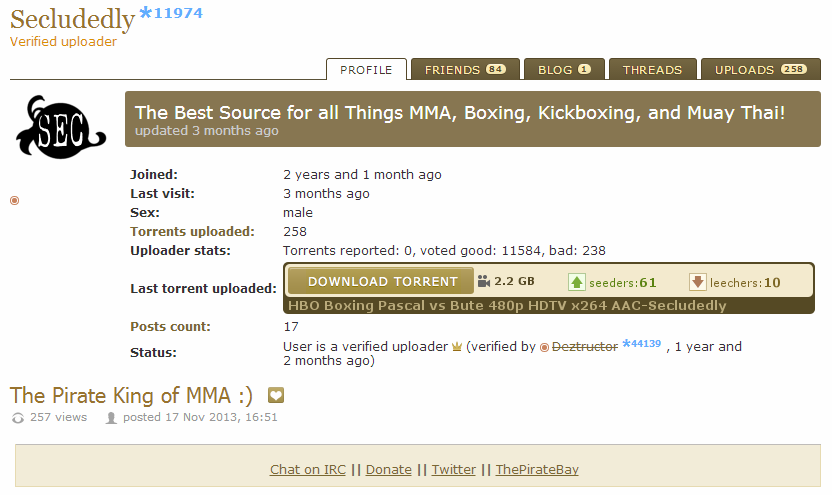
ufcFor quite some time a releaser known as Secludedly was one of the most reliable sources of UFC events on file-sharing sites around the world. But after a strong run, a release in January would prove to be his last.

After interviewing Secludedly in April 2013 and subsequently hearing he was in considerable trouble, earlier this year TorrentFreak tried to reach the ripper/uploader through previously-established channels. All attempts failed and now it’s clear why.

UFC parent company Zuffa have caught up with Secludedly in a very big way indeed. In a lawsuit filed at the United States District Court for the Eastern District of New York, Secludedly is revealed as Steven A. Messina, a 27-year-old from Staten Island, New York.

The lawsuit, which includes two other doe defendants and an unknown company Zuffa refers to as XYZ Corp (“a business entity, the exact nature of which is unknown”), centers around the unlawful recording (“capping”), uploading and distribution of more than 120 UFC events via two of the world’s biggest torrent sites.

“Defendants have, on over 124 occasions, used the torrent websites known as http://kickass.to and http://thepiratebay.se to upload, distribute and publicly display the Broadcasts to the users of said websites,” the lawsuit reads.

Also receiving a prominent mention from Zuffa is the fact that Secludedly allowed people to donate via a PayPal in order to help with the financing of future ripping and uploading activities.

Secludedly, who TF understood to be just one person, is repeatedly referred to as a group in the lawsuit, such as when it’s claimed that “their” aim was to become “the most well-known pirates and infringers on the internet” who were “content to profit handsomely from user payments and donations to fund their rampant piracy and copyright infringement.”

Secludedly’s profile at Kickass.to

secludedly

While it’s no surprise that Zuffa is claiming statutory damages of $150,000 for each of the alleged 124 infringements (a cool $18.6m), the MMA organization is definitely not stopping there. In a second count, Zuffa goes on to claim that Secludedly violated the Federal Communications Act.

“Defendants, wishing to use Plaintiff's Broadcasts for their own commercial gain, surreptitiously gained access to Plaintiff's Broadcasts by purchasing the programming through their satellite TV provider, without proper authorization, at residential rates, and subsequently copying the Broadcasts and uploading them to the users of the websites known as http://kickass.to and http://thepiratebay.se,” the lawsuit reads.

For these “willful violations”, Zuffa is claiming up to the maximum of $110,000 for each of the alleged 124 offenses, potentially another $13.64m in damages. In a third count, Zuffa seeks up to $60,000 after Secludedly “willfully and unlawfully accessed, received and subsequently re-transmitted the Broadcasts over a cableTV or internet system.”

Not content with the millions already on offer, Zuffa throw in an additional claim for breach of contact after Secludedly legally purchased PPV events but went on to step over the terms and conditions.

“Upon information and belief, Defendants purchased the Broadcasts through Plaintiff's
authorized websites or via Pay-Per-View purchase for private, residential viewing…[but then]…willfully and unlawfully copied, uploaded and distributed the Broadcasts..”

Zuffa further alleges a “civil conspiracy” in which “members” of Secludedly supposedly worked together to infringe the company’s rights and went on to violate the Computer Fraud and Abuse Act.

“[Defendants], without authorization or by exceeding such authorization as was granted, accessed a protected computer containing Plaintiff's live internet streams of the Broadcasts knowingly and with intent to defraud, and unlawfully copied, distributed and publicly displayed said Broadcasts,” the lawsuit reads.

It seems that Zuffa has left no stone unturned in its attempts to make life as difficult as possible for Secludedly. The company is seeking statutory damages of $18.6m for copyright infringement, up to $13.64m plus $60,000 for breaches of the Federal Communications Act, plus sundry damages on the remaining counts.

That all adds up to at least $32.2m and it could get much worse, but there’s not a chance in the world that Zuffa will see that kind of money from a 27-year-old reportedly living with parents. The company will settle for big anti-piracy headlines instead, in the hope of deterring others.

Source: TorrentFreak, for the latest info on copyright, file-sharing and anonymous VPN services.

Accused of Movie Piracy, Senior Citizen Kicked Out of Theater

Posted: 30 Apr 2014 09:27 AM PDT

While recording a movie strictly for personal use is entirely legal in UK cinemas, the same definitely cannot be said about the United States. Recording or ‘camming’ a movie in the U.S. can result in jail-time, particularly if the activity is connected to subsequent bootlegging or illegal online distribution.

This strict approach is the result of intense Hollywood lobbying during the last decade, and there can be few cinema-goers today who haven’t been touched by the results. Bag searches and night-vision goggles are now used to deter ‘cammers’, coupled with industry-funded rewards programs aimed at vigilant theater workers.

This climate of fear hasn’t stopped cammed copies of movies turning up online, but it has sucked in a few innocent victims over the years. If a new report from Utah is to be believed, another one can now be added to the list.

According to Provo resident Enos Ledezma, his elderly parents go to the movies several times a week. They find it both entertaining and practical, since it allows them to brush up on their English.

However, this past weekend things weren’t so enjoyable when Ledezma’s mother stood accused of illegally camming a movie in a Cinemark theater.

Ledezma says that part-way through the movie his father had to leave, but before doing so handed his wife a “brick, slider-type” cellphone. She apparently put the device in her pocket, but shortly after was confronted by not only a Cinemark employee, but also two police officers.

The trio reportedly informed the woman she had been seen recording the movie and would therefore have to leave, but due to her poor grasp of English the woman didn’t fully understand what was going on. Attempting to hand over her phone for inspection didn’t ease the situation either.

The woman was eventually ejected from the theater and not allowed to watch the remainder of the film, even after the false allegations were withdrawn.

Ledezma told KSL that it’s possible that another cinema-goer saw the theater-provided closed-captioning device next to his mother and presumed it was a bootlegging tool, but that was still no excuse for mistreating a regular customer.

While it seems unlikely that the woman broke the law (the police officers would have seen any footage by accessing her cellphone), it occurred to us that she may have broken Cinemark’s policy on using cellphones in the theater.

However, this somewhat amusing footage, filmed in a Cinemark theater by someone using a Nintendo DS, seems to clear up that cellphones are allowed, as long as they’re silent.

And here’s the thing. If anything, the footage from the DS in the clip above is likely to be better than that obtained from what appears to be an old cellphone. This kind of end result is definitely not a threat to the movie industry, even if the woman had been recording, which it appears she was not.

Interestingly and this case aside, Cinemark actually approaches the cellphone-in-theater problem in an innovative way. If visitors have a smartphone with the Cinemark app installed, switching over to CineMode darkens the screen for the duration of the movie. If that state is maintained right to the end, users can pick up rewards, such as a free drink.

Cinemode

But even in the event Ledezma’s mother upgrades to an iPhone, it’s unlikely she’ll be taking advantage of the offer.

"At the moment, I have no intention of going back to that Cinemark. I'd rather drive 45 minutes to the Megaplex,” Ledezma concludes.

Source: TorrentFreak, for the latest info on copyright, file-sharing and anonymous VPN services.