http://AccessPirateBay.com- PirateBay's Newest Domain Feb 2014

Torrentfreak: “UK Museums and Libraries Protest Outdated Copyright Laws” plus 4 more

Torrentfreak: “UK Museums and Libraries Protest Outdated Copyright Laws” plus 4 more


UK Museums and Libraries Protest Outdated Copyright Laws

Posted: 03 Nov 2014 05:19 AM PST

copyright-brandedCurrently, the duration of copyright protection for published works in the UK is life of the author plus 70 years, but for unpublished works the situation is different. ­­

As per the Copyright, Designs and Patents Act (CDPA) 1988, unpublished works from authors who died before 1969 are protected until 2039, regardless of the age of the work. This is unlike other countries in Europe where institutions are allowed to use such important historical material freely and lawfully.

The fact that very old unpublished works from authors who died long ago are still in copyright and will remain so till 2039 is especially frustrating to libraries and museums who want to display essential historical documents.

To address this issue, the Chartered Institute of Library & Information Professionals (CLIP) has launched a campaign to free the country's history from the clutches of what they are calling as "out­dated" and "inconsistent" copyright laws.

The campaign, which is being supported by several leading museums, libraries, and cultural organisations including Imperial War Museums, National Library of Scotland, Collections Trust, aims to push the UK government to reduce the current copyright term.

"The copyright laws mean we're not presenting a true representation of our cultural heritage,” says Naomi Korn, IP consultant at the Chair, Libraries and Archives Copyright Alliance.

"Cultural heritage organizations either have to be willing to incur the risks or the costs of presenting the copyrighted works. That's the choice to make it available. That's wrong.”

As part of the effort, CLIP is asking libraries, museums, archives, as well as cultural institutions to display a blank case in which they would like to show an unpublished document, but can't due to copyright laws. The document below, for example, is currently on display at the National Library of Scotland.

Blank page due to “outdated” copyright law

blank

The campaign is also protesting the issue of copyright to Orphan Works, where one or more rightsholders are unknown or cannot be located. Under current UK copyright laws, reproducing these works as well as displaying the original would require permission from the rights holder, even if they are untraceable.

The cultural institutions hope that the public will join the campaign by signing the petition on Change.org and using the hashtag #catch2039 on Twitter to spread the word.

Source: TorrentFreak, for the latest info on copyright, file-sharing and anonymous VPN services.

BitShare Hits Back at Police ‘Kinox’ Allegations

Posted: 03 Nov 2014 02:14 AM PST

bitshareLast week a quite extraordinary drama unfolded in Germany. Local police announced that they had carried out raids in several areas of the country with the aim of netting the operators of movie site Kinox.to.

Police did make two arrests but their main targets, two brothers said to be the founders of Kinox, remain at large. Subsequently police upped the ante by taking the unusual step of naming the pair and launching an international manhunt.

Ever since news broke that the pair were being pursued, police, the attorney general, and local piracy outfit GVU have linked the brothers to a string of other file-sharing related sites. Among them are streaming portal Movie4K and file-hosting sites BitShare and FreakShare.

All sites mentioned by the police remain operational. However, the anti-piracy group responsible for the investigations now wants something done about that.

GVU director Dr. Matthias Leonardy claims that BitShare receives 1.5 million users per day and FreakShare 750,000. Continuing with his fiery rhetoric, Leonardy says the sites operate from datacenters in the United States so GVU now requires international assistance to shut them down.

“This is by far the most serious case of organized economic crime with structurally infringing online services in Germany. The current case clearly shows that the illegal exploitation of creative content on the net is now firmly in the hands of criminals,” Leonardy says.

But while GVU and the police appear acutely interested in these sites, when TorrentFreak spoke to BitShare just before the weekend, we were given a different picture. Mark Girak, the site’s CEO, who was clearly annoyed at being associated with the mounting chaos. He agreed to answer some questions to put his side of the story.

Firstly, we asked Girak if anti-piracy outfit GVU or the police had ever been in contact with BitShare over the Kinox situation.

“GVU never contacted us, nor did the police or any other company,” Girak said. “They are just putting our name everywhere and trying to make life hard for us. They are completely ignoring our brand and our company.”

We then asked Girak if BitShare had any historical links with Kinox or its operators, and if so, to explain their nature.

“We never had any contact with Kinox guys, they were once affiliates of us, but since two years they have not been using our website at all,” Girak said. “Our site is most probably being linked to that website because we offer a streaming feature for some of our users.”

Finally, we asked Girak if BitShare has any pending legal problems in respect of Kinox or any other copyright matter. The answer was a clear “no”.

And Girak isn’t the only one with doubts over the way the case is being presented by the authorities in Germany. The alleged ‘Kinox Brothers’, Kastriot and Kreshnik Selimi, are being portrayed as violent and rich individuals at every opportunity, but speaking to local media their lawyer questioned the allegations.

“There is no evidence that the pair are dangerous,” said Stefan Tripmaker.

“The family lives modestly and both brothers were still living in the rooms they had as children [at their parents' house]. It is a mystery to me where the money could be.”

So all eyes now turn to the United States {if GVU is correct} to see whether something will be done there. In the meantime the controversy – and apparent mystery – continues.

Source: TorrentFreak, for the latest info on copyright, file-sharing and anonymous VPN services.

Top 10 Most Pirated Movies of The Week – 11/03/14

Posted: 03 Nov 2014 12:05 AM PST

apesThis week we have four newcomers in our chart.

Dawn of the Planet of the Apes is the most downloaded movie.

The data for our weekly download chart is estimated by TorrentFreak, and is for informational and educational reference only. All the movies in the list are BD/DVDrips unless stated otherwise.

RSS feed for the weekly movie download chart.

Ranking (last week) Movie IMDb Rating / Trailer
torrentfreak.com
1 (…) Dawn of the Planet of the Apes (Webrip) 8.0 / trailer
2 (1) Let’s Be Cops 6.7 / trailer
3 (…) Hercules 6.2 / trailer
4 (7) The Expendables 3 6.2 / trailer
5 (4) Teenage Mutant Ninja Turtles 6.3 / trailer
6 (2) Step Up All In 6.1 / trailer
7 (…) Guardians of the Galaxy 8.5 / trailer
8 (3) How to Train Your Dragon 2 8.2 / trailer
9 (…) Boyhood 8.6 / trailer
10 (6) A Most Wanted Man 7.2 / trailer

Source: TorrentFreak, for the latest info on copyright, file-sharing and anonymous VPN services.

Copyright Monopoly Enforcement Gets To Trump Human Rights, Yet Again

Posted: 02 Nov 2014 01:45 PM PST

copyright-brandedOn December 14, 2005, the European Parliament approved legislation that was more Stasiesque than anything previously imagined.

Citizens would have every piece of communications logged for a minimum for six months, including from where it was made, so that this could be used against the citizens if need be. Who people talked to, how, from where, and when. In effect, since your mobile phone communicated more or less all the time, every footstep you took through a European city was not only monitored, but recorded for the specific purpose of using it against you.

The legislation – the Data Retention Directive – caused an outrage, and rightly so. But the gears of justice turn slowly. On April 8, 2014 – almost ten years later – the European Court of Justice – the highest court in Europe – ruled that the legislation violated a number of fundamental citizen rights, including the presumption of innocence, protection of personal data, and the right to privacy. It didn’t just declare the horrible law invalid from that point on – the European Court of Justice ruled that the law had never even existed.

It should come as no surprise that the copyright industry was one of the primary pushers for this legislation. In combination with the typical over-implementation of the IPRED directive, which would give the copyright industry police-like powers to demand logs from Internet Service Providers. They would use this power to find people who had violated their distribution monopolies in sharing knowledge and culture among each other. This two-pronged approach would allow the copyright industry to act as a private police force: force ISPs to save logs of all correspondence, and get the legal right to demand it (a right even the Police didn’t have for crimes at that petty level).

The copyright industry has never cared for human rights. Every single debate you go to, they talk about “balancing” fundamental rights against their right to profit. It is not just audacious, it is revolting. First, there is no right to profit for a commercial enterprise, and second, the reason we call the fundamental rights “fundamental” in the first place is that nothing gets to be “balanced” against them.

These are rights on the same level as the right to life. Yes, they’re that fundamental. And the copyright industry cares that little.

This week, about ten years late, Australia introduced Data Retention of the same model. Or at least that’s what most people think. The bill has been introduced, and yet it hasn’t, because nobody is allowed to read the details of what data is actually required to be retained in the bill yet. (Raise your hand if you’ve heard this kind of story before – an administration playing hide-and-seek with legislative details.)

And just as unsurprisingly, the first thing that pops up as purpose for this violatory legislation is copyright monopoly enforcement.

Violating fundamental human rights wholesale for entire countries at a time, with the idea of enforcing an entertainment distribution monopoly for a cartoon industry. It’s so disproportionate it wouldn’t even be funny in a cartoon; it’s so out of touch with reality that we’ve even left the Onionesque.

About The Author

Rick Falkvinge is a regular columnist on TorrentFreak, sharing his thoughts every other week. He is the founder of the Swedish and first Pirate Party, a whisky aficionado, and a low-altitude motorcycle pilot. His blog at falkvinge.net focuses on information policy.

Book Falkvinge as speaker?

Source: TorrentFreak, for the latest info on copyright, file-sharing and anonymous VPN services.

Google Takedown Requests Surge After New Anti-Piracy Measures

Posted: 02 Nov 2014 09:15 AM PST

google-bayLast week Google implemented a new search algorithm. The new measure keeps websites for which it receives a high number of takedown requests out of the top results for certain keywords.

The change has hit pirate sites hard. Some sites have lost more than half of all their search engine traffic, which translates to millions of visitors per week.

The key element of the new alghorithm are the DMCA notices. The more a website gets, the less likely it is that the site appears in the top results for various download and streaming related searches.

This has created a new incentive for copyright holders to send more takedown notices, to ensure that no pirate site can fly under the radar. Various rightsholders appear to realize this as the number of DMCA notices Google receives has skyrocketed.

Over the past week the search engine was asked to remove 11,668,660 allegedly infringing URLs. That is nearly double the amount it received earlier this month, and the largest week to week increase ever.
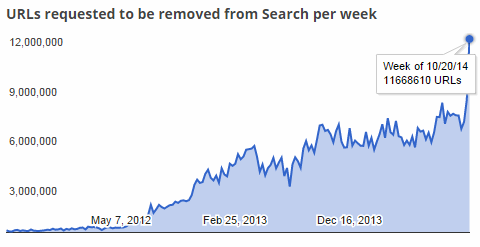
Takedown requests increase 100% in weeks

google-skyrocket

Looking at the sites that are targeted we see that most notices indeed refer to relatively new sites. The top 5 domains last week were conexaomp3.com, vmusice.net, tpbt.org, proxymirror.co and helpamillionpeople.com.

These sites went unnoticed before but all had more than 300,000 URLs removed last week. On the surface helpamillionpeople.com appears to be an odd target, but the site in question runs a Pirate Bay proxy through a subdomain.

The big question now is whether this new takedown surge will pay off.

Of course, copyright holders aren’t under the illusion that Google can eradicate piracy, or even stop those who regularly download or stream content without permission. Their goal is to make pirated content invisible in search results so less people will be drawn to it.

Whether this will decrease piracy rates in the long run is unknown, but judging from the early results it does indeed make it less likely for people to stumble upon pirate sites.

Source: TorrentFreak, for the latest info on copyright, file-sharing and anonymous VPN services.

Torrentfreak: “Scientist Deliberately Pirates Art on a Nanoscopic Scale” plus 1 more

Torrentfreak: “Scientist Deliberately Pirates Art on a Nanoscopic Scale” plus 1 more


Scientist Deliberately Pirates Art on a Nanoscopic Scale

Posted: 02 Nov 2014 01:02 AM PDT

nano-smallIn the modern age almost anything can be copied. Digital technology allows for the reproduction of audio, still and moving images, and even physical items are easily cloned using 3D printing techniques.

This ease of copying has provoked legal aggression and endless debate as to the purpose of copyright law and its role in protecting the interests of artists. In particular, entertainment industry companies often declare that no matter what its nature, infringement negatively affects those creators. But is that always the case?

A new project developed by Dr Robert Hovden at Cornell University aims to provoke discussion on that very topic by pushing replication of content – and indeed the law – to their absolute limits.

A self-confessed gradeschool downloader and former undergraduate at Jet Propulsion Labs, NASA, Hovden went on to study nanoscience at Cornell. His passion for studying the world at the tiniest possible levels has given birth to “When Art Exceeds Perception”.

The project, which will be exhibiting at Cornell University this November and December, explores the implications of copyright infringement, replication and plagiarism when the ‘pirated’ works are so tiny they cannot be perceived by human senses.

To this end, Hovden has ‘pirated’ four famous works of art by scribing them into the surface of a silicon crystal using a focused ion beam. The features in the artwork replicas are five hundred times smaller than the eye can perceive and five times smaller than the wavelength of light.


The Focused Ion Beam device used to ‘pirate’ the artwork

Ion beam

“To take a piece of art, copy it, and share it with the world without the original artists' permission is traditionally viewed as wrong and, in most cases, violates copyright laws,” Hovden says.

“Such laws are intended to protect an artist's financial interests and
provide incentive to create. However, in a digital era where information is encrypted and stored in the atomic bits of nanoscale devices, answers to philosophical, moral, and legal questions surrounding copyright become muddled.”

This leads to Hovden’s big question: When a copyright work is copied, framed and presented for public consumption on a nanoscale as it will during November and December at Cornell, has something been taken from the original artist?

“Thus far, people have discussed this project from a science or art perspective, but I believe that the readers of TorrentFreak are best equipped to understand this work. The exhibition is highly conceptual – completely beyond perception – and critical of current views on replication,” Hovden told TF.

Project creative assistant Michael Blaney informs us that the artworks involved are The Treachery of Images by RenĂ© Magritte, Le Platane by Henri Matisse, M.C. Escher’s Regular Division Of The Plane With Birds and Laylah K. by Joy Garnett.


Laylah K. by Joy Garnett, original and nanoscale

nanoartwork

“The replicated pieces chosen are from recent, famous artists where copyright is relevant to the discussion,” Hovden says.

“Joy Garnett is a fantastic creator and one of a few fine artists who release work under a Creative Commons license. She sometimes paints from the photographs of others to make something uniquely new – a benefit of a free culture society. The nanoscale replica of Garnett’s work is the only one which I retained a low resolution micrograph image of.

“The Escher is a lovely tessellation with symmetries that can be found in the crystalline silicon substrate on which it was etched and Magritte’s ‘The Treachery of Images’ was chosen for a technological modernization and extension of his original concept. The Matisse is a best-selling serigraph at MOMA.”


The works of art, on a nanoscale

nanoartwork

The concept of infringement at an imperceptible level is an intriguing one. Are artists affected by ‘pirate’ music that’s too quiet to be heard or by entire movies played in a fraction of a second, for example?

“I think your idea of an audio performance of ‘pirate’ music is in the same vein as this exhibition, but raises some new concepts,” Hovden told TF.

“The audio is quiet, with a signal to noise ratio that changes with distance. Maybe a microphone could record the sounds we can’t hear at close distances but the sound quality will drop with distance (actually, rapidly with the square of the distance). There will be a point where even a microphone cannot ‘hear’ the sound and the information is lost.

“So, does the extent of a public performance change? If a thousand people are present, but none – or only a couple – can hear it, is it a public performance? Also, you could play with the idea of translating the music to frequencies higher than the human ear can hear. It is loud, but not perceived – maybe by an animal.”

And the complexities and fascination of Hovden’s project only intensifies when one realizes that we’re all engaged in pirating on a nanoscale, quite possibly at this very moment.

“With the modern computer, most of us are continually replicating information – often without permission – in the nanoscale bits of our hard drives and memory. Not only small, the information is encoded in complex arrays.

“Here, I wanted to make something that is a direct representation of the original artwork – just like the low-amplitude ‘pirate’ music performance. The verdict is still out on how this type of work will be received (tolerated),” he concludes.

Those interested in experiencing When Art Exceeds Perception can do so at the Jill Stuart Gallery at Cornell University during November and December.

Source: TorrentFreak, for the latest info on copyright, file-sharing and anonymous VPN services.

MPAA Lobbies Lawmakers on Internet Tax and Net Neutrality

Posted: 01 Nov 2014 11:26 AM PDT

mpaa-logoIn its quest to stamp out piracy, the MPAA continues to pump money into its lobbying activities hoping to sway lawmakers in its direction.

While the lobbying talks take place behind closed doors, quarterly lobbying reports provide some insight into the items on the agenda.

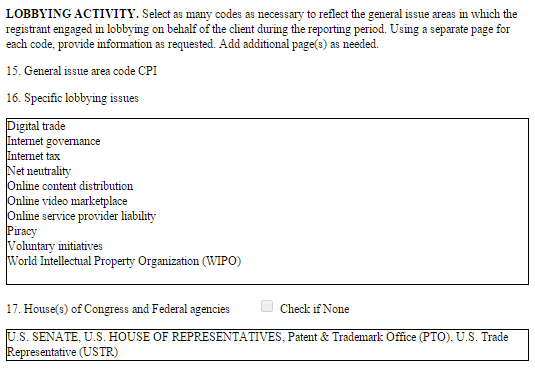
The MPAA’s most recent lobbying disclosure form (pdf) has added several new topics that weren’t on the agenda last quarter. Among other issues, the movie group lobbied the U.S. Senate and the U.S. House of Representatives on Internet tax, net neutrality and online service provider liability.

TorrentFreak contacted the MPAA hoping to get some additional information on Hollywood’s stance on these topics, but a week has passed and we have yet to receive a reply.

The only thing we know for sure is what Hollywood is lobbying on, but it doesn’t take much imagination to take an educated guess on the why part.

Net neutrality for example. While the MPAA hasn’t got involved publicly in the recent net neutrality discussions, it clearly has something to tell to lawmakers. The Hollywood group most likely wants to assure that its anti-piracy efforts aren’t hindered by future legislation.

Previously the MPAA has warned that net neutrality could make it hard to use deep packet inspection, filtering and fingerprinting techniques to prevent piracy. This concern was partially addressed by FCC’s proposal which doesn’t include “unlawful traffic” under the net neutrality proposals.

Part of MPAA lobbying disclosure filing

mpaa-lobby

The Internet tax mention is perhaps most the controversial topic. There were massive protests in Hungary this week after the Government announced it would charge a tax of 62 cents per gigabyte on all Internet traffic. For now the Hungarian plan has been shelved, but an Internet tax remains an option for the future.

In the U.S. there has been a ban on Internet Tax for more than a decade, but that expires this year. There’s currently a bill pending in the Senate that extends the ban, but this has yet to be approved. It seems likely that the MPAA has weighed in on this proposal.

Finally, the MPAA also lobbied on liability of online service providers. This presumably relates to the possible revision of the DMCA, where Hollywood wants to ensure that online services can’t leave widespread piracy unaddressed.

Ideally, the movie studios would like to make it harder for sites and services to hide behind the DMCA, as the MPAA also made clear in its lawsuits against isoHunt and Hotfile.

While we may never know what the MPAA’s exact positions are on these topics, we do know that they are trying to steer lawmakers in their direction. Perhaps future legislative proposals and discussions may reveal more details.

Source: TorrentFreak, for the latest info on copyright, file-sharing and anonymous VPN services.

Torrentfreak: “XBMC/Kodi Targets Piracy-Promoting eBay Sellers” plus 2 more

Torrentfreak: “XBMC/Kodi Targets Piracy-Promoting eBay Sellers” plus 2 more


XBMC/Kodi Targets Piracy-Promoting eBay Sellers

Posted: 01 Nov 2014 02:02 AM PDT

xbmc-logoAnyone typing the simple phrase “free movies” into eBay will be overloaded with many thousands of results. A large proportion offer hardware that has been customized to receive unauthorized online video.

The software these devices run is very often XBMC, or Kodi as its now known. The software in its basic form is an entirely legal media player, around since the days of the original Xbox (XBox Media Center).

However, XBMC/Kodi is compatible with third-party addons that can turn the player into a piracy powerhouse providing free access to movies, TV shows and live sports. With the advent of XBMC/Kodi for Android, eBay is now flooded with ready-built and configured ‘pirate’ boxes that anyone can operate.


A typical ‘pirate’ XBMC Android Box Listing

ad-listing

This week TF received information that eBay has been taking down listings for these devices, apparently at the behest of the XBMC Foundation, the organization behind the XBMC/Kodi software.

“The rights owner or an agent authorized to act on behalf of the rights owner, XBMC Foundation, notified eBay that this listing violates intellectual property rights. When eBay receives a report of this type of violation, we remove the listing to comply with the law,” eBay told a disappointed seller.

When emailed about the takedown, XBMC Foundation responded: “Your listing was removed because it violates our brand policy by altering the XBMC(tm) / Kodi ™ installation by including extra add-ons which are against our general brand policy or piracy general piracy policy.”

To discover more about these developments, TorrentFreak spoke with Kodi Project Manager Nathan Betzen.

“First, let me say that we have no copyright claims or interests in addons developed by third parties. The form provided by eBay is unfortunately over broad and says quite a bit more than we want it to say, but we work with the tools we’re given,” Betzen told TF.

“The requested takedowns are based entirely on trademark issues. All of the listings targeted so far have explicitly connected XBMC/Kodi with addons that enable piracy, resulting in eBay listings with phrases like, ‘XBMC lets you watch all the free movies you want!’”

Betzen informs TF that the Foundation not only controls the XBMC trademark in the US (and wherever else common law trademarks are recognized), but is also in the process of registering the name ‘Kodi’ with the United States Patent and Trademark Office. Once obtained, that trademark will be extended internationally using the Madrid Trademark Protocol.

ebay“We believe that these [eBay] sales are causing confusion for our users about what XBMC/Kodi does as a vanilla program. The clearest evidence of this may be found among several of the sellers themselves who are surprised and unaware of the fact that XBMC has absolutely nothing to do with the development of the piracy-related addons included in their sales pitch,” Betzen says.

“Upon being contacted by the sellers, we only request that they not associate the XBMC/Kodi name with the act of piracy described in their listings. This is possible by rebranding the software, which is permissible under the GPL.”

Betzen notes that simply refraining from mentioning piracy features is also enough to avoid an eBay takedown.

“Either way, they are welcome to post the sale again the moment they follow either of these paths or otherwise creatively solve the issue of associating the name XBMC/Kodi with piracy,” Betzen says.

Despite the takedowns, the XBMC Foundation told TF it takes no stance on piracy. Users are free to use their software how they like within the constraints of the GPL v2. However, that freedom ends when people indicate to the public that the Foundation is taking sides in the piracy debate when its goal is to remain out of the argument entirely.

“To put it simply: We are happy to remain software developers. And we are happy to let other groups stand for and against piracy,” Betzen concludes.

Source: TorrentFreak, for the latest info on copyright, file-sharing and anonymous VPN services.

Joker Goes Offline After Pressure From Copyright Holders

Posted: 31 Oct 2014 01:37 PM PDT

While most people use standalone torrent clients to download files, there are also several services that allow people to stream videos in a web-browser via the popular file-sharing protocol.

One of the best implementations of BitTorrent ‘powered’ streaming is Joker.org. Although the actual streaming is not fully peer-to-peer, as the transfers first go through central servers, its ease of use is certainly appealing.

This week hundreds of news sites wrote about the service which became overloaded with new users as a result. A success story, but one with a downside, as copyright holders were immediately on high alert.

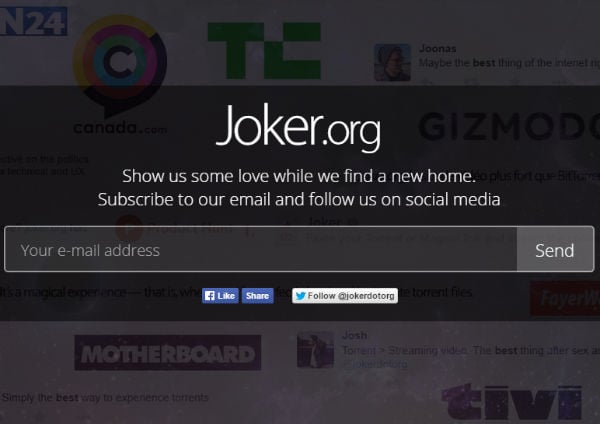
Just a few days after the service first gathered serious online momentum, it is already gone. The Joker.org website currently shows a placeholder mentioning that it’s looking for a new home.

TorrentFreak contacted the Joker team who explained to us that the service was shut down by hosting company Redstation following “pressure” from various copyright holder representatives.

jokerorg

One of the notices Redstation received was sent by Entura International on behalf of Sony Pictures Entertainment. This notice alleged that Joker facilitates copyright infringement at 3 levels.

1. The initial download of content via BitTorrent without permission. At no point has Rights Holder authorized transmission of its content via this medium.
2. The storage and/or caching of BitTorrent chunks of the content.
3. The conversion and re-transmission of stored/cached content in streaming video format to users via web browser.

Entura International asked the hosting provider to stop the alleged unlawful activities by suspending Joker’s account or null-routing the associated IP-address. Redstation chose the latter option and the Joker service has been unavailable since.

Joker is disappointed at being labeled a “pirate site”. The developers believe they offer a neutral and useful service that is piracy agnostic. Potential infringing data is stored only temporarily, without their knowledge.

“Which is the worst? Google, where you can find thousands of torrents with a single “X .torrent” search, torrent sites, where you can get access to millions of .torrent files, or joker.org?” the Joker team asks.

“Using torrents is not illegal, we are just a service that converts video torrent files to streamable mp4s. We don’t link or enable search for any content,” they add.

Despite the current problems Joker doesn’t intend to throw in the towel. They are currently looking for a new hosting solution for their service and will return.

“Hell yeah we will come back,” the Joker team concludes.

Before they return Joker intends to improve their services and address potential issues, to prevent the risk of another shutdown.

Source: TorrentFreak, for the latest info on copyright, file-sharing and anonymous VPN services.

Disney Patents a Piracy Free Search Engine

Posted: 31 Oct 2014 07:59 AM PDT

disney-pirateDisney and other rightsholders are not happy with today’s search engines after repeatedly asking Google and Co. to promote legal content and remove pirate sites from search results.

While Google implemented several changes to satisfy these requests, Disney has also taken matters into its own hands.

A new patent awarded to Disney Enterprises this week describes a search engine through which pirated content is hard to find.

Titled "Online content ranking system based on authenticity metric values for web elements," one of the patent's main goals is to prevent pirated movies and other illicit content from ranking well in the search results.

According to Disney their patent makes it possible to “enable the filtering of undesirable search results, such as results referencing piracy websites.”

Disney believes that current search engines are using the wrong approach as they rely on a website’s “popularity.” This allows site owners to game the system in order to rank higher.

“For example, a manipulated page for unauthorized sales of drugs, movies, etc. might be able to obtain a high popularity rating, but what the typical user will want to see is a more authentic page,” they explain.

While this is a rather simplified description of the complex algorithms most search engines use, Disney believes it can do a better job.

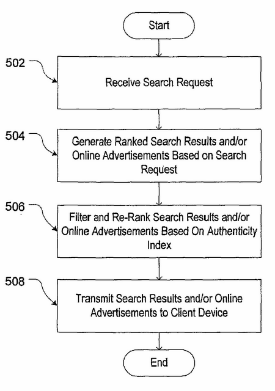
In their patent they describe a system that re-ranks search results based on an “authenticity index”. This works twofold, by promoting sites that are more “authoritative” and filtering out undesirable content.

disneypirate

“In particular, embodiments enable more authoritative search results … to be ranked higher and be more visible to a user. Embodiments furthermore enable the filtering of undesirable search results, such as results referencing piracy websites, child pornography websites, and/or the like,” Disney writes.

While Disney’s idea of a search engine may sound appealing to some, deciding what counts as “authoritative” is still rather subjective. Google, for example, uses PageRank which is in part based on the number of quality links to websites.

Disney, however, suggests giving “official” sites priority when certain terms relate to a property of a company. These “authority” weights can include trademarks, copyrighted material, and domain name information.

This doesn’t only affect pirated content, Disney explains, it also means that a Wikipedia entry or IMDb listing for “Snow White and the Seven Dwarfs” will rank lower than the official Disney page of the film.

“The Disney.go.com web page may be associated with an authenticity weight that is greater than the authenticity weight associated with the encyclopedia web page because Disney.go.com is the official domain for The Walt Disney Company. As such, with respect to the Snow White and the Seven Dwarfs™ film, the Disney.go.com web page may be considered more authoritative (and thus more authentic) than the encyclopedia web page,” Disney writes.

In other words, official sites should be the top result for “brand” related searches, even if people are looking for background info or more balanced (re)views. For pirate sites there’s no place at all in the top results, even though Disney’s definition of a pirate site may also be rather subjective.

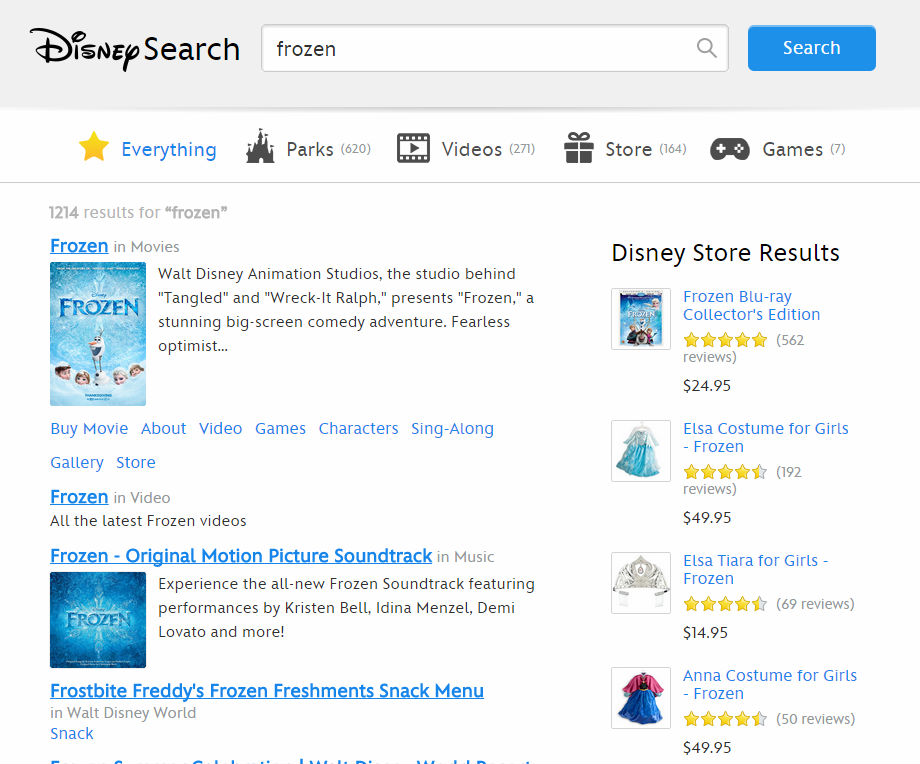
It’s unclear whether Disney has any plans to implement the patent in the wild. The company currently has a search engine but this only includes links to its own properties.

Disney search
disneysearchengine

Source: TorrentFreak, for the latest info on copyright, file-sharing and anonymous VPN services.