http://AccessPirateBay.com- PirateBay's Newest Domain Feb 2014

Torrentfreak: “Top Torrent Trackers All Return Online” plus 1 more

Torrentfreak: “Top Torrent Trackers All Return Online” plus 1 more


Top Torrent Trackers All Return Online

Posted: 06 Jan 2015 03:09 AM PST

opentrackerOpenBitTorrent, PublicBT and Istole.it are three of the largest BitTorrent trackers on the Internet, coordinating the downloads of 30 million people at any given point in time.

This means that these non-commercial services handle a staggering three billion connections per day – each.

However, over the past several weeks the three trackers have been offline most of the time. While they have had their fair share of downtime in the past, it's not often that these top trackers become unresponsive all at once.

OpenBitTorrent was the first to go offline early December. The domain name, registered to Pirate Bay’s Fredrik Neij, disappeared without notice leaving many downloaders in the cold.

Not much later the PublicBT and Istole.it trackers folded too. The latter was hit by the Pirate Bay raid as collateral damage, alongside several other BitTorrent related services.

During the weeks that followed the three trackers have worked hard on a comeback. There have been ups and downs, but now they’re all up and running again.

trackers-back

TF spoke to the operators of OpenBitTorrent (OBT) who explained that server issues were the root cause of its initial problems. After a few changes behind the scenes, the tracker eventually found a new home at a befriended torrent site.

“Through IRC we proceeded looking for a safe provider and we had an offer from a torrent site that was willing to let us use one of their servers for the tracker,” OBT tells TF.

While the tracker is up and running for most people, there may still be some stability issues, we were told.

“We are currently facing stability issues due to a large amount of users trying to connect to the tracker, so there might be some downtime until we stabilize.”

In order to make the tracker ecosystem more resilient one of the OpenBitTorrent developers has now launched a separate tracker, BTZoo.eu. The OBT team encourages torrent users to use both trackers.

“We’re planning on sharing the peers of OpenBitTorrent with BTZoo.eu and have users also use that tracker as it will help lower the load of the tracker at this crucial stage,” OBT told us.

During the weeks to come OpenBitTorrent’s operators hope things will normalize. In the meantime, they hope to revive some other Pirate Bay affiliated ventures including Bayfiles.net, but more on that later.

Source: TorrentFreak, for the latest info on copyright, file-sharing, torrent sites and anonymous VPN services.

Dotcom’s Wife Not Entitled to 50% of Seized Assets, U.S. Argues

Posted: 05 Jan 2015 10:24 AM PST

mona-dotcomFollowing the 2012 raid on Megaupload and Kim Dotcom, U.S. and New Zealand authorities seized millions of dollars in cash and other property.

Claiming the assets were obtained through copyright and money laundering crimes, last July the U.S. government launched a separate civil action in which it asked the court to forfeit the bank accounts, cars and other seized possessions of the Megaupload defendants.

In August 2014, Dotcom and his co-defendants responded by filing their own claims against the property, a move which resulted in the U.S. branding the former Megaupload operators as “fugitives“.

Early September Mona Dotcom, Kim Dotcom’s wife, filed her own claim against some of the seized property. Mona said that under New Zealand law she had “a 50% marital interest” in the assets named in the civil forfeiture complaint, which includes luxury vehicles and other expensive items.

No standing to claim

However, in a new filing the U.S. states that Mona currently has no standing to make such a claim, arguing that her interest under New Zealand law remains “unquantifiable” until she obtains a New Zealand court order defining the extent of her marital property.

Noting that Mona herself previously claimed to have been “completely financially dependent” on Kim Dotcom since their marriage, the U.S. states that Mona has failed to provide evidence that she has “dominion and control over the properties” which give her standing to make a claim.

Highlighting Mona’s claim to one of the seized vehicles, the U.S. notes that “Mona Dotcom cannot even drive — and without that ability, it would seem nearly impossible for her to establish that she had dominion and control over the vehicles.”

Already received millions from marriage

Also at issue is the value of the 50% claim itself. According to the U.S. government, Mona has already received assets “far in excess” of the value of her claim from her marriage thus far.

“Mona Dotcom has already received more than any possible marital interest claim from releases from the New Zealand Courts, as well as from a direct transfer to her from Kim Dotcom of assets not restrained by this Court,” the U.S. argues.

According to the filing, through successful court action the Dotcom’s have obtained 40% of the assets previously seized in New Zealand.

“As of December 2014, more than NZ$1 million (currently US$770,000) in restrained funds were released to the Dotcoms as ‘living expenses’ by the New Zealand courts,” the filing reads.

“An additional approximate NZ$6 million (US$4.64 million) in legal fees have already been released to the Dotcoms. Mona Dotcom has benefited from the attacks on the restraints and has continued to enjoy a lavish lifestyle as a result.”

The U.S. also references assets in cloud-storage service Mega which were gifted to Mona by husband Kim. The 17% share is estimated to be worth NZ$35 million.

“This gift, combined with the apparent proceeds of previous sales of stock in Mega Limited and [music service] Baboom, means that Mona Dotcom has been provided and still controls assets well in excess of the approximately NZ$23 million she is trying to claim in this proceeding as her marital assets.

“Because she has already been provided those assets, her claim that she is still owed half the interest in Kim Dotcom's restrained assets cannot be established under New Zealand law.”

Benefits from illegal activity?

The U.S. government also insists that in order to have a valid claim for assets Mona might have to prove that she has not unlawfully benefited from criminal activity associated with her husband and Megaupload.

“Whatever the New Zealand courts ultimately determine Mona Dotcom's marital interest to be, New Zealand courts have consistently refused to allow even an entirely innocent and unaware spouse to retain any interest in criminal proceeds,” the U.S. government writes.

But according to government’s lawyers, it may not come to that. They say that Mona was one of the incorporators of the "Megateam Corp." in the Philipines and had no less than six separate Megaupload accounts associated with her email addresses.

“Mona Dotcom's claim is insufficient to give her standing because she cannot establish any concrete injury,” the U.S. concludes. “Until the New Zealand courts quantify whatever property interest she may have, the nature of her property interest is at best, inchoate and murky.”

Finally, it appears the U.S. is also concerned about the amount of cash being burned through by the Dotcoms. In December Kim Dotcom filed a request for further legal expenses (estimated by the U.S. as likely to run into “millions”) plus additional living expenses (US$77,000 per month) to be released. That hearing will take place next week.

Source: TorrentFreak, for the latest info on copyright, file-sharing, torrent sites and anonymous VPN services.

Torrentfreak: “Google Asked to Remove 345 Million “Pirate” Links in 2014” plus 3 more

Torrentfreak: “Google Asked to Remove 345 Million “Pirate” Links in 2014” plus 3 more


Google Asked to Remove 345 Million “Pirate” Links in 2014

Posted: 05 Jan 2015 02:48 AM PST

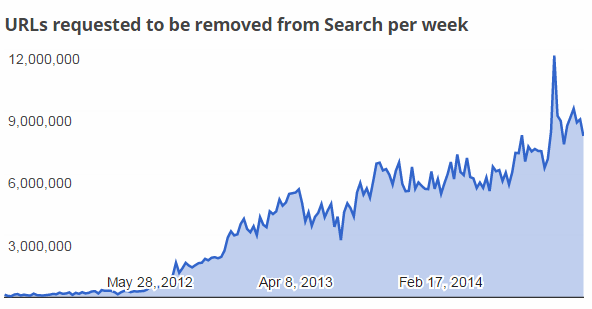
google-bayIn the hope of steering prospective customers away from pirate sites, copyright holders are overloading Google with DMCA takedown notices.

These requests have increased dramatically over the years. In 2008, the search engine received only a few dozen takedown notices during the entire year, but today it processes more than a million reported “pirate” links per day.

Google doesn't report yearly figures, but at TF we processed all the weekly reports and found that the number of URLs submitted by copyright holders last year surpassed the 345 million mark – 345,169,134 to be exact.

The majority of these requests are honored with the associated links being removed from Google’s search results. However, Google sometimes takes “no action” if they are seemed not to be infringing or if they have been taken down previously.

Most takedown requests were sent for the domains 4shared.com, rapidgator.net and uploaded.net, with more than five million targeted URLs each. The UK Music industry group BPI is the top copyright holder of 2014, good for more than 60 million reported links.

2014-takedown

Despite the frequent use of the takedown process many copyright holders have stressed that the search giant should take responsibility and do more to tackle the piracy problem.

Facing this harsh criticism from copyright holders, Google has gradually changed its attitudes towards sites and services that are often associated with piracy.

October last year the company implemented the most significant change to its search algorithm to date, aimed at downranking sites that often link to copyright-infringing material.

This significantly reduced the visibility of pirate links in search results and had a major impact on the traffic levels of some sites. However, Google also reminded copyright holders that they too can do more to prevent piracy.

Without legal options it's hard to beat unauthorized copying, is the argument Google often repeats.

"Piracy often arises when consumer demand goes unmet by legitimate supply. As services ranging from Netflix to Spotify to iTunes have demonstrated, the best way to combat piracy is with better and more convenient legitimate services," the company noted earlier.

"The right combination of price, convenience, and inventory will do far more to reduce piracy than enforcement can."

In recent weeks tensions between rightsholders and Google reached a new high. After the MPAA issued a ‘snarky’ press release responding to Google’s downranking efforts, the company ended its anti-piracy cooperation with the Hollywood group.

Not much later, Google sued Mississippi State Attorney General Jim Hood who secretly collaborated with the MPAA to get certain pirate sites delisted.

Source: TorrentFreak, for the latest info on copyright, file-sharing, torrent sites and anonymous VPN services.

Top 10 Most Pirated Movies of The Week – 01/05/15

Posted: 05 Jan 2015 12:41 AM PST

gonegirlThis week we have three newcomers in our chart.

Gone Girl is the most downloaded movie.

The data for our weekly download chart is estimated by TorrentFreak, and is for informational and educational reference only. All the movies in the list are BD/DVDrips unless stated otherwise.

RSS feed for the weekly movie download chart.

Ranking (last week) Movie IMDb Rating / Trailer
torrentfreak.com
1 (2) Gone Girl 8.4 / trailer
2 (6) Penguins of Madagascar 5.0 / trailer
3 (1) The Interview 7.8 / trailer
4 (…) The Drop 7.3 / trailer
5 (…) A Walk Among the Tombstones 6.6 / trailer
6 (…) The Judge 7.5 / trailer
7 (3) Horrible Bosses 2 6.9 / trailer
8 (10) PK 8.8 / trailer
9 (4) Outcast 5.0 / trailer
10 (7) Dumb And Dumber To 6.4 / trailer

Source: TorrentFreak, for the latest info on copyright, file-sharing, torrent sites and anonymous VPN services.

In Europe, Pirates Are Writing The Copyright Law

Posted: 04 Jan 2015 01:59 PM PST

europe-flagFor years – nay, for decades – net activists and freedom-of-speech activists have been fighting against the copyright industry’s corrupt initiatives. In country after country, the copyright industry was practically calling out for mail-order legislation, and receiving it every time.

The collateral damage to liberties has been immense, and has spilled far outside the net. In the US, people are complaining that copyright monopoly law is now unintentionally preventing them to modify items they legally own, such as cars or games consoles. They’re absolutely wrong: that was the exact intention with the most recent round of revisions to copyright monopoly law – to limit property rights and to lock people out of their own possessions. (The copyright monopoly is, and has always been, a limitation on property rights.)

Further, that collateral damage includes making messengers (“intermediaries”) liable for any damages caused by a message they carry, unless they immediately take sites offline – which they would of course rather do, rather than risking immense lawsuits. The messenger immunity was gutted around the turn of the century, by the EUCD and the DMCA alike. “Notice-and-takedown” has been abused by everybody and their corporate brother, up to and including the oil company Neste Oil who attacked a Greenpeace protest site by threatening the Internet provider of Greenpeace, thereby killing the protest site.

As activists fought – and won! – against software patent monopolies in Europe in 2005, it became clear that we couldn’t fight one bad thing after another, never having the initiative, always being on the defense against onslaught from corporate mail-order legislation. For every exhausting victory, there were nine bad laws being passed in the shadows. We had to go on the offense. We had to aspire to write the law ourselves, keeping corporate lobbyists firmly out of any corrupt influence.

On January 1, 2006, I founded the Swedish and first Pirate Party. It’s now on its tenth year, and on its second term in the European Parliament. This term, that European Parliament is revising the copyright monopoly – definitely once, possibly twice. It starts out by evaluating what works and what doesn’t with the current set of laws on the matter. And the rapporteur for that dossier – meaning “the person writing the actual legislative document” – is Julia Reda, representative for the Pirate Party from Germany.

Let’s take that again: a Pirate Party representative is writing the European Union’s official evaluation of the copyright monopoly, and listing a set of necessary changes.

In 2006, did I imagine that a pirate would be writing the European Parliament’s official evaluation of how well the copyright monopoly has worked – and what needs to be changed – in the European Union, the world’s largest economy? No, I didn’t, to be honest. But neither did I expect that the Pirate Party representatives would manage to get “three strikes” schemes outlawed across all of Europe in 2009, or take a radical reform proposal (allowing file-sharing and more) into the political mainstream in 2012. When you open the floodgates of the unrepresented, things can apparently happen fast.

Now, just because it’s a pirate writing the legislative document, that doesn’t mean that document is going to pass a vote in the European Parliament no matter what it contains. It needs to be negotiated to get majority support, as usual and as appropriate in a parliamentary democracy. The first of those votes is in the Legal Affairs committee on April 16, and the vote in the European Parliament as a whole is on May 20. So pirates aren’t “in charge”; democracy is, as it should be.

But the initiative has shifted. It is no longer solely initiated by mail-order lobbyists for corrupt incumbents who gladly sacrifice civil liberties and the entire Internet to preserve an unjust and immoral lucrative monopoly. For the first time, legislation on the matter is initiated by net liberty activists.

This shift of the initiative was what we set out to accomplish ten years ago. I think it went faster than most people had expected.

About The Author

Rick Falkvinge is a regular columnist on TorrentFreak, sharing his thoughts every other week. He is the founder of the Swedish and first Pirate Party, a whisky aficionado, and a low-altitude motorcycle pilot. His blog at falkvinge.net focuses on information policy.

Book Falkvinge as speaker?

Source: TorrentFreak, for the latest info on copyright, file-sharing, torrent sites and anonymous VPN services.

Dozens of Pirate Bays Isn’t Necessarily a Pirate’s Dream

Posted: 04 Jan 2015 08:07 AM PST

kongbayThe Pirate Bay was quite possibly the world’s most-loved torrent site before it was taken offline in a police raid. Through thick and thin fans supported the site but now, in a somewhat unbelievable bad dream, the site has gone – possibly for good.

Of course at this point there will be some shouting at the screen while furiously pointing towards various domains where the site has been supposedly resurrected. To be clear, TPB hasn’t been brought back to life yet, on any domain. All these other sites are clones.

But aren’t 30 Pirate Bays better than one? Isn’t it now 30 times more difficult for law enforcement to disappear the site? Hasn’t that single point of failure been taken away?

There are many arguments in favor of having multiple Pirate Bays but when examining the situation from a user perspective, they don’t really add up. In fact, by having so many clones everything that made The Pirate Bay such a success has been critically watered down.

A pirate Pirate Bay is not as good as the original

It’s a truly great irony that The Pirate Bay cannot be successfully copied by outsiders. Sure, millions of torrents and magnet links can be put into a searchable database and most will probably work as advertised, but clones are missing several key components.

No community

While basic torrent indexes are undoubtedly useful, one of Pirate Bay’s strengths was its community. It’s true that not many of the site’s users took the time to participate on its Suprbay discussion forum, but the comments section attached to every torrent was an unrivaled source of information.

At any point, one could jump into a pool of torrents dating back 10 years, pick one, and get an idea of what it was about and how it had been received by the community. Were better versions available? The comments would have link. Was the download poorly seeded? Potential peers could be found. Anything interesting or topical about the torrent would also be noted.

No cloned Pirate Bay has yet managed to fully recreate the comments section of the site (although one is trying). And since no clone has access to the genuine TPB database, every user account has disappeared. In some cases names exist, but logins are impossible. That’s bad because……

Sharing is caring (and getting thanked is awesome too)

To dismiss the importance of genuine, active, verifiable user accounts is to misunderstand the mindset of uploaders and those who appreciate their work. Despite the claims of some anti-piracy companies, many uploaders do what they do not for money, but for recognition – and fun.

With the disappearance of The Pirate Bay, thousands of recognizable uploader accounts (many of them verified ‘VIP’) have simply gone. Worse than that, the pages of historical uploads regular users see when they click on these names has gone too. The work of these ‘famous’ uploaders has been wiped from history – and much of their kudos with it.

Another issue relates to those same valuable uploaders. Where are they now? Some are indeed present on torrent sites such as Kickass.so and a number of others, but bringing them all back together under one Pirate Bay-branded roof that’s not the real thing could prove impossible.

It’s unlikely that any of the current clones has the standing to assure uploaders that they’re the single site worth supporting, which leaves the prospect of a release force scattered in dozens of locations. As a result, the largely single-location competition between these players could easily wither away.

Quality control

What The Pirate Bay offered that it’s clones largely do not is a team of human beings prepared to wade through every single uploaded torrent in order to check it for authenticity. Fakes, virus and malware-laden files had short lives on the real Pirate Bay and as a result the site gained a reputation among users.

The little colored skulls on Pirate Bay uploads meant that users could click and forget, safe in the knowledge that their chosen torrents will perform as expected. That entire system was destroyed when the site was raided early this month and any ‘clone’ site will struggle to emulate it.

Reputation and trust

While they may not have stayed with the site until the end, in the eyes of millions the three most recognizable names behind The Pirate Bay have remained associated with the site. In fact, Gottfrid Svartholm, Peter Sunde and Fredrick Neij are the only world-famous torrent site celebrities around today.

Through years of news, Pirate Bay users have built up a trust with not only these guys, but by proxy whoever they handed the site over to. With that level of respect gone, copy Pirate Bays will struggle to relive the dream.

Sure, Pirate Bay’s advertising ethics got a little bent up in recent years, with soft and even hardcore porn appearing when it should not, but the feeling remained that the site would never completely sell users down the river to the highest bidder. One can never be so certain about many of the faceless clones popping up today.

Fragmentation is not the same as decentralization

Finally, an anecdote. One night more than 20 years ago, a nightclub frequented every Saturday by myself and by association hundreds of friends, unceremoniously burnt to the ground. For the previous five years it had been not only our dance music mecca, but also our home. We were devastated.

Several other clubs stepped in to recreate the experience – one even took the name of the now-destroyed venue. Homeless and desperate, a group of us went around testing the ‘clone’ clubs. Some were OK, but didn’t have all the DJs we’d been used to. Others had the music right, but lacked half our friends who had chosen to go elsewhere.

Before the fire we’d been a powerful, well-developed community in a venue we knew and trusted, coming to the same place at the same time every week to do what we loved. The fire hadn’t just destroyed the place where we met, but also the unfathomable something that had been holding us all together.

Sure, our club was a dump with badly functioning bathrooms and carpet your feet stuck to. But it was our club with a community we’d built. Without it we drifted apart.

Conclusion

Dozens of Pirate Bays might look like defiance, but the long-term outcome will be a lot less glamorous unless something can be done to play to uploaders’ sense of pride and achievement.

From a technological standpoint, decentralization or a multi-location clone setup is clearly much more difficult for authorities to deal with, but fragmenting the community and key uploaders is perhaps an even bigger problem waiting for a solution.

Make no mistake, a solution will be found. But dozens of sites that look the same and offer a watered down version of something already in need of repair probably won’t be it.

See everyone back here, February 1.

Source: TorrentFreak, for the latest info on copyright, file-sharing, torrent sites and anonymous VPN services.

Torrentfreak: “Top 10 Most Popular Torrent Sites of 2015” plus 1 more

Torrentfreak: “Top 10 Most Popular Torrent Sites of 2015” plus 1 more


Top 10 Most Popular Torrent Sites of 2015

Posted: 04 Jan 2015 02:40 AM PST

2015-top-torrent-sitesMost torrent users rarely change their downloading habits or the places where they get their daily torrent dose.

This is also reflected in our annual top 10 where most sites have had a consistent listing for more than half a decade.

Like every year there are a few movers and shakers though, and the biggest impact was made by the Pirate Bay raid early last month.

The notorious torrent site has been crowned the most popular torrent site since 2008, but isn’t serving any torrents at the beginning of this year. As a result, the top spot is now taken by KickassTorrents.

The Pirate Bay hasn’t gone away completely though. There are currently several popular clones and copies of the site that together can easily match the traffic of most other sites that are listed.

Thanks to one of its top copies TPB managed to secure a spot in 4th place. Considering the situation we decided to mention both the original Pirate Bay domain and the most-used copy.

The rest of the top 10 consists of other familiar names. Bitsnoop.com is the only site to drop from the list, with Limetorrents.cc taking its place.

Demonoid, which returned online earlier this year, just fell out of the top 10 but appears to be making a slow but steady comeback that’s worth mentioning. There is a good chance that it will return again next year.

Below is the full list of the top 10 most-visited torrent sites at the start of the new year. Only public and English language content sites are included. The list is based on various traffic reports and we display the Alexa and U.S. Compete rank for each. In addition, we include last year’s ranking for each of the 10 sites.

1. KickassTorrents

KickassTorrents was founded in 2009 and surpassed The Pirate Bay in traffic this year, even before it went down. Battling various censorship efforts the site has burned through a few different domain names over the years. Most recently it switched to the Somalian Kickass.so address.

Alexa Rank: 151 / Compete Rank: 711 / Last year #2

2. Torrentz

Torrentz has been the leading BitTorrent meta-search engine for many years. Unlike the other sites featured in the list Torrentz does not host any torrent files, it merely redirects visitors to other places on the web. The site uses several domain names with .eu being the most popular.

Alexa Rank: 206 / Compete Rank: 1.716 / Last year #3

3. ExtraTorrent

ExtraTorrent continues to gain more traffic and has become one of the most active torrent communities. The site is also the home of the popular ETTV and ETRG release groups.

Alexa Rank: 356 / Compete Rank: 3,446 / Last year #4

4. The Pirate Bay (copies and clones)

At the time of writing The Pirate Bay isn’t serving any torrents. However, there are several copies and clones of the site which, at least temporarily, take its place. OldPiratebay.org is currently the most popular and based on its recent traffic the site is already ranked at least 4th in this list.

Alexa Rank: NA / Compete Rank: NA / Last year #1

5. YTS

YTS, also known as the release group “YIFY,” has become the most recognizable movie piracy brands on the Internet. Despite a court court-ordered ISP blockade in the UK the group’s torrent site continues expand.

Alexa Rank: 740 / Compete Rank: 4,271 / Last year #5

6. EZTV

TV-torrent distribution group EZTV is a niche site specializing in TV content only. Because of its narrow focus, EZTV’s traffic varies in line with the TV seasons. Despite posting only a few dozen torrents per week it attracts millions of visitors.

Alexa Rank: 1,262 / Compete Rank: 5,421 / Last year #6

7. RARBG

RARBG, which started out as a Bulgarian tracker, was last year’s newcomer and continues to rake in more visitors. The site was blocked by UK ISPs last month, which put it on par with most other sites in the top 10.

Alexa Rank: 1,326 / Compete Rank: 8,890 / Last year #10

8. isoHunt.to

Isohunt.to was launched in 2013, less than two weeks after isoHunt.com shut down. The site is not affiliated with the old isoHunt but hopes to keep its spirit alive. The same people are also behind Oldpiratebay.org, which is is listed in 4th place.

Alexa Rank: 1,890 / Compete Rank: 7,723 / Last year #8

9. 1337x

1337x is a community driven torrent site. The site’s owners say they launched 1337x to “fill an apparent void where it seemed there was a lack of quality conscience ad free torrent sites with public trackers.” This year the site dropped its .org domain and is now operating from 1337x.to.

Alexa Rank: 2,581 / Compete Rank: 11,389 / Last year #7

10. Limetorrents

Limetorrents.cc has been around for several years already, and regained a spot in the top 10 this year. The site appeared in the news this summer after it was sued by LionsGate for posting a link to a leaked copy of The Expendables 3. The case is still ongoing.

Alexa Rank: 2,608 / Compete Rank: 3,984 / Last year #NA

Disclaimer: Yes, we know that Alexa isn’t perfect and that Compete has plenty of flaws, but combined both do a pretty good job at comparing sites that operate in a similar niche.

Source: TorrentFreak, for the latest info on copyright, file-sharing, torrent sites and anonymous VPN services.

Netflix Cracks Down on VPN and Proxy “Pirates”

Posted: 03 Jan 2015 11:11 AM PST

netflix-logoDue to complicated licensing agreements Netflix is only available in a few dozen countries, all of which have a different content library.

Some people bypass these content and access restrictions by using VPNs or other circumvention tools that change their geographical location. This makes it easy for people all around the world to pay for access to the U.S. version of Netflix, for example.

The movie studios are not happy with these deviant subscribers as it hurts their licensing agreements. Previously entertainment industry sources in Australia complained bitterly that tens of thousands of Netflix "VPN-pirates" were hurting their business.

Over the past weeks Netflix has started to take action against people who use certain circumvention tools. The Android application started to force Google DNS which now makes it harder to use DNS based location unblockers, and several VPN IP-ranges were targeted as well.

Thus far the actions are limited in scope, so not all VPN users may experience problems just yet. However, TorGuard is one of the VPN providers which noticed a surge in access problems by its users, starting mid-December.

“This is a brand new development. A few weeks ago we received the first report from a handful of clients that Netflix blocked access due to VPN or proxy usage. This is the very first time I’ve ever heard Netflix displaying this type of error message to a VPN user,” TorGuard’s Ben Van der Pelt tells us.

In TorGuard’s case the users were able to quickly gain access again by logging into another U.S. location. It further appears that some of the blocking efforts were temporary, probably as a test for a full-scale rollout at a later date.

“I have a sneaking suspicion that Netflix may be testing these new IP blocking methods temporarily in certain markets. At this time the blocks do not seem aggressive and may only be targeted at IP ranges that exceed too many simultaneous logins.”

Netflix is reportedly testing a variety of blocking methods. From querying the user’s time zone through the web browser or mobile device GPS and comparing it to the timezone of their IP-address, to forcing Google’s DNS services in the Android app.

TorGuard told us that if Netflix continues with a strict ban policy, they will provide an easy solution to bypass the blocks. Other services, such as Unblock-us are also suggesting workarounds to their customers.

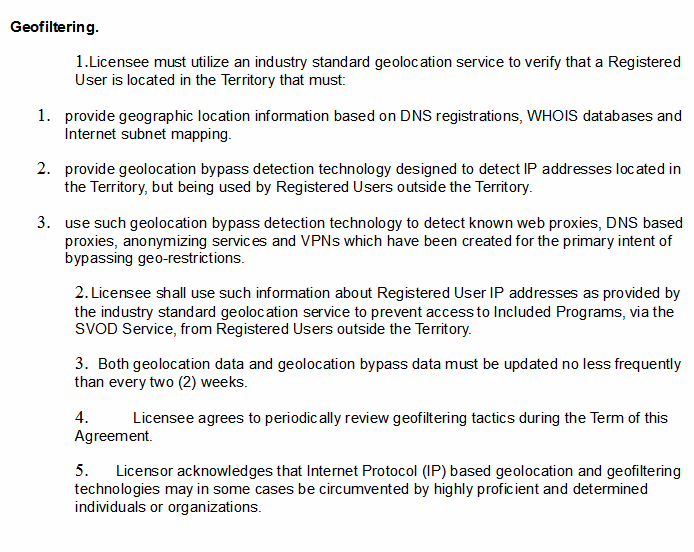
Netflix’ efforts to block geoblocking circumvention tools doesn’t come as a surprise. TF has seen a draft of the content protection agreement Sony Pictures prepared for Netflix earlier this year. This agreement specifically requires Netflix to verify that registered users are indeed residing in the proper locations.

Among other things Netflix must “use such geolocation bypass detection technology to detect known web proxies, DNS based proxies, anonymizing services and VPNs which have been created for the primary intent of bypassing geo-restrictions.”

geofiltering

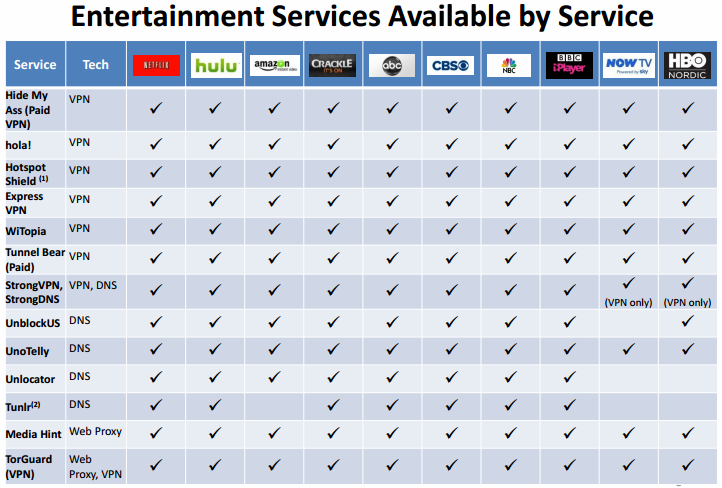
Blocking VPN and proxy “pirates” has become a priority for the movie studios as streaming services have failed to introduce proper countermeasures. Early 2014 the movie studio looked into the accessibility of various services through popular circumvention tools, including TorGuard, to find out that most are not blocked.

In a follow-up during the summer of 2014 Sony Pictures conducted research to identify the IP-ranges of various VPNs and proxies. These results were shared with Netflix and other streaming services so they could take action and expand their blocklists where needed.

geolocationresults

Based on the above it’s safe to conclude that Netflix will continue to roll out more aggressive blocking tools during the months to come. As with all blocks, this may also affect some people who use VPNs for privacy and security reasons. Whether Netflix will factor this in has yet to be seen.

TF contacted Netflix for a comment on the findings and its future plans, but a few days have passed and we have yet to receive a response.

Netflix is not the only streaming service that’s targeting VPN and proxy users. A few months ago Hulu implemented similar restrictions. This made the site unusable for location “pirates,” but also U.S. based paying customers who used a VPN for privacy reasons.

Source: TorrentFreak, for the latest info on copyright, file-sharing, torrent sites and anonymous VPN services.

Torrentfreak: “Wiziwig: Poor Legal Options Turn People into Pirates” plus 1 more

Torrentfreak: “Wiziwig: Poor Legal Options Turn People into Pirates” plus 1 more


Wiziwig: Poor Legal Options Turn People into Pirates

Posted: 03 Jan 2015 03:22 AM PST

Until our report yesterday it’s likely that Wiziwig, a streaming portal covering just about every spectator sport around, had flown under the radars of many readers. And that’s surprising.

The site is ranked #1,546 worlwide by Alexa and is the 239th most-popular site in the UK. On Thursday the term ‘wiziwig’ was the 8th most popular search on Google.co.uk, ahead of official sports broadcaster BT Sport. But the popularity wasn’t based on good news. Citing changes in Spanish law, Wiziwig had been forced to close just hours earlier.

In the wake of the closure TorrentFreak caught up with the operators of this hugely popular site to find out about events leading up to its shutdown. Interestingly it’s what didn’t happen on the site’s first day offline that topped the discussion.

Among dozens of other sports, Wiziwig carried links to live soccer games and as a result became somewhat of a magnet for companies such as the UK’s Premier League. New Year’s Day is a traditionally big date for UK soccer so coinciding with the first day of Wiziwig downtime, the site’s operators stood back and watched what happened.

“What we noticed Thursday, and that’s what we’ve always been thinking, is that the Premier League has only been focusing on Wiziwig lately to take down streams, like those from [P2P streaming service] Sopcast for example,” Wiziwig told us.

“If we added a Sopcast link for a game in the Premier League, then quickly that link was made inaccessible. On Thursday all Sopcast channels kept working all day, without any been taking down during the early kickoff, 3pm game and late game. Coincidence?”

The idea that the soccer league had been using Wiziwig to find streams and have them taken down at source was confirmed when matches streamed from other sources also remained up.

“Same applied with Veetle links, as when those previously appeared on Wiziwig they were quickly taken down. If we didn’t add them they were working all game long, while people could find them easily in Veetle. That also applied to several other links.”

Aside from changes in Spanish law where the site was based, Wiziwig also reminded us of two serious events in the UK earlier in the year. In April the operator of sports streaming site Nutjob.eu was arrested by officers from the Police Intellectual Property Crime Unit. That was followed by a September raid on the operator of the Coolsport streaming service.

When all things were considered (Wiziwig’s Twitter account was shutdown by a complaint in December) the team felt that the timing was right to call it a day. But even though Wiziwig is no more, other sites are bound to try and fill the gap the portal has left in the market. These, Wiziwig’s operators say, wouldn’t even exist if more effort was put into getting official services to consumers.

“We’ve seen in the past several years that people don’t get the right options to watch the sports and games they want to watch. Many sports events, and many games, aren’t available worldwide. The Leagues or competitions often don’t provide the right options for people to watch games in a legal way, which is also what we’ve seen from many replies on Twitter and Facebook,” Wiziwig explain.

“People want to subscribe to some games, some PPV events, and don’t want long contracts. In many countries there are no options to watch specific sports events and competitions. So not just the big sports/leagues, but also for smaller events.

“Then people decide to watch the online streams. A good example is the 3pm soccer games in England which aren’t shown on UK TV due to an old law designed to keep stadiums full. If the leagues fail to provide such options then websites like Wiziwig and [illicit] streams will always exist,” Wiziwig adds.

With the site closed the team are now turning their attention to GetYourFixtures, a TV guide for sports with links to only official streams.

“GetYourFixtures’ aim is to provide people with the correct TV info for all sports events, and if there isn’t a TV channel showing it then they want to give people the options to watch it officially online.

“Maybe leagues and competitions will wake up and start working on providing decent PPV options, letting people pay for just a single game, a flexible way of watching sports. On TV, mobile or tablet: wherever they are, either free and supported with advertisements when there isn’t any TV coverage/legal pay option, or just for small fees. They should work together,” Wiziwig concludes.

Source: TorrentFreak, for the latest info on copyright, file-sharing and anonymous VPN services.

Canadian ISPs and VPNs Now Have to Alert Pirating Customers

Posted: 02 Jan 2015 10:27 AM PST

pirate-runningAfter years of public and private discussions, Canada started implementing a new copyright law in recent years.

The law introduced great improvements in terms of fair use and non-commercial file-sharing, and also adopts a "notice-and-notice" policy for ISPs that goes into effect today, January 2nd.

Under the new law Internet providers are required to forward copyright notices they receive from rightsholders to their customers. Providers who do not comply, including VPN services, face damages up to $10,000.

The notice scheme creates a safe harbor for Internet providers, protecting them from copyright holder lawsuits. For Internet subscribers the effects are limited to warnings, which is less draconian than the “strikes” systems other countries have implemented.

University of Ottawa professor Michael Geist, who has been a critical follower of the copyright law changes, notes that despite its modesty people should be wary of the negative consequences these notices may have.

“I think they’re generally a good solution – proven effective when used informally and far less draconian than takedown systems. That said, there is the danger of potential abuse that will be need to be monitored,” Geist tells TF.

Among the most prominent concerns are the so-called settlement schemes where copyright holders ask pirating subscribers to pay a fee. These have become relatively common in the U.S. and are now expected to expand into Canada.

One of the companies that helps rightsholders to collect settlements is CEG TEK, and they are already gearing up to enter the Canadian market.

"We have been conducting tests in the Canada market and see positive results with ISPs. We look forward to a full-scale launch in the new year," CEG TEK’s COO Kyle Reed informs TF.

These settlement notices are a “significant concern” according to Professor Geist. He says that the law currently doesn’t prohibit copyright holders from sending them in, but that subscribers’ identities are shielded.

“The law does not preclude the inclusion of a settlement demand, though Canada has a cap on liability for non-commercial infringement and the sender of the notice obviously does not know the identity of the subscriber,” Geist tells TF

“ISPs would seemingly be required to send these notifications, but there is nothing in the law that would stop them from advising subscribers on the context of these notices,” he adds.

The new notice-and-notice system also has a great impact on VPN providers. The new law requires them to identify pirating customers so they can forward the infringement notices.

To be able to do so the companies have to retain access logs for a minimum of six months. This mandatory data retention is expected to lead to a customer exodus as it makes it impossible for providers to guarantee people's anonymity, a key feature of any VPN service.

As we pointed out before, the new law requires VPN providers to implement an extensive logging and notice policy to deal with takedown notices. This will prove to be quite costly or simply impossible, especially for smaller companies that are sometimes run by individuals.

Many VPN providers assign shared IP-addresses to their customers, so even if they wanted to there is no option to accurately identify a copyright infringer. For these companies the only option will be to shut down, or move the company outside of Canada.

During the months to come it will become apparent what impact the notice-and-notice system will have on businesses and customers.

Source: TorrentFreak, for the latest info on copyright, file-sharing and anonymous VPN services.

Torrentfreak: “Rental Car Stereos Infringe Copyright, Music Rights Group Says” plus 1 more

Torrentfreak: “Rental Car Stereos Infringe Copyright, Music Rights Group Says” plus 1 more


Rental Car Stereos Infringe Copyright, Music Rights Group Says

Posted: 01 Jan 2015 03:59 AM PST

Car rentals are big business. According to Car Rental Market – Global Industry Analysis, Size, Share, Growth, Trends and Forecast, 2013 – 2019, the global car rental market was valued at $36.89 billion in 2013. In the US alone an estimated 2.07m vehicles are available for hire.
Over in Europe, the second largest market next to North America, a storm is brewing. Up in the north of the continent Swedish music rights outfit and car rental company Fleetmanager are locked in dispute over the latter’s business, specifically how the company provides car rental customers access to music.

STIM (Svenska TonsĂ€ttares Internationella MusikbyrĂ„) is a collecting society for songwriters, composers and music publishers. It demands license fees whenever its members’ music is broadcast or transmitted, and collects sizable revenues from music streaming service Spotify. STIM also ensures that its members are paid when their music is played in public and this is at the heart of the dispute with Fleetmanager.

Each car rented out by Fleetmanager contains a stereo radio and CD player so that the customer can enjoy broadcasts of all kinds, including music. STIM says that to do so legally Fleetmanager needs to obtain a license but to date has failed to do so.

According to SVD, STIM is arguing that the inside of Fleetmanager’s cars contain members of the public and therefore amount to public places. On this basis the company needs to obtain a public performance license. Fleetmanager disagrees, noting that any music played inside a car is only heard by a limited circle of people.

STIM disagrees. The collection society says that previous cases involving hoteliers have ended with licenses being obtained which enable hotel guests to listen to music while on the premises. Furthermore, other car rental companies in Sweden have already agreed to pay a per-stereo levy so Fleetmanager should also pay, STIM argues.

This is not the first music-related copyright case to hit the car sector this year. In July, the Alliance of Artists and Recording Companies launched a class action lawsuit against Ford and General Motors over the CD-ripping capability of their cars. In November the group followed up with fresh legal action against Chrysler and technology partner Mitsubishi.

Source: TorrentFreak, for the latest info on copyright, file-sharing and anonymous VPN services.

Mortally Wounded Pirate Bay Enters 2015 in Uncertainty

Posted: 31 Dec 2014 07:36 AM PST

tpb-logoMay 31, 2006 was a momentous day for everyone involved in the BitTorrent scene.

The Pirate Bay, one of the world’s most famous torrent sites, was smashed to its knees. Dozens of police, acting on information provided by the global entertainment industries via local anti-piracy group Antipiratbyran, raided Swedish datacenter PRQ and seized all of the site’s hardware.

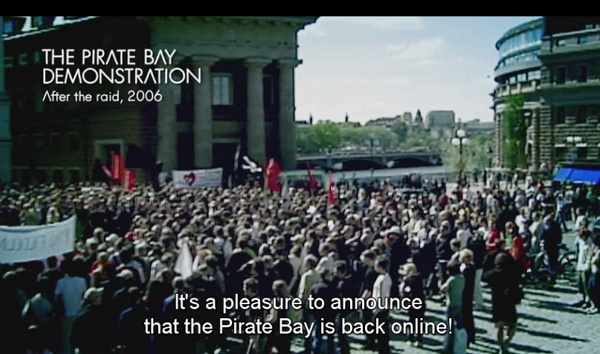
But like a phoenix rising from the ashes, three days later The Pirate Bay was back online utilizing a backup that Fredrik Neij, aka TiAMO, had made of the site. In a public speech heralding the site’s return, Neij excited gathered crowds in Sweden.

“It’s a pleasure to announce that the Pirate Bay is back online. In your face, Hollywood,” the Swede declared. TPB was back.


TPB Back online in 2006 – Image from TPB AFK

tpb-back

In the years that followed The Pirate Bay grew in size and reputation, an apparently unstoppable behemoth supported by a hard-core following renewed determination.

But while the masses enjoyed the spoils of the site for years to come, in November 2014 history caught up with Neij when he was arrested at the Laos/Thai border, shipped back to Sweden and locked in a prison cell.

Several weeks later, on a December morning more than eight years after the original raid, Antipiratbyran – now known as Rights Alliance – showed the world that they also have extremely long memories when it comes to The Pirate Bay.

Following a new investigation and presentations to the authorities, police descended on a datacenter in Nacka and once again ripped The Pirate Bay offline.

The events of 2006 and the Megaupload case aside, never before had so much attention been focused on the shutdown of a file-sharing site. Tens of millions of worried Pirate Bay users sat in disbelief as the hours passed by. Some thought the downtime was related to technical issues. Others believed news of a fresh raid was a hoax. It was neither.

As file-sharers and interested observers absorbed developments, one train of thought persisted through most conversations. Hadn’t The Pirate Bay become raid-proof? Wasn’t its virtual server setup immune to the attentions of the police? Who was in charge of making the backups this time around and why isn’t the site back online already?

piratesaintThe days passed and it became increasingly clear – this wasn’t The Pirate Bay of 2006. Times – and people – had changed.

The team that had driven the site to glory during the last decade had long since parted ways and the collective defiance of Piratbyran (the Pirate Bay’s founding group) had dissipated following a decade of pursuing still unsurpassed culture sharing ideals.

"We were not that surprised by the raid. That is something that is a part of this game. We couldn't care less really," a Pirate Bay insider informed TF in the wake of the shutdown.

“We have however taken this opportunity to give ourselves a break. How long are we supposed to keep going?”

So what could be done to fill the vacuum before any Pirate Bay return? Interestingly it was previous efforts to limit the availability of The Pirate Bay in countries such as the Netherlands, United Kingdom and elsewhere that provided the springboard.

Sites and domains that previously acted as mirrors and proxies to TPB suddenly transformed themselves into clones of the famous site. Some early efforts were controversial, with fears over impostors and malware unsettling the masses. Others (such as ThePirateBay.com.ua) became the closest representation of what the site once was, with user names and a high percentage of comments now restored.

But despite the claims and suggestions, not a single one of these sites is the real Pirate Bay resurrected. Nevertheless, many have flourished simply by virtue of similar looking domains and a half decent torrent index. However, one of the most interesting developments was launched by the team responsible for launching isoHunt.com clone, isoHunt.to.

TheOpenBay project is an attempt at open-sourcing a Pirate Bay-like site, and not without success. The initiative has resulted in hundreds of mini TPB clones and the sky-rocketing of the project to the top spot on developer platform Github.

OpenBay has real potential and provides an easier route into the torrent scene for budding admins, but ultimately this platform provides an alternative, not a replacement, to The Pirate Bay.

The disappearance of The Pirate Bay has been somewhat of a roller-coaster. Emotions have been running high all month, with hopes for a return and/or a worthy replacement at the forefront of millions of users’ minds.

Dreams of a grand return were boosted four days before Christmas when the original Pirate Bay domain – ThePirateBay.se – burst back to life. While the famous front page was missing, an elaborate pirate flag has waved on the site ever since. Alongside other cryptic hints, the flag is keeping the pirate spirit alive and hopes of a resurrection with it.

At the time of writing The Pirate Bay has been down a record-setting three weeks. In all of its history the site has never been offline for such a long time which raises some obvious questions. Will the site ever return or is the delay down to important technical issues which need to be overcome in order for the site to come back up and stay up?

Whatever the reason, it now seems that 2015 will begin without The Pirate Bay and if that is to be the case, somehow the community needs to come to terms with that. Will things ever be the same? Perhaps not. But file-sharing did not begin with The Pirate Bay and will not end with it either.

Source: TorrentFreak, for the latest info on copyright, file-sharing and anonymous VPN services.